Could aircraft fly on hydrogen?
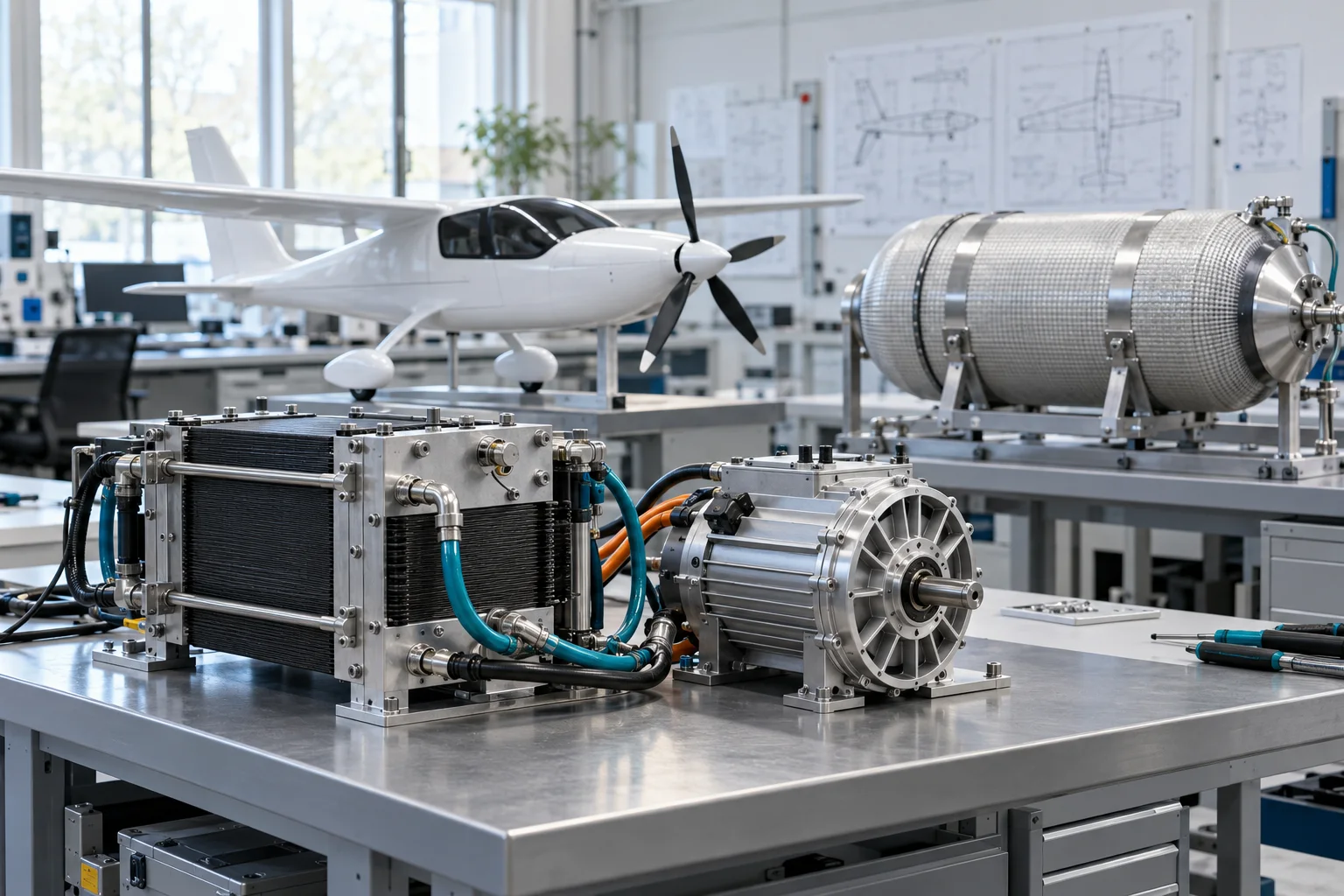
Yes. Hydrogen aircraft have already flown in experimental programmes. Routine passenger service also needs a certified aircraft, a dependable fuel supply and workable airport operations. A test flight, an engine ground test and a proposed airliner answer different questions. EASA's aviation report documents flight demonstrations; Airbus still describes its future hydrogen aircraft as a development programme.
Two ways to use hydrogen in an aircraft
A hydrogen fuel cell makes electricity by reacting hydrogen with oxygen. The electricity drives a motor and propeller. At the cell, the products are water and heat as well as electricity. Unlike a rechargeable battery, it keeps producing power while fuel is supplied (US Department of Energy).
Hydrogen combustion takes a different route: burning hydrogen in an engine. The UK Civil Aviation Authority (CAA) reports tests of a modified gas turbine. Read our jet-engine explainer for the conventional engine cycle. A fuel-cell result does not establish the performance of a combustion engine, or vice versa.
| Route | Energy conversion | Evidence to look for |
|---|---|---|
| Fuel-cell electric | Hydrogen becomes electricity, then motor power | Complete propulsion-system weight, heat management and flight results |
| Hydrogen combustion | Hydrogen burns in an engine | Engine operating envelope, fuel-system integration and emissions measurements |
Demonstrated: experimental flights and ground tests
EASA records H2FLY's piloted HY4 liquid-hydrogen electric demonstrator flight in September 2023. It also describes ZeroAvia's Dornier 228 campaign, in which a prototype hydrogen-electric engine powered the left propeller, and Beyond Aero's flight using a modified G1 SPYL-XL aircraft. These are demonstrations, not evidence of a routine airline service (EASA).
Separately, the CAA reported in July 2026 that Rolls-Royce and easyJet had run a modified Pearl 15 on hydrogen at take-off thrust and across a simulated flight cycle. This was an engine test, not a hydrogen airliner flight. The release also describes airport ground-equipment trials and a fuel-cell drone programme. Success with a ground vehicle does not establish passenger-aircraft performance (CAA test summary).
For the narrower engine result and its missing measurements, see our hydrogen jet-engine ground-test record.
Reported and proposed: what Airbus is developing
Airbus says its ZEROe programme selected fuel-cell propulsion in 2025. Its concept has four propellers, each with a fuel-cell stack. The company also reports powering a demonstrator at 1.2 megawatts in 2023. This is a manufacturer-reported test figure, not an independently established passenger-aircraft capability (Airbus ZEROe).
In July 2026, Airbus and MTU announced plans for a fuel-cell-engine joint venture. Their agreement was non-binding, subject to approvals and social processes, with operations expected in 2027. That date concerns the proposed venture, not the launch of an aircraft (Airbus announcement).
What still needs to work around the aircraft
The CAA's September 2026 sandbox selections cover three practical gaps: cryogenic compressed storage, airport turnarounds and airside hydrogen supply. The projects aim to generate safety evidence; it is not certification or proof that their proposed systems meet every claim (CAA sandbox announcement).
Climate claims need a separate check. Water at a fuel cell does not describe the emissions from producing and supplying its hydrogen. Airbus conditions its near-carbon-neutral claim on renewable hydrogen. Treat that as a stated condition, not a full life-cycle assessment of a flight (Airbus ZEROe). Our hydrogen-production explainer covers the upstream process.
How to read the next hydrogen-flight headline
Ask what actually ran: one component, a ground vehicle, an experimental aircraft or a complete passenger operation. Then check who measured the result, what the other propulsion system was doing, and whether the claim concerns testing, certification or service.
The CAA's July roadmap describes support for scaling small-aircraft hydrogen operations by 2035. It is a regulatory pathway, not a guaranteed airline start date. A delivery forecast beyond the evidence remains speculative (CAA roadmap announcement). Use our breakthrough-headline checklist to separate the result from the prediction.
Technology profiles
Making sense of space and aerospace
Read space progress as a sequence of defined mission tasks. Launching hardware, operating it in its destination environment and delivering a useful service are separate milestones. Keep the mission design visible: payload, orbit or trajectory, operating duration and the equipment around the vehicle. A test result is easier to assess when the report explains which part of the eventual mission it represents.
What to check in this field
Questions to take to the evidence
- What happened in the reported test? Distinguish ground testing, flight demonstration and sustained operation, and check which mission requirements were directly exercised.
- What is included in a performance or cost figure? Ask about payload, preparation, ground support, refurbishment, replacement hardware and the assumptions behind a proposed operating rate.
- What happens after deployment? Look for communications, navigation, energy, fault recovery and an end-of-mission plan appropriate to the destination and proposed activity.
What would make the future useful?
Future space infrastructure would need useful missions that can be supported repeatedly. Assess ambitious scenarios through their intermediate demonstrations, dependencies and operating demands, keeping an announced objective separate from an achieved capability or a dependable service.
Explore the field: Reusable launch vehicles · Space debris removal.
Sources
- https://www.easa.europa.eu/en/domains/environment/eaer/technology-and-design/low-carbon-emissions-aircraft/hydrogen-powered
- https://www.energy.gov/cmei/fuels/fuel-cells
- https://www.caa.co.uk/newsroom/news/regulator-publishes-report-marking-important-progress-towards-hydrogen-aviation-in-the-uk/
- https://www.caa.co.uk/newsroom/news/cryogenic-storage-aircraft-turnarounds-and-airside-supply-tech-make-next-round-of-hydrogen-sandbox/
- https://www.airbus.com/en/innovation/energy-transition/hydrogen/zeroe-our-hydrogen-powered-aircraft
- https://www.airbus.com/en/newsroom/press-releases/2026-07-airbus-and-mtu-aero-engines-to-create-a-joint-venture-to-develop-a-fully-electric-hydrogen-fuel-cell
Checked against its sources by Codex AI editorial reviewer (separate from the drafter), 26 October 2026.