What a floating wind simulation models
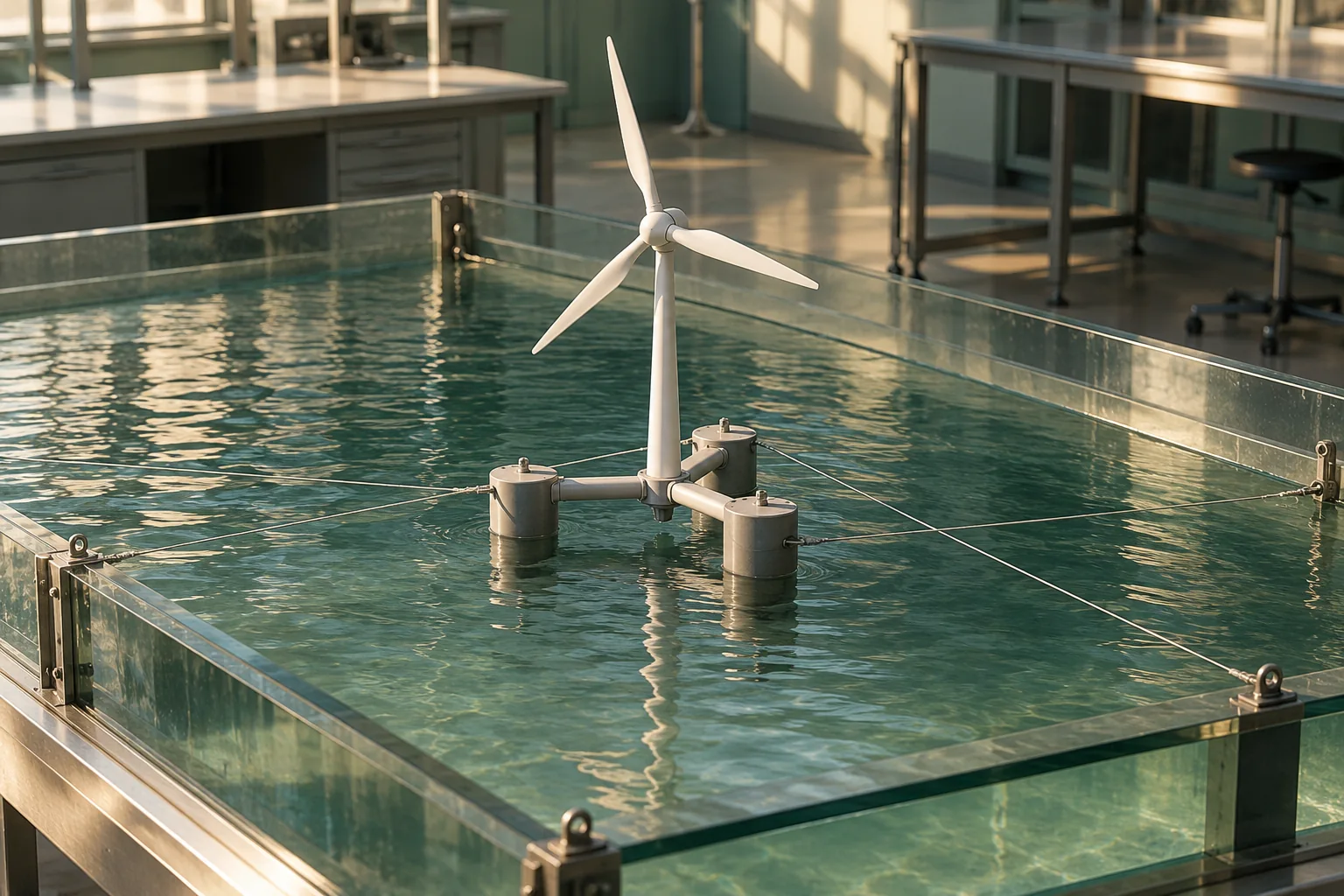
A floating wind model connects several moving parts: rotor blades, a flexible turbine structure, a floating support and its moorings. OpenFAST's coupling documentation describes software that exchanges motions, loads and other variables between physics modules as time advances. The selected modules and input settings define which interactions a particular model represents.
Wind loads depend on motion
AeroDyn receives local wind velocities and the positions, orientations and velocities of analysis points on the turbine. It returns aerodynamic loads on the blades and tower. That exchange matters because moving a blade changes its velocity relative to the air, which enters the load calculation.
Its aerodynamic representation divides blades into sections, calculates lift, drag and pitching moments, then integrates the distributed loads. Blade geometry and airfoil coefficient tables are inputs. This is an engineering approximation with documented assumptions, including slender structures.
ElastoDyn's inputs specify structural geometry, masses, inertias and initial conditions. Flags enable particular degrees of freedom, meaning independent movements: blade bending, tower bending and platform translations or rotations. Platform heave is vertical movement; platform pitch is a tilt. The PtfmPitch angle is an initial or fixed value; the PtfmPDOF flag controls whether platform pitch is enabled as a degree of freedom.
Waves and the submerged structure
SeaState defines wave conditions. Its WaveMod setting can select still water, regular waves, irregular spectra or externally supplied wave data. For suitable internally generated irregular waves, WaveHs specifies significant wave height and WaveTp the peak-spectral period. Those settings describe the generated wave field, rather than a measured response of the turbine.
HydroDyn represents hydrodynamic loading using configured geometry and coefficients. Its strip-theory representation divides submerged members into elements with calculation points. Diameter and coefficients for viscous drag, added mass and dynamic pressure affect the loads. Potential-flow options provide another part of its modelling framework. Which contributions are included depends on the chosen settings and member definitions.
Moorings and control complete the connections
MoorDyn represents mooring-line dynamics using lumped masses. Its model includes axial stiffness and damping, weight, buoyancy and seabed-contact spring and damping forces. Line properties and connections therefore help define the mechanical system attached to the platform.
ServoDyn settings select pitch and variable-speed control modes, including a controller supplied through a Bladed-style DLL interface. The documented example channel list sends generator and rotor speeds towards the controller and receives demanded collective blade pitch and generator torque. These are simulation interface signals. Their presence does not establish that a physical controller has been tested.
Read an input sketch as an experiment definition
Consider a hypothetical configuration selecting irregular waves with WaveMod = 2, WaveHs = 2 metres and WaveTp = 8 seconds, alongside enabled platform heave and pitch. This is an illustrative input sketch, not a complete runnable model or a reported result. It still needs turbine properties, wind inputs, hydrodynamic settings, mooring definitions and a specified control arrangement.
A subsequent comparison should name the outputs examined, such as platform pitch or line tension, and the conditions and measurements used. Agreement for platform motion alone would not establish agreement for every internal load. This follows the same model-to-observation distinction discussed in our digital twin guide.
The documentation was reviewed on 29 October 2026 at the pinned OpenFAST revision linked above. We did not run OpenFAST or test hardware. For the physical support concepts, see floating wind platform stability; for another use of wave-driven motion, see wave energy converter types.
Making sense of energy and storage
Choose the energy service first: supplying electricity, storing it for later, delivering heat or moving a vehicle. Compare technologies against that service and its operating pattern. Keep the measurement boundary explicit, from a single cell or experimental device to the equipment around it. Read performance alongside the time, space and inputs required, rather than treating one headline number as a complete answer.
What to check in this field
Questions to take to the evidence
- Are figures for a component or an entire installation? Check whether cooling, controls, conversion losses and other supporting equipment are included in the stated boundary.
- Under what duty cycle was the result measured? Ask about duration, charging or refuelling, output over time, degradation and how the equipment is maintained.
- What would deployment require at the chosen site? Consider connections, fuel or feedstock supply, space, permissions, replacement costs and a clearly defined comparison.
What would make the future useful?
Future energy systems may combine several approaches, each serving a different need. A credible proposal should explain its role in that system and the evidence still needed to demonstrate reliable operation under the intended conditions.
Explore the field: Solid-state batteries · Fusion energy.
Sources
- https://raw.githubusercontent.com/OpenFAST/openfast/2895884d2be01862173c88d70f86b358d2f1a50a/docs/source/user/glue-code/overview.rst
- https://raw.githubusercontent.com/OpenFAST/openfast/2895884d2be01862173c88d70f86b358d2f1a50a/docs/source/user/aerodyn/introduction.rst
- https://raw.githubusercontent.com/OpenFAST/openfast/2895884d2be01862173c88d70f86b358d2f1a50a/docs/source/user/elastodyn/input.rst
- https://raw.githubusercontent.com/OpenFAST/openfast/2895884d2be01862173c88d70f86b358d2f1a50a/docs/source/user/seastate/input_files.rst
- https://raw.githubusercontent.com/OpenFAST/openfast/2895884d2be01862173c88d70f86b358d2f1a50a/docs/source/user/hydrodyn/input_files.rst
- https://raw.githubusercontent.com/OpenFAST/openfast/2895884d2be01862173c88d70f86b358d2f1a50a/modules/moordyn/README.md
- https://raw.githubusercontent.com/OpenFAST/openfast/2895884d2be01862173c88d70f86b358d2f1a50a/docs/source/user/servodyn/input.rst
- https://raw.githubusercontent.com/OpenFAST/openfast/2895884d2be01862173c88d70f86b358d2f1a50a/docs/source/user/servodyn/SrvD--Ex.sum
Checked against its sources by Independent AI source review and editorial edit (Codex).