Fusion power on the UK grid: what the evidence still needs to show
By the Vrulum team
Evidence checked 23 October 2026. This is a longer companion to our fusion power tracker and our shorter article, How far away is fusion power?
Fusion experiments have crossed an important scientific boundary. A 2024 paper reports that a National Ignition Facility (NIF) experiment on 5 December 2022 released more fusion energy than the laser delivered to its target. That result establishes target gain, not electricity generation. None of the sources we assessed shows a fusion plant exporting net electricity to a grid over an operating campaign. These are different endpoints, and we keep them separate. F01 F13
For a UK reader, the useful question is what would turn a short scientific result into a dependable electricity supply. That requires an energy balance covering the whole plant, a sustainable fuel supply, components that can be replaced safely, permissions, and an operating record. A headline gain figure cannot answer all those questions.
This article concentrates on deuterium-tritium routes, including magnetic confinement and laser-driven inertial confinement. Requirements tied to that fuel do not automatically apply to every alternative fusion concept.
How we organise the evidence
A machine under construction does not establish a grid pilot. Equally, a working magnet or fuel-processing component deserves its own evidence record even before a complete plant exists. We use six evidence groups:
| Evidence group | What should count | What would remain unproven |
|---|---|---|
| Scientific gain | A published experiment with a defined input boundary and uncertainty | Whole-plant electricity balance |
| Integrated engineering | Relevant heat extraction, conversion, controls and auxiliary systems working together | Sustained net grid export |
| Net-electric pilot | Metered imports and exports over a disclosed campaign | Commercial reliability and repeat builds |
| Fuel and maintenance | Accounted fuel flows, replacement operations and component exposure | A fleet's long-term supply and economics |
| First commercial supply | Permissions, an operating plant and delivered contracted electricity | Widespread adoption |
| Widespread grid use | Several operating plants, repeatable delivery and a material service record | No automatic promise of cheap electricity |
These groups are our editorial framework, not six equal time intervals. Fuel and materials work runs in parallel with plasma research, so counting completed groups does not tell you how much time remains.
The road so far: keep the unit and the boundary attached
What has been demonstrated: NIF's original result is documented in a peer-reviewed paper. Abu-Shawareb and colleagues report a target gain of 1.5 for the 5 December 2022 shot, in which 2.05 MJ of laser light produced 3.1 MJ of fusion yield. The denominator is laser energy delivered to the target; it excludes the electricity needed upstream to create that laser pulse. The gain is an experimental result, not a power station's return. F01
Reported by the laboratory: later NIF results. Lawrence Livermore National Laboratory's (LLNL) results page lists a yield of 8.6 MJ, with a measurement uncertainty of ±0.45 MJ, from 2.08 MJ delivered to the target on 7 April 2025, a target gain of 4.13. Its 20 June 2026 entry reports 7.9 ±0.4 MJ and a target gain of approximately 3.8. These are laboratory-reported results; we have not checked them against separate peer-reviewed publications. F02
JET demonstrated a different achievement. On 8 February 2024, UKAEA announced that JET's final deuterium-tritium experiments had produced 69 MJ of fusion energy, with high fusion power sustained for 5 seconds. JET was an experimental tokamak. The announcement does not describe electricity generation, and total energy over a pulse is not the same measurement as gain. Comparing NIF and JET by their MJ totals alone would be misleading. F03
ITER is a research machine with a specified plasma target. Its stated design goal is 500 MW of fusion power from 50 MW of input heating power, a ten-fold return (Q = 10). ITER says it will not convert the heat it produces into electricity. The 500 MW is therefore not a grid-export rating. F04
The next meaningful record needs both magnitude and context: energy or power, duration, the relevant input boundary, uncertainty, operating conditions and who verified it. A long pulse with the wrong fuel or low fusion output may answer a valuable engineering question without reaching the grid milestone.
Three meanings of "more energy out than in"
A laser target gain compares fusion yield with laser energy arriving at the target. A magnetic plasma gain compares fusion power with external heating delivered to the plasma. A whole-plant electricity balance compares electrical output with all the electricity the facility consumes over a defined period. ITER and SLAC both explain that the first two measures leave substantial work before a generating station. F04 F13
When a result is described as "net", we ask where the meter boundary sits. Does the account include lasers or heating equipment, cooling, cryogenics, pumps, fuel processing, controls and other house loads? Does it cover start-up and shutdown? Are exported and imported electricity measured over the same interval? These are the questions we will apply to any future claimed net-electric result.
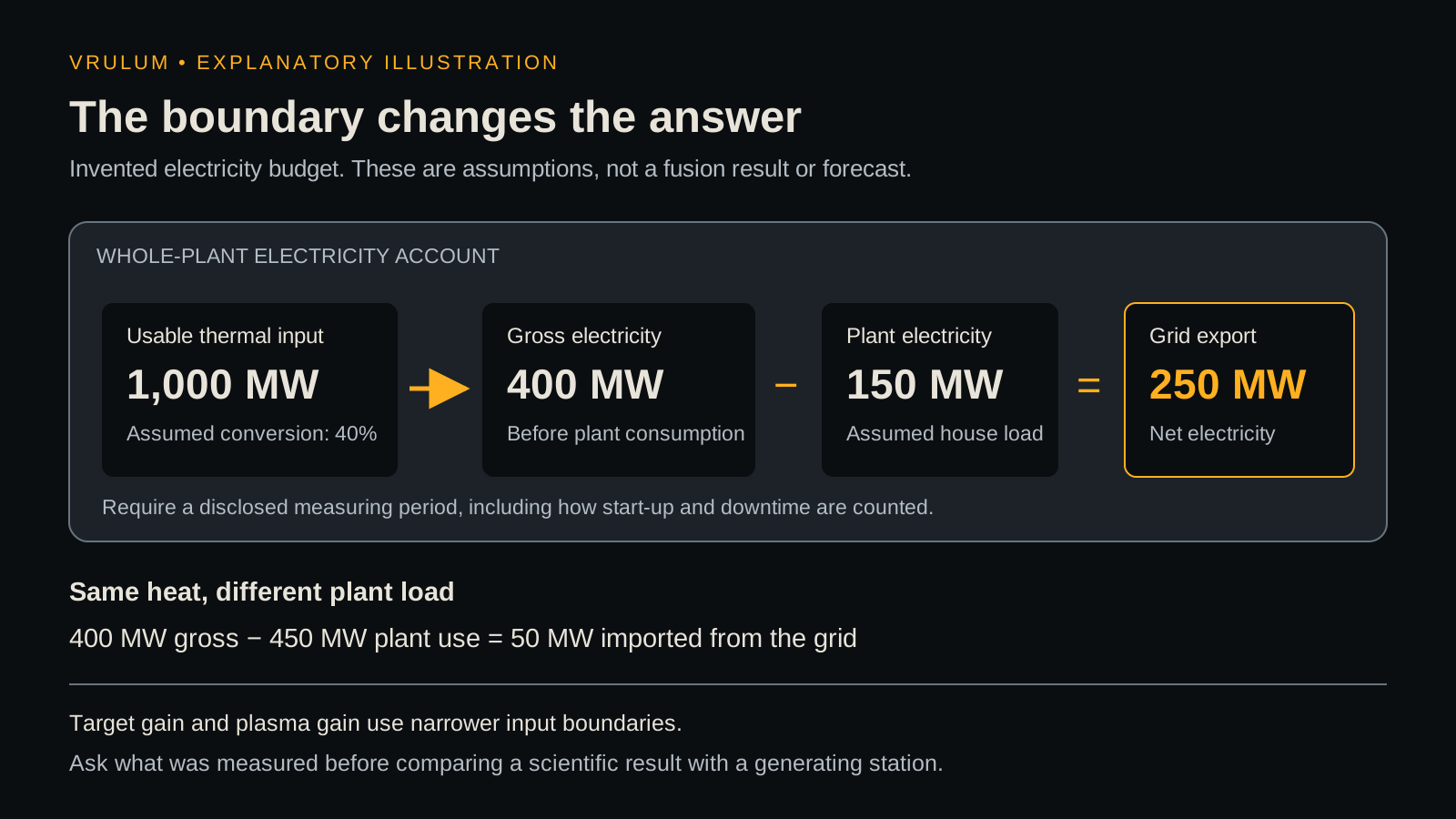
Original explanatory illustration. Every number in this example is an invented assumption, not a fusion result, design estimate or forecast.
Suppose a hypothetical plant supplies 1,000 MW of usable thermal power to a conversion system. At an assumed 40% conversion efficiency it produces 400 MW of gross electricity. If its assumed electrical house load is 150 MW, the export is 250 MW:
1,000 × 0.40 − 150 = 250 MW.
Changing the assumed house load to 450 MW makes the same plant a 50 MW net importer. Nothing about the original thermal figure changed. This is why a physics gain cannot be translated directly into electricity sold.
As a separate illustration of utilisation, 250 MW delivered for an assumed 70% of the hours in a 365-day year gives 1,533,000 MWh, or 1.533 TWh. This simplified example treats the remaining hours as zero export; real plants may draw electricity during downtime. It is not a predicted fusion capacity factor or annual output.
What stands in the way
A fuel cycle that replenishes usable fuel
For deuterium-tritium plants, fuel supply is an engineering system, not simply a statement that hydrogen exists in seawater. UKAEA describes breeding blankets in which neutrons react with lithium to produce tritium. Its LIBRTI programme aims to build a testbed where engineering-scale breeder blanket prototypes can be tested, alongside models to simulate and predict breeding. A programme description shows the research being pursued, not that a power-plant fuel cycle has been closed. F14
Producing a tritium atom somewhere in a blanket is not the same as delivering usable fuel back to the machine. A useful demonstration would report production, extraction, processing time, material retention, losses, decay and reserve inventory, using consistent system boundaries.
Abdou and colleagues' fuel-cycle modelling shows how sensitive tritium needs are to fuelling efficiency, burn fraction, processing time and availability. For a modelled 3 GW fusion reactor, a fuelling-efficiency × burn-fraction product of 2% with four-hour processing gives a start-up inventory of 11 kg; a product of 5% with one-hour processing gives less than 5 kg. These are conditional model results, not measured inventories that every proposed plant would need. The paper was published online on 23 November 2020, so it is not a current stocktake of tritium supply. F09
What has been demonstrated at small scale. MIT's account of its BABY experiment describes a crucible holding 100 millilitres of a lithium salt mix, kept at 700 °C and exposed to two deuterium-tritium neutron sources producing 14 MeV neutrons. From the tritium collected, the team calculated a tritium breeding ratio of approximately 0.000357, which MIT says is about four orders of magnitude below what a commercial plant would need. That small set-up was a measurement and model-validation experiment. Its ratio does not demonstrate self-sufficiency, and it is not a ceiling for a full blanket either. These details come from MIT's account rather than the underlying paper. F20
The milestone that matters is a demonstrated sustainable fuel supply at the relevant scale and operating conditions. That may involve a plant's own breeding system or a substantiated wider supply arrangement, and different designs may take different routes. A calculated breeding ratio above one does not by itself settle inventory delays, reserves or supply for later plants.
Materials qualified for combined conditions
The UK Fusion Materials Roadmap 2021-2040 treats irradiation, mechanical load, corrosion and tritium behaviour as connected qualification problems, and calls for combined test campaigns. Where proxies are used in place of fusion neutrons, it says outcomes should be qualified accordingly. A material sample surviving one laboratory exposure is useful evidence, but a working component also has joints, interfaces, manufacturing variation and its own temperature and stress history. F10
For any materials claim, we look for the neutron spectrum and dose, temperature, specimen and component dimensions, loads applied together, the failure criterion and the uncertainty in any extrapolated lifetime. It matters whether a stated lifetime was measured, modelled or adopted as a design assumption.
The roadmap dates from 2021. It is useful for framing questions, not as evidence that no progress has been made since. Closing one gap also does not show that every material, weld and seal in a plant is qualified.
Maintenance that restores operation
Proposed, not demonstrated. UKAEA engineers working on STEP describe a hybrid maintenance approach: access through ports for a limited list of tasks soon after shutdown, and larger openings to speed up major refits, with robotic handling in areas people cannot enter. They say the approach will need significant technology development, and that the segmented magnet design, with 48 remountable magnet joints, carries significant risk. This is an engineering proposal with a development programme, not a demonstration of rapid repair at a power plant. F11
This changes what counts as progress. A headline "lifetime" need not mean every internal component lasts the whole life of the plant; a credible design can replace components. The evidence then needs to show replacement frequency, duration, tooling, spares, waste handling and the effect on electricity output.
A rehearsed removal in a clean mock-up is weaker evidence than a timed replacement after realistic service exposure, followed by a successful return to operation. We record these as separate steps; this is our reporting standard, not a claim that one maintenance approach must win.
Repetition for laser-driven plants
NIF can fire only about three times a day. SLAC's 2024 explainer quotes researchers saying an inertial fusion energy plant would need lasers that operate 10 times per second. Delivering rapid laser pulses alone would still leave target manufacture, injection, accurate targeting and chamber recovery to integrate. F13
LLNL's Livermore Institute for Fusion Technology lists goals for laser beamline demonstrators that include at least 10% wall-plug efficiency and a lifetime exceeding one billion shots. These are research goals, not measured performance of a complete fusion driver. A low-energy repetitive laser and a high-yield fusion shot should not be shown on one chart as though a single machine had done both at once. F12
The signal to watch is sustained operation at relevant energy, repetition rate and component conditions, with missed shots, damage, target consumption and downtime disclosed. Average exported electricity over a campaign tells us more about the grid endpoint than an isolated peak.
Economics and delivery at a real site
Reported commercial commitment. A purchase agreement is a commercial commitment reported by its parties; it does not certify a physical result. Commonwealth Fusion Systems' (CFS) 30 June 2025 announcement describes Google's power purchase agreement for 200 MW of electricity from CFS's planned ARC plant in Chesterfield County, Virginia, and says the agreement is anchored in CFS's SPARC machine achieving net fusion energy (Q > 1). Google has been an investor in CFS since 2021 and increased its stake as part of the deal, so this is not independent technical validation. Financial terms were not disclosed. F06
Design target, not a result. A peer-reviewed paper published in the Journal of Plasma Physics on 4 June 2026, led by CFS authors, sets out the physics basis of the ARC design and identifies physics risks for SPARC to address. ARC is designed to produce about 1.13 GW of fusion power and deliver at least 400 MW of net electricity to the grid. The paper's power balance gives roughly 500 MW of gross electricity, about 100 MW consumed by the plant and 400 MW net, and states that engineering analysis and the details of these calculations are outside its scope. The work was funded by CFS with US Department of Energy support. It is a design calculation, not an operating result or independent certification. F07
A useful commercial milestone would disclose delivered electricity, operating costs, replacement needs and capital scope. A quoted price without a currency date, financing assumptions, utilisation and included costs would not support a like-for-like UK comparison. None of the sources we assessed gives a verified commercial cost per kWh for fusion electricity.
The UK's route: a prototype is not a household service
STEP is planned for West Burton in Nottinghamshire, on the site of a former coal-fired power station. UK Fusion Energy's announcement of 14 April 2026 says the plant is expected to begin operations in 2040. Its undated FAQ page, as read on 23 October 2026, describes STEP as "targeting 2040" but, in its answer on timescales, says first operations are targeted for the early 2040s. We note both wordings and do not infer a formal change of date. First operations are also not the same as commercial net-electric export: the FAQ says STEP aims to demonstrate net energy from fusion as operations progress. F18 F19
The UK government's fusion strategy, published on 16 March 2026, sets nearer-term tests of delivery. Its table of STEP technical milestones places breeder material characterisation and a tritium recovery proof of concept in 2027, agreement of the full design basis for the tokamak in 2028, submission of the Development Consent Order in 2029 and the start of full site construction in 2030. These are the government's planned milestones; we have not checked progress against each, and the table does not set a date for electricity delivery. F15
For sites in England, the Environment Agency's guidance of 14 September 2026 says it regulates fusion activities with the Health and Safety Executive. Environmental permits may cover the use of radioactive substances, abstracting cooling water from a river and other industrial activities. Early engagement with regulators is not a permit, and a permit is not proof of energy performance. The guidance applies to England only; arrangements elsewhere in the UK may differ. F16
Saying fusion "produces no waste" would be misleading. The draft National Policy Statement for fusion energy (EN-8), published for consultation on 8 June 2026 and covering England and Wales, says radioactive materials will arise mainly from neutron activation and tritium contamination. It expects fusion waste to fall into the low or intermediate level categories, with some material stored on site before classification and potential disposal. Actual classification depends on the materials and the facility. The consultation has closed, but the document is still a draft rather than adopted policy. F17
For a household making an energy decision now, there is no fusion retail product, tariff or installation to compare. A prototype abroad or an offtake agreement does not mean fusion electricity is available to UK homes. Current energy choices are best judged on their own costs and suitability; nothing here suggests that waiting for fusion will lower a future bill.
Named, dated targets: what was actually said
| Who and when | Stated target or milestone | What it covers |
|---|---|---|
| ITER Organization, 3 July 2024 | Full magnetic energy in 2036; start of deuterium-tritium operation in 2039 | Research milestones from the 2024 baseline proposal; ITER will not generate electricity. F05 F04 |
| CFS, 30 June 2025 | ARC expected to "put power on the grid in the early 2030s" | Company expectation for a US plant. F06 |
| US Department of Energy, 9 June 2026 | Roadmap to support "fusion pilot plants and commercial fusion power in the mid-2030s" | Government aim; the release says support depends on future partnerships and Congressional appropriations and does not commit specific funding levels. F08 |
| UK Fusion Energy, 14 April 2026 | STEP expected to begin operations in 2040 | Programme expectation for a UK prototype; the undated FAQ says "early 2040s" for first operations. F18 F19 |
These are targets set by the organisations involved, not forecasts we endorse. They describe different events and are not a consensus. We do not give our own arrival year.
ITER is not a prerequisite for every route to the grid. Its stated purpose is research, while CFS describes a route from SPARC to ARC. What matters is satisfactory evidence for each chosen approach, not completion of every international project. F04 F06
Signals that would change our assessment
For each future announcement, we record the publication date, experiment date, primary report, evidence type and what remains outside its scope.
- A gain result with a clear boundary: original methods, measurement uncertainty and external assessment. Company or laboratory announcements stay "reported" until the evidence supports a stronger label.
- A whole-plant net-electric campaign: metered imports and exports, treatment of start-up, duration, interruptions and auxiliary loads.
- A fuel-supply demonstration: measured breeding and recovery with a mass balance, inventory, losses and processing delays at relevant conditions, and a credible start-up supply for the next machine.
- Qualified components and maintenance: realistic exposure, failure criteria, successful replacement and restart, with availability over a campaign disclosed.
- UK delivery evidence: specific applications, consent decisions and permits, followed by construction and commissioning records, kept separate from planned dates.
- Commercial repetition: delivered contracted electricity from a first plant, and evidence that more plants can be financed, built, fuelled and maintained.
No single item gives a countdown to widespread use. Together they show which uncertainty a new result removes, and which large questions remain.
Time-sensitive points
Several statements here reflect sources as read on 23 October 2026 and may change: LLNL's results page is updated as new shots are reported; ITER's dates come from its 2024 baseline; the CFS and US Department of Energy dates are stated aims; the STEP FAQ wording may be revised; and EN-8 may be designated in final form. The government's STEP milestones for 2027 onwards had not yet fallen due when we checked.
Sources
All checked 23 October 2026. Undated pages are marked as such.
- F01. Abu-Shawareb et al. (Indirect Drive ICF Collaboration), Physical Review Letters 132, 065102. Achievement of Target Gain Larger than Unity in an Inertial Fusion Experiment. Published 5 February 2024. DOI 10.1103/PhysRevLett.132.065102.
- F02. Lawrence Livermore National Laboratory. Achieving Fusion Ignition. Undated, regularly updated page; entries read to 20 June 2026.
- F03. UKAEA. Fusion research facility JET's final tritium experiments yield new energy record. 8 February 2024.
- F04. ITER Organization. What will ITER do?. Undated.
- F05. ITER Organization. New baseline to prioritize robust start to exploitation. 3 July 2024.
- F06. Commonwealth Fusion Systems. Google and Commonwealth Fusion Systems Sign Strategic Partnership. 30 June 2025. Company announcement.
- F07. Hillesheim et al., Journal of Plasma Physics. Overview of the physics basis for the ARC fusion power plant. Published online 4 June 2026. DOI 10.1017/S0022377826101706. Funded by CFS, with US Department of Energy support.
- F08. US Department of Energy. Energy Department Releases Finalized Fusion Science and Technology Roadmap to Accelerate Commercial Fusion Power. 9 June 2026.
- F09. Abdou et al., Nuclear Fusion 61 (2021) 013001. Physics and technology considerations for the deuterium-tritium fuel cycle and conditions for tritium fuel self sufficiency. Published 23 November 2020. DOI 10.1088/1741-4326/abbf35. Author-hosted PDF.
- F10. UKAEA, with the Henry Royce Institute. UK Fusion Materials Roadmap 2021-2040. 2021.
- F11. van Arkel, Lamb, Robinson and Dieudonné, Philosophical Transactions of the Royal Society A 382: 20230415. Unlocking maintenance: architecting STEP for maintenance and realizing remountable magnet joints. 2024 (accepted 22 May 2024). DOI 10.1098/rsta.2023.0415.
- F12. Livermore Institute for Fusion Technology, LLNL. Driver Technology. Undated.
- F13. SLAC National Accelerator Laboratory. SLAC scientists explain: What is inertial fusion energy?. 21 February 2024.
- F14. UKAEA. LIBRTI: The Lithium Breeding Tritium Innovation Programme. Undated.
- F15. Department for Energy Security and Net Zero. A new energy revolution: The UK's plan for delivering fusion energy. 16 March 2026. Table 4 lists STEP technical milestones for 2026 to 2030.
- F16. Environment Agency and Health and Safety Executive. Fusion energy: environmental regulation. 14 September 2026. Applies to England.
- F17. Department for Energy Security and Net Zero. Draft National Policy Statement for fusion energy generation (EN-8). 8 June 2026. Draft; applies to England and Wales. Waste: paragraphs 3.3.12 to 3.3.14.
- F18. UK Fusion Energy (STEP Fusion). New UK Fusion Energy strategy maps path to commercial fusion. 14 April 2026.
- F19. STEP Fusion. Frequently Asked Questions. Undated.
- F20. MIT Plasma Science and Fusion Center. First steps towards measuring fusion fuel self-sufficiency: the BABY blanket. 20 May 2025.
Technology profiles
Sources
- https://journals.aps.org/prl/abstract/10.1103/PhysRevLett.132.065102
- https://lmf.llnl.gov/science/achieving-fusion-ignition
- https://www.ukaea.org/news/fusion-research-facility-jets-final-tritium-experiments-yield-new-energy-record/
- https://www.iter.org/fusion-energy/what-will-iter-do
- https://www.iter.org/node/20687/new-baseline-prioritize-robust-start-exploitation
- https://cfs.energy/news-and-media/google-and-commonwealth-fusion-systems-sign-strategic-partnership/
- https://www.cambridge.org/core/journals/journal-of-plasma-physics/article/overview-of-the-physics-basis-for-the-arc-fusion-power-plant/B472B3A64EF71DA1899B9EFB65D7C390
- https://www.energy.gov/articles/energy-department-releases-finalized-fusion-science-and-technology-roadmap-accelerate
- https://bpb-us-w2.wpmucdn.com/research.seas.ucla.edu/dist/d/39/files/2019/08/Abdou_et_al_Physics_and_Technology_Considerations_Nuclear-Fusion_V61_2021.pdf
- https://www.royce.ac.uk/wp-content/uploads/2024/11/UK_Fusion_Materials_Roadmap_Interactive.pdf
- https://scientific-publications.ukaea.uk/wp-content/uploads/van-arkel-et-al-2024-unlocking-maintenance-architecting-step-for-maintenance-and-realizing-remountable-magnet-joints.pdf
- https://lift.llnl.gov/research-areas/ife/driver-technology
- https://www6.slac.stanford.edu/news/2024-02-21-slac-scientists-explain-what-inertial-fusion-energy
- https://www.ukaea.org/work/librti/
- https://www.gov.uk/government/publications/uk-fusion-strategy-2026/a-new-energy-revolution-the-uks-plan-for-delivering-fusion-energy-accessible-webpage
- https://www.gov.uk/guidance/fusion-energy-environmental-regulation
- https://www.gov.uk/government/consultations/draft-national-policy-statement-for-fusion-energy-generation-en-8/draft-national-policy-statement-for-fusion-energy-generation-en-8-accessible-webpage
- https://stepfusion.com/ukfe-strategy-2026/
- https://stepfusion.com/faqs/
- https://www.psfc.mit.edu/resources/news/baby-fusion-fuel/
Checked against its sources by Claude (check-and-publish session).