How holograms work: real optics and display illusions
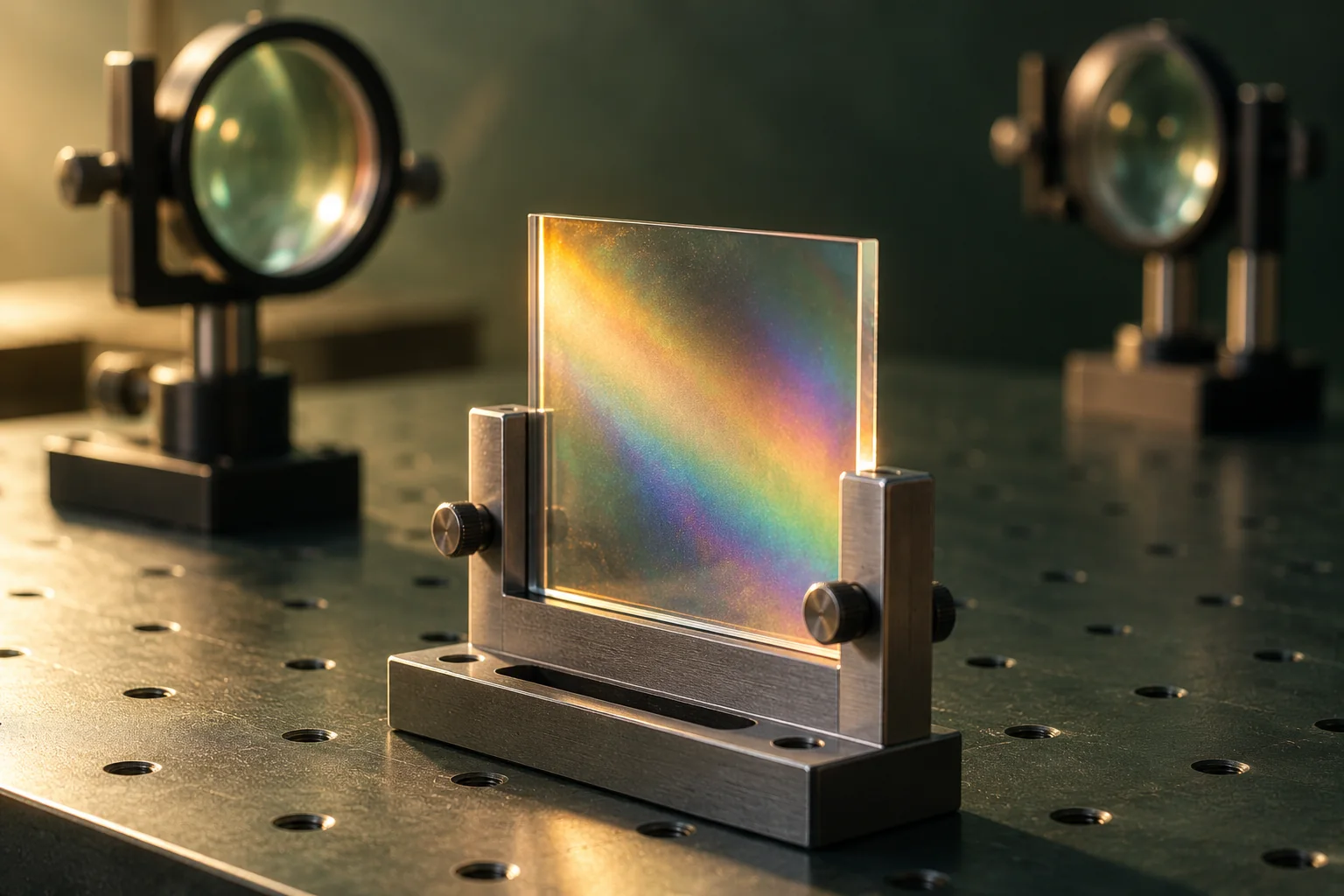
A hologram reconstructs a light wavefront so that an image can appear to have depth. It does not require a glowing object suspended in empty air. To understand a display, ask how it forms its image: optical holography, a stage illusion and a multi-view screen can all look three-dimensional while working differently.
How a hologram stores depth
Light is a wave. Its amplitude describes the size of its oscillation; phase describes where it is within that oscillation. In one optical recording method, coherent laser light is split into two paths. One illuminates the object; the other becomes a reference beam. Object light and reference light overlap at a recording surface. Their waves reinforce or cancel one another, leaving an interference pattern rather than an ordinary picture of the object.
Illuminate the recorded pattern appropriately and it diffracts light, reconstructing a wavefront associated with the object. Different viewing positions can reveal different perspectives. OpenStax's holography chapter explains this using a transmission hologram. It also distinguishes reflection holograms, including examples visible under white light: not every hologram needs a laser for viewing.
Computing the pattern instead
Computer-generated holography calculates a pattern instead of recording a physical object's interference with a reference beam. A spatial light modulator, or SLM, can display a calculated phase pattern that shapes illuminated light.
Stanford's Neural Holography research code generates phase patterns and separates ideal-model reconstruction, camera-calibrated simulation and physical camera capture. Those are three different kinds of evidence. The repository accompanies a 2020 paper, so it illustrates the method rather than a new breakthrough.
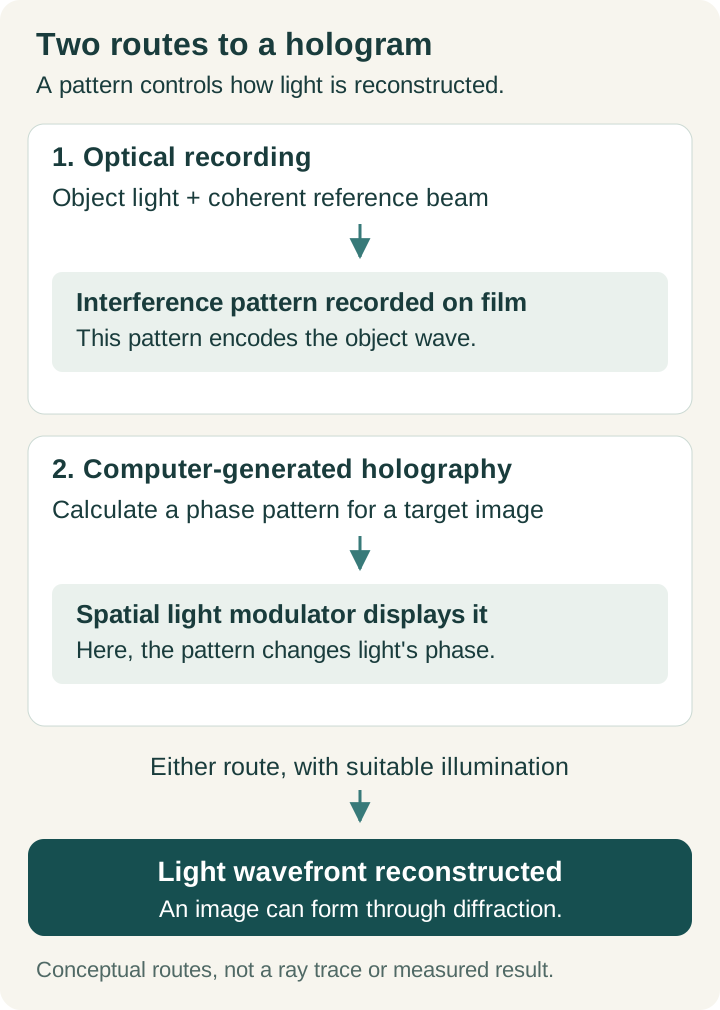
Conceptual routes to holographic reconstruction, not a measured optical layout or ray-tracing result.
Why other “holograms” look convincing
Pepper's ghost is a stage illusion rather than an interference-recorded hologram. The creator of Prisma describes using a large transparent projection screen in front of a stage to make that illusion. A floating-looking performance is therefore not, by itself, evidence of holographic wavefront reconstruction.
Multi-view displays offer different perspectives of a scene. Looking Glass's older Core SDK documentation describes rendering multiple views into a texture and applying a calibrated shader. The manufacturer calls its output holographic, but that terminology does not establish optical interference recording. That SDK is obsolete; its documentation illustrates the architecture rather than current installation requirements.
Volumetric displays organise imagery within a display volume. Voxon's legacy developer kit identifies its platform as volumetric and distinguishes physical display output from simulation. “Volumetric” describes a different display approach; it does not automatically mean the system reconstructs the original optical wavefront.
What still needs checking
A calculated hologram must work with real optics. The slmsuite implementation connects its modelled angular extent to wavelength and SLM pixel pitch, and warns that imperfect diffraction efficiency leaves unwanted undiffracted light. Its project documentation also describes camera feedback and wavefront calibration to compensate for aberrations. A convincing simulation does not remove those physical constraints.
For any demonstration, ask where viewers can stand, which viewpoints are available, how large the image is and whether the footage shows actual optical output. Check whether colour and motion were demonstrated together. Keep the authors' measured results separate from renders and proposed applications, using our breakthrough-headline guide.
Making sense of photonics and optical computing
Follow the role of light through the system: carrying information, performing a calculation or measuring a signal. A component result becomes more useful when you can see its connections to sources, detectors, electronics and packaging. Define the work performed before comparing speed or energy figures. A device demonstration and a complete computing or communications service should be assessed at their own boundaries.
What to check in this field
Questions to take to the evidence
- What operation does the optical device perform? Check the input and output format, precision, error measure and whether the reported workload reflects the intended application.
- Which supporting costs are included? Ask about light sources, data conversion, memory access, calibration, control electronics and the energy needed for a complete task.
- What would integration require? Look for packaging, alignment, thermal stability, manufacturing yield and a clear account of connecting the device to existing equipment.
What would make the future useful?
Optical systems could serve specialised computing and communication needs if their advantages remain useful after integration. Evaluate a proposed application on the end-to-end task and its constraints, including the parts that still use conventional electronics.
Explore the field: Photonic computing for AI · Thin-film lithium niobate photonics.
Sources
- https://raw.githubusercontent.com/openstax/osbooks-university-physics-bundle/2300d5b8ca2571dacc6ec25ebef56ba8d49000a2/modules/m58552/index.cnxml
- https://raw.githubusercontent.com/computational-imaging/neural-holography/d2e399014aa80844edffd98bca34d2df80a69c84/README.md
- https://raw.githubusercontent.com/slmsuite/slmsuite/5ac5a19ac356fe238a54db8a0a6be7114f085cf8/slmsuite/holography/algorithms/_hologram.py
- https://raw.githubusercontent.com/keijiro/Prisma/c9dfdead4e2db72b20761ba7d85879dd1e18d5f1/README.md
- https://raw.githubusercontent.com/Looking-Glass/LookingGlassCoreSDK/5f786480e8906396a06a442a18e9091ef9e0aa74/README.md
- https://raw.githubusercontent.com/voxon-photonics/Content-Developers-Kit/c0a35e0476d091149a66a06dec5c27fa11908b91/README.md
- https://raw.githubusercontent.com/slmsuite/slmsuite/5ac5a19ac356fe238a54db8a0a6be7114f085cf8/README.md
Checked against its sources by Independent AI source review, complete editorial edit and visual review (Codex).