Multi day grid storage in Britain and the evidence for iron air batteries
By the Vrulum team
Evidence checked 23 and 24 October 2026. Supplement to Vrulum's iron-air tracker and broader storage tracker.
A battery rated for 100 hours could help an electricity system through a prolonged shortage of wind and solar generation. Establishing that capability involves several separate questions: how much power it supplies, how much energy it returns, how quickly it recharges and what service it delivers over repeated years.
The evidence for iron-air batteries now includes published module tests and large announced projects. Britain also has a programme supporting longer-duration electricity storage. These developments concern different scales and endpoints. An eight-hour project in Britain's support scheme does not demonstrate a four-day battery, and a developer's module test does not establish routine utility service. G01 G06 G08
For the iron-air tracker, the useful destination is repeated, dependable delivery of electricity over several days from commercial installations, with disclosed performance and costs. The broader tracker should ask which combinations of storage and other resources deliver that service affordably. Neither endpoint requires every proposed battery chemistry to succeed.
Duration needs both power and energy
Power, measured in megawatts, is the rate of delivery. Energy, measured in megawatt-hours, is the quantity delivered over time. At constant output:
Discharge duration in hours = usable output energy in MWh ÷ output power in MW.
Consider three hypothetical installations, each supplying a steady 100 MW. An eight-hour system delivers 800 MWh, or 0.8 GWh. A 100-hour system delivers 10,000 MWh, or 10 GWh. A full week requires 16,800 MWh, or 16.8 GWh. These are explanatory calculations, with energy defined at the output connection, rather than specifications of an actual plant.
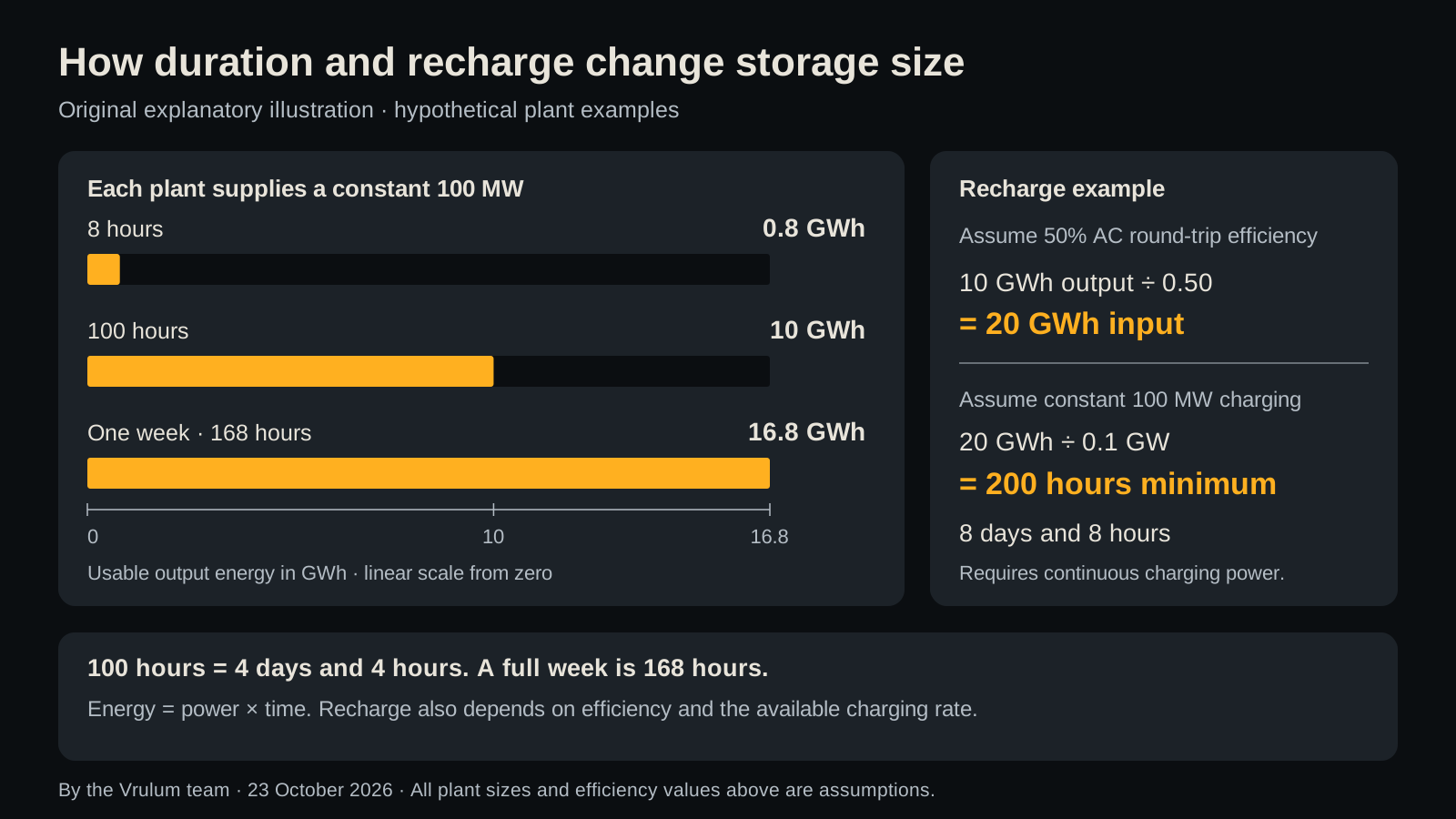
Original explanatory illustration. All plant sizes and efficiency assumptions in the illustration are hypothetical. The bars compare energy at equal output power.
One hundred hours is four days and four hours, not a week. A battery can sometimes discharge for longer at a lower output, but an article must state the power at which a duration applies. A long discharge rating also does not specify how long energy can remain stored before use: retention losses and discharge duration answer different questions.
Ofgem defines long-duration electricity storage for its scheme as eight hours or more. The US funding notice cited by both live trackers used a 10 hour or longer discharge. Those are programme thresholds, not interchangeable definitions of storage lasting several days. G08 G14
What iron air batteries do
Form Energy describes its battery as reversible rusting: discharge consumes oxygen from the air while converting iron to rust; charging reverses that process. Its cells use a water-based electrolyte. These are manufacturer descriptions, checked on 23 October 2026. G04
The attraction is a potentially inexpensive store of energy that can be made large relative to its output power. That proposition must ultimately survive the cost of the complete installation, energy losses and maintenance. Abundant iron alone does not establish an inexpensive electricity service.
The manufacturer's claims that a system can be located anywhere or provide year-round reliability require narrower interpretation. A particular site still needs a feasible connection, suitable land, a charging supply and the necessary consents. A duration specification cannot establish reliability across every possible sequence of shortages. G04
What the published module tests establish
The November 2025 California Energy Commission report is authored by Form Energy. It describes EPRI analysing developer-supplied test data and reviewing the setup; this is stronger than an announcement alone, but does not establish independent operation of a commercial plant. G01
| Reported module result | First module, Table 5 | Second module, Table 6 |
|---|---|---|
| Continuous DC discharge power | Approximately 2.14 kW, 23 active cells | Approximately 2.81 kW, 30 active cells |
| Discharge energy | Approximately 257 kWh | Approximately 306 kWh |
| Discharge duration | 117 to 126 hours | 108 to 110 hours |
| Charge duration | 64 hours | 63 hours |
| Round-trip efficiency | Proprietary | Proprietary |
These are reported DC module measurements, not AC plant results. The first module was retired after downtime; a revised second module completed testing. The report's annual duty-cycle demonstration uses accelerated cycling, not a year of uninterrupted availability. Its grid dispatch results are modelled for 2035, not operating traces. G01
Evidence label: Reported, unverified, with described third-party analysis. The separate EPRI analysis was not accessible for this audit. The published evidence supports a bounded module result while leaving full-plant efficiency, availability and installed cost unresolved.
Grid testing and commercial service are different milestones
Form's living company timeline reports grid-connected test systems in California from 2023 and 2024, a Great River Energy commercial demonstration deployment in 2025, and continuous 100-hour testing in its 2026 entry. These remain company reports. They mean the question should be whether independently assessed operational data are public, rather than whether anybody claims to have connected an iron-air battery to a grid. The page gives years rather than original publication dates for those entries. G05
Great River Energy's announcement of 15 August 2024 described a 1.5 MW Cambridge, Minnesota pilot capable of storing energy for up to 100 hours, then expected to operate by late 2025. Its 2026 to 2040 resource plan instead includes commissioning and the start of performance testing by the end of 2026. Neither document confirms completed commissioning. G02 G03
The live tracker also cites an October 2026 press report of a 2027 start for a Great River Energy system, while acknowledging that linking that reference to Cambridge is an inference. That later claim needs a project-specific primary update before the schedule can be reconciled. The older resource-plan target must not be presented as the latest confirmed timetable.
A deployment announcement should therefore be followed by acceptance testing and a dated operating record. Useful records would show output at the grid connection, charge energy, starting state of charge, weather, interruptions and the power maintained throughout the event. Repeating the test after ageing matters more than extending a single best run.
Larger projects are announced capacities
Xcel Energy's 24 February 2026 announcement describes a 300 MW / 30 GWh Form installation associated with a new Google data centre in Minnesota. Dividing the announced energy by power gives 100 hours. The announcement also says the electricity service agreement requires Minnesota regulatory approval. It does not establish installed capacity, current approval status or delivered cost. G06
On 17 March 2026, Form and FuturEnergy Ireland announced a 10 MW / 1,000 MWh project in north-west Ireland, targeting operation in 2029. This is a developer announcement concerning Ireland, not evidence of UK availability. The announcement cites analysis by Form Energy for possible savings, which should not be treated as measured savings from an operating plant. G07
Orders, factory capacity and delivered storage serve different purposes. Orders indicate commercial interest. Factory figures need their own denominator: nominal annual capacity, actual production, accepted deliveries or installed usable energy. A large backlog cannot be divided by a current factory figure to produce a dependable completion date, because production rates, product design and project schedules can all change.
Where Britain stands
Ofgem's 26 June 2026 announcement identified 16 projects for its long-duration storage portfolio, as minded-to decisions for the first cap-and-floor window, covering pumped hydro, compressed air, lithium-ion and vanadium flow batteries. This is already a portfolio of alternative approaches, rather than a requirement for one chemistry to displace all others. G08
The government's 13 July 2026 update describes that proposed portfolio as approximately 7.6 GW / 137 GWh, subject to consultation and final confirmation. Those are aggregate figures. Dividing them produces roughly 18 hours, but that arithmetic cannot tell us the duration of any individual project or show a 100-hour capability. The same update records existing LDES at 2.8 GW / 23.9 GWh in June 2026. Existing storage and new project selection must remain separate. G10
When checked, the Ofgem consultation page still displayed Closed (awaiting decision). The government's July update says the portfolio is subject to final consultation and confirmation in autumn 2026. That is a stated expectation, not a completed award or a commissioning date. G09 G10
The cap-and-floor mechanism addresses revenue uncertainty. Ofgem explains that consumers may support a project's minimum revenue when earnings fall below its floor, while revenues above the cap benefit consumers. Consequently, being selected for support does not itself demonstrate that a technology is cheap without support, or quantify the eventual effect on bills. G08
This programme concerns Great Britain: England, Scotland and Wales. It should not be described as identical policy coverage across Northern Ireland. Nor should the Irish iron-air announcement be used as a substitute for a named, consented British installation. G09 G07
Recharge and efficiency can change the answer
Round-trip efficiency is the electricity returned divided by the electricity supplied over a defined cycle and boundary. The Royal Society's storage analysis illustrates why losses increase the energy that must be generated to fill a store. A comparison needs the same measurement boundary and operating conditions for both technologies. G12
For a utility, an especially useful boundary is AC electricity into and out of the complete plant, including conversion equipment and auxiliary consumption. Module DC efficiency cannot by itself specify that result. The cycle definition should explain whether standby consumption and a long period waiting for dispatch are included.
Take a deliberately hypothetical plant that returns 10 GWh, has 50% AC-to-AC efficiency, and can draw a constant 100 MW while charging. It needs 20 GWh of input. At 0.1 GW, that requires 200 hours, or eight days and eight hours, of charging. This assumes continuous charging power is available and no separate charging constraint lengthens the process. It is not a Form specification.
The example explains why a long-duration battery does not necessarily refill during one windy night. A larger charger could shorten that interval, but it would change the connection and equipment requirements. A second shortage before recharge is complete can find the store only partly full. A useful system study follows the actual sequence of surpluses and deficits, rather than repeatedly assuming a full battery.
Efficiency is also only one part of cost. A rarely dispatched reserve may tolerate greater losses if storing a large quantity of energy is sufficiently inexpensive. A frequently cycled store faces a different trade-off. Sepulveda and colleagues' 2021 Nature Energy study, assessed here through its repository abstract, identifies energy-capacity cost and discharge efficiency as key parameters in its modelled systems. It also finds that electrifying end uses in a northern latitude context makes full displacement of firm generation more challenging. These are scenario results, not a validated quotation for an iron-air plant. G13
Cheap storage needs a defined comparison
An energy-capacity price in pounds per kWh does not describe the whole service. It needs a stated scope: cells, modules, a delivered system, construction, connection and land can be very different cost boundaries. The denominator must also specify nominal energy or usable electricity delivered at the connection.
The useful procurement question is the cost of meeting the same reliability requirement. Compare the same output power, usable energy, expected operating life, charging opportunities and availability requirement. Include electricity purchased for charging, losses, operation, replacement, financing and decommissioning. These are comparison requirements, not an estimate of today's iron-air price.
There are two distinct economic questions. One concerns the owner's revenues and costs. The other concerns the cost of the electricity system as a whole. A resource can have modelled system benefits while lacking a sufficient market revenue stream; Britain's support programme explicitly addresses insufficient investment signals for LDES. Conversely, a supported owner can earn adequate revenue without that alone proving the lowest system cost. G10
The original evidence assessed here does not provide a comparable, commissioned British iron-air project quotation. Assigning a UK retail price, payback time or household saving would therefore add precision the evidence does not support.
Alternatives serve different intervals
Pumped storage already contributes to Britain's electricity system. Eight-hour batteries, flow systems and compressed air can also be relevant to the longer-duration portfolio without meeting a multi-day endpoint. Their existence is a reason to compare services, rather than treating long-duration storage as a field awaiting one invention. G08
The Royal Society's September 2023 GB study uses 37 years of weather, 1980 to 2016, against a model of future demand. It highlights shortages over much longer intervals than a few days, and evaluates hydrogen alongside other resources. It also warns that the weather sample does not capture every rare event. Its assumptions and projected costs do not establish a universal storage requirement or today's cheapest technology. G12
A multi-day battery can therefore be useful without resolving every seasonal or multi-year challenge. Demand flexibility, interconnection, generation and storage all belong in the comparison. Britain's flexibility roadmap treats these as complementary parts of the system. Heat storage is relevant when the desired output is useful heat; comparison with electricity storage must include any conversion needed to supply electricity again. G10
For readers deciding what to buy, these utility projects offer no household purchase timetable. A claim about future grid storage should not delay a decision about current home equipment. That decision needs its own load, backup and tariff assessment; it cannot be calculated from a grid battery's announced discharge duration.
The six stages and the next evidence
Both live storage trackers currently use the Pilots stage, the fourth of six. Retain that recorded assessment for editorial review, while making the scope explicit. The broad category includes mature technologies; the iron-air endpoint has a different evidence base. A stage number should not imply that every announced pilot is operating.
| Vrulum stage | What a storage tracker should identify |
|---|---|
| Science unproven | The physical proposition whose feasibility is still unresolved |
| Science demonstrated | The experiment, measurement boundary and conditions |
| Engineering prototypes | A working integrated device and repeatable duty cycle |
| Pilots | A named installation, with construction, commissioning and operation distinguished |
| Scaling up | Repeat deliveries and independently assessed performance across sites |
| Widespread | Routine use for the defined application, supported by operating and cost records |
These are proposed evidence requirements, not newly assigned completion dates. The road so far should record the funding notice as funding, the Cambridge announcement as construction, the California report as module testing, and the large agreements as planned projects. A US grant notice is not a universal prerequisite for a British deployment.
The next useful signals are concrete:
- Accepted commissioning: a named site's date and acceptance criteria, followed by an operating record.
- A complete multi-day dispatch: grid-connection power and energy traces, starting charge and all interruptions.
- AC-to-AC efficiency: declared auxiliary loads, standby period, temperature and cycle conditions.
- Dependability: calendar availability, planned and unplanned downtime, ageing and maintenance across repeated events.
- A complete cost boundary: actual installed power and usable energy, charging costs and support arrangements.
- Repeat delivery: operating installations and accepted annual output, distinguished from factory nameplate capacity and orders.
- British delivery: a named site, consents, connection, commercial arrangements and actual commissioning, rather than extrapolation from overseas announcements.
Named forecasts and their status
| Forecaster and source date | Published expectation | Interpretation on 23 October 2026 |
|---|---|---|
| Great River Energy, 15 August 2024 | Cambridge operational by late 2025 | Historical target; superseded by a later planning target, without operation established here. G02 |
| Great River Energy, 2026 resource plan; exact publication day unconfirmed | Commission its Form pilot and begin performance testing by end-2026 | Planning target. Later press reporting cited on the live tracker needs a project-specific primary reconciliation. G03 |
| Form Energy and FuturEnergy Ireland, 17 March 2026 | Irish 10 MW / 1,000 MWh project online in 2029 | Announced developer target; no inference of UK delivery. G07 |
| DESNZ, 13 July 2026 | Final consultation and confirmation of the provisional portfolio in autumn 2026 | Government expectation about a regulatory decision, not plant completion. G10 |
No arrival date is assigned by Vrulum. The next advance in this tracker should follow the relevant evidence, with commissioning, measured operation, commercial repetition and widespread adoption recorded separately.
Dated sources
All sources checked 23 October 2026. Company statements remain reported claims unless independently confirmed. Where a source could only be read in part, the text says so.
- G01: Form Energy authors; California Energy Commission, November 2025. Demonstrating an Aqueous Air Breathing Energy Storage System for Multi-Day Resiliency. Full report text assessed.
- G02: Great River Energy, 15 August 2024. Cambridge construction announcement. Utility announcement.
- G03: Great River Energy, 2026, exact publication day unconfirmed. 2026 to 2040 Integrated Resource Plan. Five-year action plan, printed page 12; filename date is not treated as a verified publication date.
- G04: Form Energy, undated living page. Battery technology. Manufacturer description and claims.
- G05: Form Energy, undated living page. Company timeline. Entries labelled by event year, not original publication date.
- G06: Xcel Energy, 24 February 2026. Google data-centre agreement. Announced project and approval requirement at announcement.
- G07: Form Energy and FuturEnergy Ireland, 17 March 2026. Irish project agreement. Developer announcement and target.
- G08: Ofgem, 26 June 2026. Provisional storage portfolio and scheme explanation. Eight-hour definition and cap-and-floor description.
- G09: Ofgem, 26 June 2026, living status checked on access date. Window 1 minded-to consultation. Awaiting-decision status; updated response deadline is 14 August, despite differing closed-date metadata.
- G10: DESNZ, updated 13 July 2026. Clean flexibility roadmap update. Grid-scale storage chapter and provisional portfolio qualifications.
- G12: Royal Society, September 2023. Large-scale electricity storage. Model, weather limitations, losses and technology trade-offs; scenario evidence.
- G13: Sepulveda and colleagues, Nature Energy, 2021. The design space for long-duration energy storage in decarbonized power systems. Repository abstract assessed; accepted manuscript download inaccessible during this audit. No full-paper review claimed.
- G14: US Department of Energy, 2 July 2024. Notice of intent for non-lithium storage pilots. Historical funding intention and 10-hour threshold, not operating evidence.
Technology profiles
Sources
- https://www.energy.ca.gov/sites/default/files/2025-11/CEC-500-2025-045.pdf
- https://greatriverenergy.com/?p=4542
- https://greatriverenergy.com/wp-content/uploads/2026/05/2026-2040-GRE-IRP-FINAL-4-24-2026.pdf
- https://formenergy.com/technology/battery-technology/
- https://formenergy.com/about/
- https://newsroom.xcelenergy.com/news/xcel-energy-to-power-new-google-data-center-in-minnesota
- https://formenergy.com/form-energy-and-futurenergy-ireland-announce-agreement-to-deploy-first-iron-air-battery-storage-project-in-ireland/
- https://www.ofgem.gov.uk/press-release/ofgem-boosts-long-duration-storage-secure-more-homegrown-energy-customers
- https://www.ofgem.gov.uk/consultation/long-duration-electricity-storage-window-1-minded-decisions
- https://www.gov.uk/government/publications/clean-flexibility-roadmap/clean-flexibility-roadmap-july-2026-update-accessible-webpage
- https://royalsociety.org/-/media/policy/projects/large-scale-electricity-storage/large-scale-electricity-storage-report.pdf
- https://dspace.mit.edu/entities/publication/82b26cf1-b0ef-4df8-a226-7b4a1bede137
- https://www.energy.gov/cmei/oced/articles/oced-issues-notice-intent-100-million-non-lithium-long-duration-energy-storage
Checked against its sources by Claude (check-and-publish session).