How far are perovskite solar panels from everyday UK roofs?
By the Vrulum team
Evidence checked 23 October 2026.
Perovskite-silicon tandem solar has progressed beyond small laboratory cells. Published calibration work covers a full-size module, a manufacturer has announced a commercial shipment, and a research institute has built modules with dimensions relevant to roofs. The remaining question is whether a specific, supported product can be bought and installed for an ordinary UK household, with convincing evidence about its performance over time.
That question needs more than the newest efficiency record. It needs a chain of evidence connecting the tested device to the manufactured module, the installation and the warranty. This guide follows that chain and identifies which links the sources we reviewed establish.
Where we are
Our how-far tracker for perovskite panels on everyday roofs places this endpoint at the Pilots stage. That does not mean every part of the technology is still a small experiment, or that every commercial milestone has been achieved.
The evidence supports three distinct statements:
- Demonstrated: large-format tandem modules have been made and measured. A peer-reviewed calibration paper from Fraunhofer ISE documents how one such module was measured, which establishes more than a manufacturer repeating a number. P17
- Reported: Oxford PV announced its first commercial shipment, to a US-based customer for a utility-scale installation, in September 2024. That is a company account of a commercial transaction, not a UK household installation programme. P05
- Not established: ordinary UK household availability, the exact applicable product certificates and the full warranty contract are not established by the sources we reviewed. That is a limit of this evidence, not proof that no supplier exists.
No arrival year follows automatically from those statements. We report other people's targets as their targets, with their dates and scope.
Define the destination before counting milestones
The endpoint here is perovskite-containing modules as normal, supported buying options for UK household roofs. A convincing record would identify the module variant, installer and supply route, relevant qualification, warranted performance, installation requirements and actual customer delivery.
Most named product evidence below concerns perovskite on silicon. The US Department of Energy explains that a tandem cell stacks a perovskite layer with another material, such as silicon, which uses the colours of light the perovskite does not absorb. It lists four challenges for commercial success: stability and durability, efficiency at scale, manufacturability, and validation and bankability. Other perovskite architectures should not inherit the performance or commercial history of this particular design. P01
For readers who want the mechanism first, our tandem-cell explainer covers that narrower question. This article assesses readiness and evidence boundaries.
The road so far: milestones that should stay separate
| Milestone | Assessment | What would be an overstatement? |
|---|---|---|
| High-efficiency tandem research cells | Demonstrated in published research. P07, P16 | Assigning a small-cell efficiency to an entire roof panel. |
| Large-format module power measurement | Demonstrated for a published calibrated specimen. P17 | Calling it a product lifetime certificate or a guarantee for every production unit. |
| Commercial delivery | Reported by the manufacturer, for a US-based utility-scale customer. P05 | Describing it as ordinary UK household availability. |
| Product-specific qualification and production continuity | Not established here for any proposed household variant. | Assuming the brand name, a research result or one certificate covers every future model. |
| Long-term field reliability and containment | Still an open evidence requirement for a defined product. | Turning a short ageing experiment into decades of outdoor service. |
| Normal UK ordering, installation and support | Not established by the sources reviewed. | Inferring a launch date from an efficiency roadmap. |
These milestones overlap and can advance in parallel. They are not equally difficult, so the number completed is not a percentage of the time remaining.
Large modules already exist: read the measurement boundary
The 2024 institute result
Fraunhofer ISE's 31 January 2024 release describes a glass-glass module built with Oxford PV's tandem cells, producing 421 W at 25% efficiency. The efficiency was calculated on a designated area of 1.68 m². Its CalLab PV Modules used a multispectral LED solar simulator, and because standard measurement methods do not fully transfer to this technology, the method was additionally validated with field measurements. The release said the teams were working towards certification and that long-term stability tests were under way in climate chambers. P02
This is useful evidence of module integration. The area qualifier belongs beside the efficiency: a designated area is not automatically the outside dimensions of the glass panel.
The 2025 calibration paper
Chojniak and colleagues at Fraunhofer ISE, in a paper first published on 21 May 2025, set out a calibration procedure and apply it to a two-terminal module built from 60 M6 tandem cells produced by Oxford PV. They cite the January 2024 report for this module's 25% result. Masking the inactive outer edge and centre bar left an active area of 1.682 ± 0.015 m². The temperature-corrected output was 421 ± 13 W at standard test conditions, giving 25.00% ± 0.83%. P17
Spectral adjustment, stabilisation and temperature correction are documented. Because a climate chamber was not yet available, the module ran well above 25 °C during measurement and results were corrected using temperature coefficients measured on the same set-up. The result establishes specimen performance on that area basis, not qualification or lifetime. P17
The 26.9% announcement
Oxford PV's separate 19 June 2024 announcement describes a 60-cell, residential-size, double-glass module at 26.9%, with a designated area "just over 1.6 m2". It states that the efficiency was independently measured and certified by Fraunhofer CalLab. We have not seen the underlying certificate for that specimen. P03
It should therefore be described as a manufacturer report of independent measurement, not as a certificate we have inspected.
The 2026 roof-sized demonstrators
Fraunhofer ISE reported on 18 June 2026 that it and Oxford PV had built a 491 W rooftop module of 1.92 m² and a 546 W bifacial module of 2.13 m², using Fraunhofer's matrix-shingle interconnection. Both reached 25.6% across the entire module area. The release does not say which laboratory measured these figures. The modules were shown at The Smarter E / Intersolar trade fair in Munich on 23 to 25 June 2026; the release is not evidence of normal UK household supply. P04
The difference between 26.9% and 25.6% should not be read as a simple decline: the designs, area definitions and measurement records differ. Compare equivalent objects under equivalent conditions before drawing a trend.
Small-cell progress still matters, but it answers another question
Jia and colleagues' paper, published on 7 July 2025, reports a certified efficiency of up to 34.58% for a perovskite/silicon tandem cell built on a silicon heterojunction cell, using a new hole-selective molecule named HTL201. The abstract does not name the certifying laboratory or give the device area, and we could read only the abstract. The figure concerns the tandem device; it is not a standalone silicon cell result or a rooftop module specification. P16
A larger research cell is another useful milestone. Artuk and colleagues' paper, published on 30 September 2025, reports a steady-state efficiency of 28.9% for a tandem device with a 60 cm² active area, certified by Fraunhofer ISE CalLab. It also reports stability limitations, which should remain part of the story rather than disappear behind the headline figure. P07
The right comparison is not merely "which number is higher?" Ask whether the work improves a relevant bottleneck: reproducible coating, interconnection, stability, measurement or integration. A lower-efficiency large specimen can answer questions a record small cell cannot.
A useful negative result inside a successful paper
The Artuk study reports a trade-off. In dark storage under nitrogen, a 1 cm² tandem device and two 60 cm² devices with the new surface treatment showed no sign of degradation. But when unencapsulated single-junction devices were held at their maximum power point in nitrogen at about 35 °C, the treated devices fell from 21% to 16% efficiency over 115 hours, while untreated controls rose from 17.5% to 20%. The authors attribute the loss to increased mobile-ion losses and a weakened interface, made worse under illumination. P07
This does not mean the certified 60 cm² tandem device lost the same amount. It means the efficiency and stability evidence cannot be merged casually. When writing about a paper, identify which device underwent each experiment.
It also does not show that all perovskites are unstable because one configuration degraded, or that stability is solved because another configuration set a record.
Newer scaling evidence, with access limits
Luo and colleagues' paper, published online on 5 August 2026, uses thermal evaporation rather than solution coating. The abstract reports a steady-state efficiency of 31.5% on a 1 cm² tandem and 30% on a 200 cm² device made on a commercial half-cut G12 wafer. It also reports that the tandem kept 95% of its initial efficiency after 2,000 hours of damp-heat ageing (85 °C and 85% relative humidity) and showed negligible power loss after two months of outdoor operation. The abstract does not describe these efficiencies as certified. P08
We could read only the abstract, which does not give specimen identities, sample counts or measurement details. We therefore do not assume the 200 cm² device was the exact specimen used for every durability claim.
The sensible follow-up is the methods and supporting information, not multiplying a two-month exposure into a household warranty. Nor does a 200 cm² research device replace the evidence required for a complete roof module.
Durability: ask what was stressed, and what was measured
The 2020 ISOS consensus statement sets out procedures for testing perovskite stability and recommends reporting key details, including the number of samples in each ageing test. It addresses effects specific to perovskites, such as reversible degradation. Its authors state that the protocols are not intended to replace existing qualification standards. P09
Use the following checklist when a new longevity claim appears:
| Question | Why the answer changes the interpretation |
|---|---|
| Was it a cell, mini-module or finished module? | It identifies the object for which the result was obtained. |
| Was it operating, stored in the dark or measured only periodically? | These are different exposure histories. |
| Was the atmosphere air, controlled humidity or inert gas? | A protected test cannot automatically represent a roof. |
| Was power continuously tracked, or was a voltage sweep used? | The measurement method must accompany the result. |
| How many samples and batches were included? | A single selected specimen is a narrower result than a repeatable distribution. |
| Which failure criterion and baseline were used? | "Retained 90%" needs a declared starting point and a particular test. |
These are questions to ask of each result. They are not an assertion that every published test lacks the information.
Sandia National Laboratories' PACT outdoor-test protocol (version 0.2, dated 28 February 2025) gives a further practical warning. It says existing outdoor test standards do not anticipate the unusual electrical behaviour of perovskite cells, and that perovskite modules still show considerable variation between nominally identical samples. It envisages fielding modules for weeks to months. A test protocol states how to collect evidence; its existence does not show that a named product has completed a successful field campaign. P10
Qualification, calibration and warranty are three different records
Calibration determines electrical performance under defined measurement conditions. The large-module paper above is evidence in that category.
Design qualification assesses the specified module design against a test programme. IEC's public description of IEC 61215-1:2021 says the useful service life of qualified modules depends on design, environment and operating conditions, and that test results are not a quantitative prediction of module lifetime. Passing qualification should not be translated into a finding that a particular panel will last a specified number of years. We reviewed the public description, not the full paid standard. P11
A warranty is a contract whose exact terms matter. Oxford PV's technology page, checked on 23 October 2026, advertises "10+ Years lifetime warranty for our module products today". That headline does not tell us the full terms for a particular household order. P06
For any proposed installation, ask for the actual document and establish:
- Whether it covers product defects, output, or both.
- The legal provider and the exact covered model.
- The output baseline, any initial allowance and later degradation schedule.
- Installation, maintenance and operating exclusions.
- Whether removal, labour, transport and reinstatement are covered.
- What remedy is offered and how a claim is made.
- Which party supports the installation if a supplier or installer changes.
These are due-diligence questions, not a description of terms we have seen in Oxford PV's contract.
What UK product certification would need to identify
MCS 005 Issue 4.0, the MCS solar PV product standard, is dated 1 August 2024. Compliance with this issue is mandatory for products certified to MCS 005 from 1 August 2026. It covers technical documentation, factory production control and ongoing factory and product audits, and certificates name the manufacturer, model and reference number. It states that certification does not imply compliance with other regulations unless explicitly stated. Roof-integrated modules must also meet a separate standard, MCS 012. P12
MCS 005 requires products to meet the relevant parts of BS EN IEC 61215. The special-requirement parts it lists cover crystalline silicon and three thin-film types (cadmium telluride, amorphous silicon and copper indium gallium selenide); none is specific to perovskite or tandem modules. We have not established how a certification body would treat a perovskite-silicon tandem module under this list. P12
For a UK quote, ask the installer or supplier for the exact certificate and model reference relevant to the proposed installation, and check the current scheme requirements and listing at the time of purchase. We have not established a current listing for any perovskite household module, and we do not infer one from a brand name or an efficiency certificate.
This article does not provide planning, electrical or structural approval for any property.
Lead containment: neither dismissal nor blanket reassurance
Li and colleagues' 2020 paper reports a chemical approach that captured more than 96% of the lead leakage caused by severe device damage, using lead-absorbing films on the front and back of the device stack. This establishes a mitigation approach under the study's conditions, not proof that any marketed tandem module contains those layers or keeps that protection over its service life. We could read only the abstract. P13
For a proposed product, ask for evidence on its actual formulation, encapsulation, damage behaviour and end-of-life route, and whether containment testing was performed after ageing and on the supplied module design. A capture percentage on a research device is not a household exposure assessment, and no general declaration of safety follows from the word "encapsulated".
Another wording trap appears in the 2026 Fraunhofer module release: it describes 100% lead-free, electrically conductive adhesives used to bond the cell strips. That statement concerns the adhesive. It must not be expanded into a claim that the whole perovskite-containing module is lead-free. P04
More watts per square metre is not automatically more yearly energy
Efficiency describes the conversion of incident light under the stated conditions. Annual electricity generation needs a location, orientation, weather history, shading and a system model. The PVGIS manual from the European Commission's Joint Research Centre defines installed peak power at standard test conditions, separately from modelled energy output. Its temperature and irradiance corrections are available for crystalline silicon, CIS/CIGS and cadmium telluride modules, and its spectral correction for crystalline silicon and cadmium telluride; for other technologies, the manual says the correction cannot be calculated. Perovskite-silicon tandems are not among the listed options. P14
Consider an illustrative calculation, using invented module efficiencies and a simplified area. It is not a current product comparison or a property forecast:
- Both hypothetical arrays occupy 20 m² of module area.
- At an assumed irradiance of 1,000 W/m², the incoming light power is 20,000 W.
- At an assumed 22% module efficiency, electrical output is 4,400 W.
- At an assumed 25%, output is 5,000 W.
- The difference is 600 W, or approximately 13.6% relative to 4,400 W.
That result is not 13.6% more annual household electricity. The calculation deliberately leaves out temperature, spectrum, shading, layout, downtime and system losses. It also does not say 20 m² of roof can always hold 20 m² of panels.
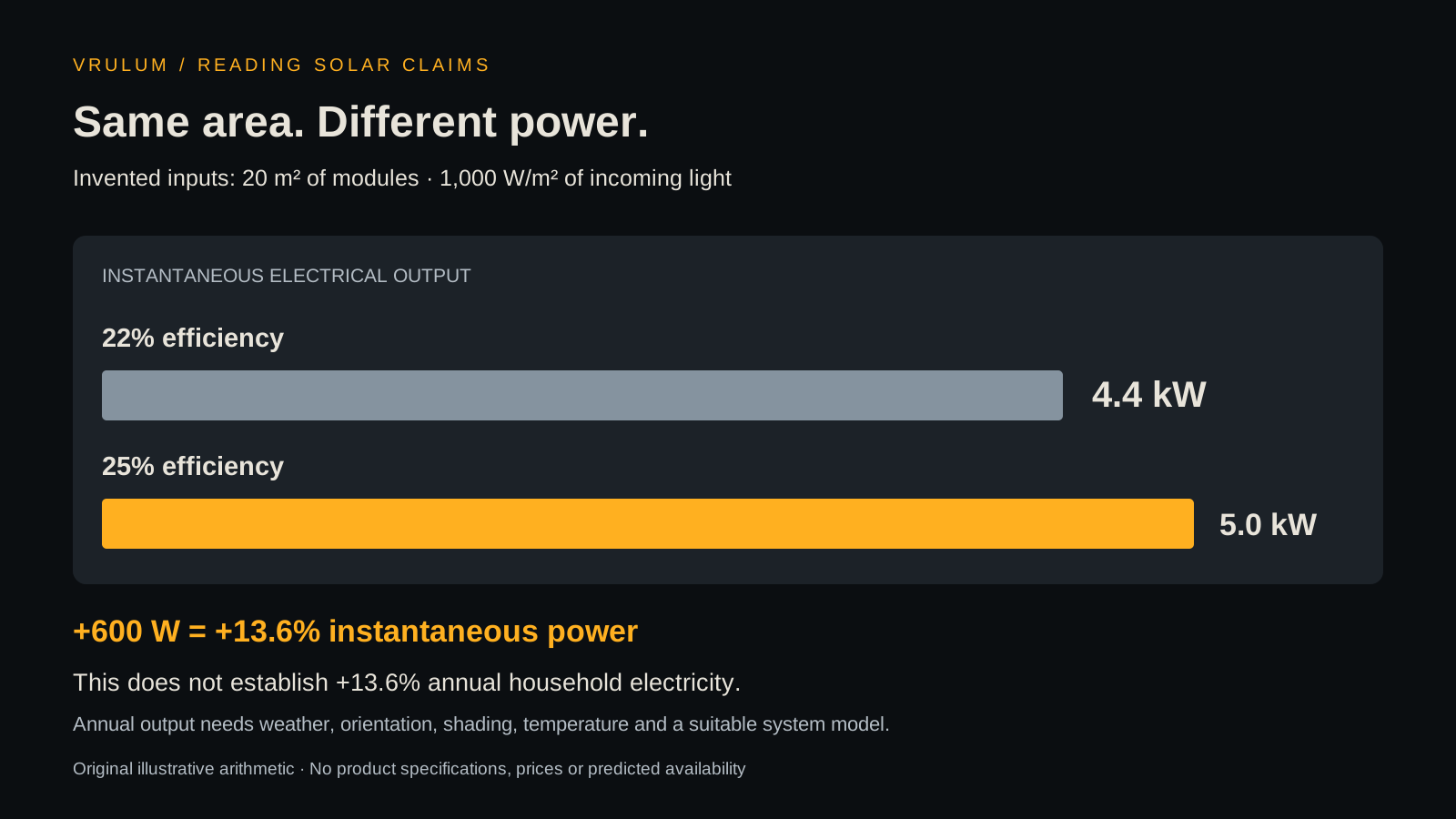
Original schematic using invented efficiencies. It illustrates arithmetic, not a measured product advantage or an installation forecast.
Energy Saving Trust's UK guidance (last updated 1 October 2026) says an unshaded, south-facing roof is ideal, and that east- or west-facing systems tend to get around 15 to 20% less energy than one facing directly south. A higher-efficiency future panel does not remove the need to assess the actual property. P15
Published targets: preserve their original scope
Oxford PV's technology page, which carries no publication date and was checked on 23 October 2026, states that its tandem modules are at 25% efficiency today and that it targets 27% by 2027 and 30% by 2030. These are manufacturer targets. The page does not show when the roadmap was first published, so our check date must not be presented as the date the forecast was made. P06
Neither target is a UK household launch commitment. It would be inaccurate to turn "27% by 2027" into "UK homeowners can buy 27% modules in 2027". Efficiency, available volume, market destination and support are different records.
The commercial-shipment date is similarly easy to misuse. An announcement from 5 September 2024 should not be presented as a new 2026 delivery event, and a first shipment is not evidence of every later sales channel. In that release, Oxford PV said it planned to allocate future production to additional utility customers, specialty products and pilot residential applications; that is a stated plan, not a record of UK household sales. P05
What would change this assessment?
The following would materially strengthen the case for everyday UK use:
- A named household module with an exact datasheet, area definition, measurement protocol and accessible test documentation.
- Applicable, current qualification and product-listing evidence tied to the production design rather than an earlier demonstrator.
- Repeated manufacturing evidence: accepted output, batch consistency and traceability of the shipped units.
- Multi-season outdoor results with sample counts, operating conditions, failure analysis and comparisons against suitable controls.
- Containment and end-of-life evidence relevant to aged and damaged examples of the supplied design.
- An actual UK offer with installers, delivery evidence, complete warranty terms and an identified support route.
No single press release needs to answer all six. A claim about normal ownership should wait until the combined record does.
What to look for if you are comparing solar options now
This guide gives no current tandem price, no household savings figure and no recommendation on whether or when to buy. If you are gathering quotes, useful things to compare include:
- Module layout and the exact module model, with its datasheet.
- Inverter design and expected annual output, with the shading and orientation assumptions used.
- The installation work included.
- The actual warranty documents and who supports the system.
- The certificate and listing references for the products quoted.
There are no affiliate links or claims of hands-on testing in this guide.
Research limits
This is a readiness assessment, not a complete global supplier census or an independent certification service. We read the full text of the Artuk study and the Chojniak calibration paper. For several other papers we could read only the publisher abstract, and their numerical claims here are limited to what those abstracts state. The MCS document and IEC public description are identified by version and date; they are not legal advice and may be superseded.
Sources
All checked 23 October 2026. Pages without a publication date are identified; check dates are not publication dates.
- P01: US Department of Energy, Perovskite Solar Cells, undated research overview.
- P02: Fraunhofer ISE, Full-sized tandem module at 25%, 31 January 2024.
- P03: Oxford PV, Residential-size module efficiency announcement, 19 June 2024; company report naming the measurement laboratory.
- P04: Fraunhofer ISE, Matrix-shingled tandem modules, 18 June 2026.
- P05: Oxford PV, First commercial shipment announcement, 5 September 2024.
- P06: Oxford PV, Technology, warranty headline and roadmap, undated page; manufacturer statements.
- P07: Artuk et al., 60 cm² tandem devices and interface stability, Nature Communications, 30 September 2025; full text.
- P08: Luo et al., Thermally evaporated tandems via formamidinium eutectic, Nature, online 5 August 2026; abstract only.
- P09: Khenkin et al., ISOS stability reporting consensus, Nature Energy, 22 January 2020.
- P10: Sandia National Laboratories, PACT outdoor-test protocol version 0.2, 28 February 2025; report summary.
- P11: IEC, IEC 61215-1:2021 public description, published 23 February 2021; public description only.
- P12: MCS, MCS 005 Issue 4.0, dated 1 August 2024.
- P13: Li et al., On-device lead sequestration, Nature, 19 February 2020; abstract only.
- P14: European Commission Joint Research Centre, PVGIS 5 user manual, undated documentation.
- P15: Energy Saving Trust, Solar panels, last updated 1 October 2026.
- P16: Jia et al., Asymmetric self-assembly molecule for tandem cells, Nature, 7 July 2025; abstract only.
- P17: Chojniak et al., Traceable large-area tandem module calibration, Progress in Photovoltaics, first published 21 May 2025; open access, full text.
Technology profiles
Sources
- https://www.energy.gov/cmei/systems/perovskite-solar-cells
- https://www.ise.fraunhofer.de/en/press-media/press-releases/2024/oxford-pv-and-fraunhofer-ise-develop-full-sized-tandem-pv-module-with-record-efficiency-of-25-percent.html
- https://www.oxfordpv.com/press-releases/oxford-pv-solar-sustainability-initiative
- https://www.ise.fraunhofer.de/en/press-media/press-releases/2026/perovskite-silicon-solar-cells-meet-matrix-shingled-interconnection.html
- https://www.oxfordpv.com/press-releases/oxford-pv-solar-technology-patent
- https://www.oxfordpv.com/technology
- https://www.nature.com/articles/s41467-025-63673-y
- https://www.nature.com/articles/s41586-026-10970-1
- https://www.nature.com/articles/s41560-019-0529-5
- https://www.sandia.gov/research/publications/details/pact-perovskite-pv-module-outdoor-test-protocol-version-0-2-2025-02-28-1/
- https://webstore.iec.ch/en/publication/68594
- https://mcscertified.com/wp-content/uploads/2025/02/MCS-005-Version-4.0-Final.pdf
- https://www.nature.com/articles/s41586-020-2001-x
- https://joint-research-centre.ec.europa.eu/photovoltaic-geographical-information-system-pvgis/using-pvgis-5/pvgis-5-user-manual_en
- https://energysavingtrust.org.uk/advice/solar-panels/
- https://www.nature.com/articles/s41586-025-09333-z
- https://onlinelibrary.wiley.com/doi/10.1002/pip.3928
Checked against its sources by Claude (check-and-publish session).