Self-driving cars on UK roads: what a robotaxi launch actually proves
By the Vrulum team
Evidence checked 23 October 2026. This is a longer companion to our self-driving cars tracker.
Self-driving passenger services and a private car that can handle an ordinary driver's whole journey are different destinations. Wayve's September 2026 London launch is explicitly supervised, with a licensed driver onboard (Wayve). The government's list of self-driving vehicles for Great Britain, checked on 23 October 2026, still says no vehicles are listed. Neither fact is evidence of a generally available driverless car.
There is also evidence worth taking seriously from driverless US operations. An IIHS analysis reports lower crash involvement rates for the Waymo vehicles it studied, while stating that its results apply only to those vehicles. That evidence deserves more attention than a demonstration video, but it does not settle the safety of every future deployment.
The question for our tracker is therefore precise: what evidence would establish unsupervised, broadly usable driving on everyday UK roads, including in privately owned cars? "Every road" here does not mean driving through an impassable flood, ignoring a closure or making an unsafe journey. The destination is general driving capability within conditions in which people can reasonably drive, together with lawful availability and support.
The legal discussion below concerns Great Britain: England, Scotland and Wales. Northern Ireland is not covered by the GB listing and pilot guidance cited here, and we have not established its position.
Where we are: pilots are real, the endpoint is broader
Our tracker currently places self-driving cars on every road at Pilots, stage 4 of 6, with two of its seven steps complete (last reviewed 21 October 2026). That stage reflects bounded services, which are much further developed than unrestricted private ownership. The word "Close" in the general description of the Pilots stage should not be read as a forecast for every-road driving.
Vrulum's six-stage scale runs from Science unproven through Science demonstrated, Engineering prototypes, Pilots and Scaling up to Widespread. These are broad editorial categories. They are separate from SAE's six automation levels and do not measure the same thing.
Six groups of evidence help organise this future:
| Group | Evidence that would move it forward | What it would not establish |
|---|---|---|
| Defined capability and responsibility | A named feature, operating conditions and a clear human role | Safety merely from an automation label |
| Driverless operation in a bounded domain | Documented operation without an onboard safety driver | Coverage outside that domain |
| Lawful GB passenger deployment | Relevant vehicle permissions, a service permit and local consent where required | Nationwide or unrestricted use |
| Safety and service performance | Comparable exposure data, incidents, failures and passenger outcomes | The same performance in an untested environment |
| Broader roads and conditions | Evidence for each material expansion and safe handling of limits | A private consumer launch |
| Supported private ownership and widespread use | Named purchasable variants, lawful features, maintenance and real adoption | A guarantee that every journey is safe or possible |
These are groups of evidence, not equal steps in time. A UK deployment need not wait for particular US cities to launch, and a private-car route need not pass through any one robotaxi company.
Who is actually responsible for the driving?
SAE's current catalogue lists J3016_202609, dated 20 September 2026. Its public summary distinguishes driver support that needs continual driver supervision, automated driving under defined conditions where a human must take over when alerted, and automated driving under defined conditions where human driving is not needed. Its highest level covers all conditions in which humans can drive. The summary also says the taxonomy is not a safety standard. We read the public summary, not the full paid standard.
For readers, three questions are more useful than a level number: who monitors the road, who must respond when the feature reaches its limits, and where is that arrangement valid?
The Highway Code distinguishes assisted driving features, where the driver remains responsible at all times, from listed self-driving vehicles driving themselves "in a valid situation". A vehicle's branding, hands-free steering or ability to change lanes does not answer those questions. A passenger in a genuine driverless service is in a different position from the supervising driver of an assisted car.
Do not assume a software update turns a UK vehicle into a lawful eyes-off car. The Vehicle Certification Agency (VCA) reviews ALKS approvals case by case before listing, checking that the UK is within the system's operational design domain, that there is evidence of compliance with GB traffic rules and of validation in GB, and how the particular vehicle variant can be identified. An international type approval or a similar model name is not enough on its own.
The operational design domain is part of the product
An operational design domain, or ODD, is the set of conditions for which a driving feature is designed. A useful readiness record documents the permitted geography, road types, speed range, weather and other relevant limits, rather than reducing them to a city name. The GB pilot scheme guidance for applicants asks for a description of the system's ODD and the deployment area.
A service covering much of a city can still exclude an airport, a road class or a weather condition. A trip can begin inside the geographical boundary but meet a road closure or conditions outside the feature's capability. A useful system must recognise its limits and respond safely; crossing a boundary on a map is not the whole problem.
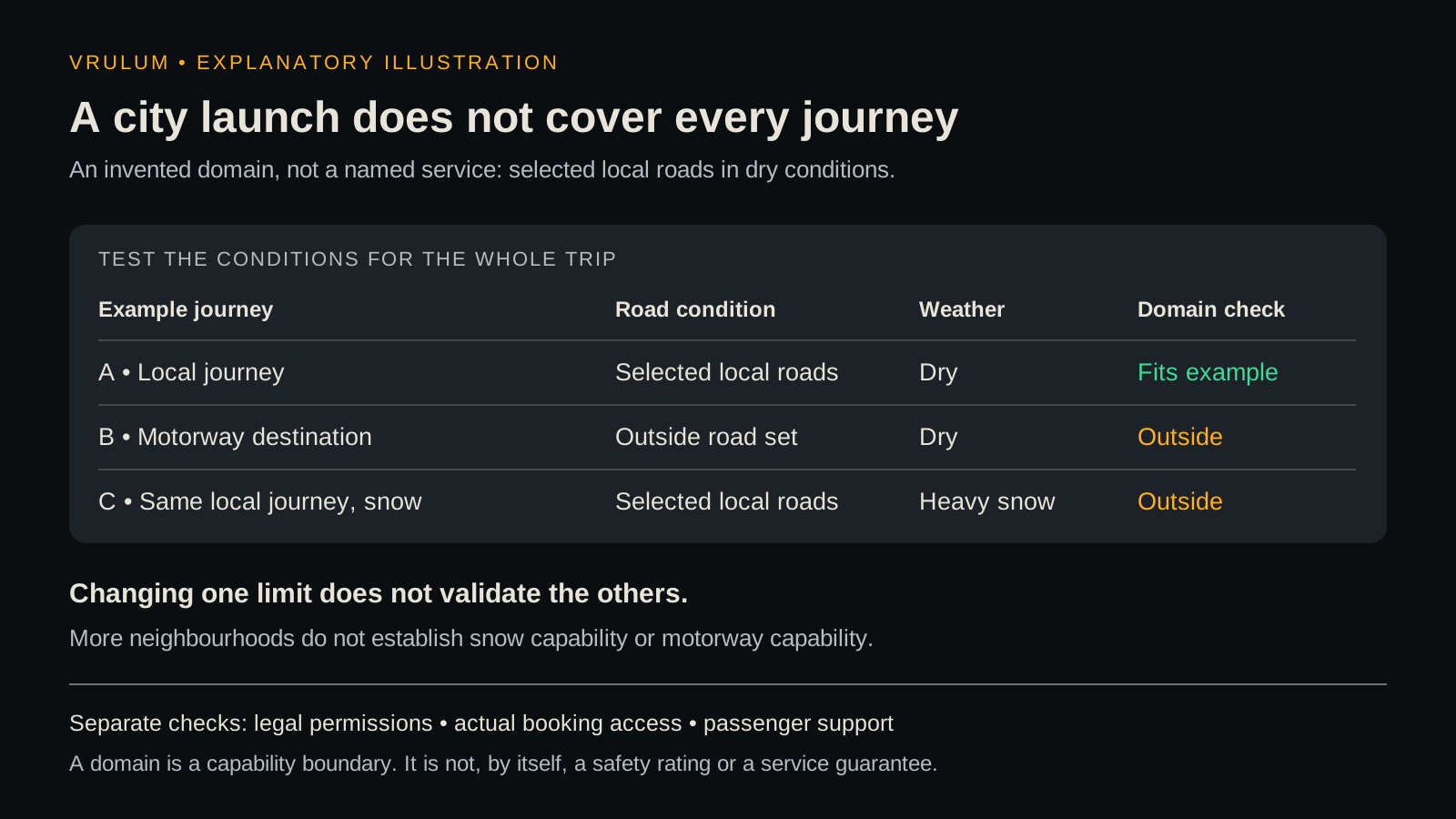
Original explanatory illustration. The example domain is invented and does not represent a named provider, a service map or approved operating limits.
Take an imaginary feature permitted on selected local roads in dry conditions. An otherwise identical journey in heavy snow has changed one crucial condition. Adding another neighbourhood does not prove snow capability, and showing snow handling does not prove every motorway scenario. That is why each expansion of the domain needs its own evidence.
Broad capability should also include a clear account of safe stopping, or other ways of reducing risk, when a journey cannot continue. A successful arrival is useful evidence, but so is a correctly handled refusal or interruption. A safe refusal is not a crash, but frequent refusals still matter for practical usefulness.
What has changed recently
Waymo's four new US cities have moved on from employee-only rides. On 8 July 2026 Waymo said it would soon begin rider-only driving in Denver, San Diego, Tampa and Las Vegas, initially for employees, with the public to follow. On 1 September it announced its first public riders in Denver, San Diego and Tampa, and on 14 September in Las Vegas, with access widening gradually. These are company announcements. They update the history but do not independently verify service performance.
Public access, payment, access for everyone and continuous operation are separate claims. The September posts describe first public riders; we do not infer fares, paid status or unrestricted access from them.
London has a reported supervised passenger service. Wayve's 3 September 2026 release describes rides matched through Uber, a trained, TfL-licensed private hire driver onboard to oversee each trip, a small initial fleet, and a launch area covering London apart from airports. The word supervised belongs beside the launch claim. It does not meet the milestone of a passenger service without a safety driver. The release's "first-ever" wording is the companies' own description, which we have not independently checked.
Waymo's London plans remain company statements. Its 15 October 2025 announcement said it intended to offer rides with no human behind the wheel in London in 2026. Its 24 September 2026 London statement says it will use the automated passenger services permitting scheme, which needs national approval from the Department for Transport and the consent of Transport for London. Neither document is an approval decision or evidence that a public driverless service has started.
The GB permit regulations are now law. The Automated Vehicles (Permits for Automated Passenger Services) Regulations 2026, made under the Automated Vehicles Act 2024, were made on 20 April 2026, laid before Parliament on 23 April and came into force on 15 May 2026. They set out the permit procedure; they are not a permit granted to any operator.
What a UK permission actually establishes
There are separate questions about the vehicle, the driving system, how it is operated and any passenger service. The VCA distinguishes trials, which need a safety driver ready to take control, from pilots without a safety driver. For pilots it describes vehicle approval and registration, a Vehicle Special Order and vehicle listing, plus an automated passenger services permit where passengers are carried. A press launch or a local private hire licence is not a substitute for this evidence.
The geography matters. The 2026 regulations apply to bus-like automated passenger services in England, Wales and Scotland, and to other automated passenger services (such as taxi-like and private hire-like services) in England only. That is not one identical taxi-permitting process across the UK.
The Department for Transport's guidance for local authorities explains that a taxi-like or private hire-like service needs consent from each taxi and private hire licensing authority in whose area it would run, that a bus-like service in a franchised area needs consent from the franchising body, and that traffic authorities likely to be substantially affected must be consulted. It also explains that permit holders will sit alongside other responsible organisations once the full Act is in force. A single approval headline does not settle all of those responsibilities.
The government's public listing is a useful check, but its scope should be stated accurately. On 23 October 2026 it reported no listed self-driving vehicles for Great Britain. We have not found a published record of a named GB driverless passenger permit with an operating public service. That is a statement about published records, not about unpublished applications or every trial vehicle.
When a permit is announced, the useful details are the decision itself, the named operator, the vehicles, the permitted area and conditions, the start date, whether a safety driver is present and who can ride. A plan to apply is a plan. A permission for a trial with a safety driver does not show that a service is driverless.
What the strongest safety evidence does and does not show
Company research and independent analysis answer bounded questions
Kusano and colleagues examined 56.7 million Waymo rider-only miles through the end of January 2025, using human benchmarks aligned to the same vehicle types, road types and locations. The accepted manuscript reports an 85% reduction in Suspected Serious Injury+ crashes across all locations combined, with a 95% confidence interval from a 39% to a 99% reduction, based on two Waymo events in that category. All authors work for Waymo. The study is published in Traffic Injury Prevention, but it is not an independent replication.
IIHS's July 2026 study examines 2021 to 2024 operation, excluding interstates and freeways, and reports that Waymo vehicles in driverless operation had police-reportable crash involvement rates 68% lower than human drivers in the same areas and years. Its Table 5 gives a rate ratio of 0.32, with a 95% confidence interval of 0.25 to 0.40. The paper is marked as a preprint submitted to a journal. IIHS is separate from Waymo, but the study relies on federally required incident reports and on mileage data from Waymo.
Those results are encouraging for the deployments studied. They do not establish a general guarantee for a UK private car. Questions to ask of any comparison:
- Does the numerator count crashes, vehicles involved, injured people or insurance claims?
- Does the denominator count all autonomous miles, occupied miles or passenger journeys?
- Are road types, locations, reporting thresholds and periods comparable?
- Are rare outcomes frequent enough to support the headline, and what do the confidence intervals allow?
- Is the comparison with average drivers or with a careful and competent driver?
Reporting differences can change the apparent rate
The US regulator NHTSA warns that data recording and telemetry vary between reporting companies, that incident reports may be incomplete or unverified, and that more than one report may be submitted for the same crash. Reporting rules also differ between automated driving systems and Level 2 driver assistance. Raw totals from its crash reports are therefore not a fair ranking of manufacturers, especially without mileage and consistent inclusion rules.
An invented example shows the denominator problem. Twelve comparable incidents over six million miles gives 2 incidents per million miles; thirty over twenty million miles gives 1.5 per million. The fleet with more incidents has the lower rate. The second rate is 25% lower than the first (1.5 divided by 2 is 0.75). These are invented numbers; they give no confidence interval, causal conclusion or safety evidence for any real vehicle.
Rare serious outcomes need particular care. RAND's 2016 report by Kalra and Paddock explains why road mileage alone can require hundreds of millions, or even billions, of miles to answer some reliability questions statistically. It does not set one universal mileage threshold that every safety case must meet. Simulation, targeted testing and monitored deployment answer different questions, and each needs its own evidence.
The GB benchmark is not just beating an average driver
The June 2026 consultation on draft safety principles proposes that self-driving vehicles should be at least as safe as careful and competent human drivers, which the consultation describes as a higher standard than the average driver. It also proposes that vehicles take account of the specific territory where they operate, and discusses evidence representative of comparable locations. This is a draft, not a final statement. A favourable US fleet average cannot by itself show that a GB authorisation standard is met.
Contrary evidence: good average results do not remove specific defects
NHTSA's 11 May 2026 recall acknowledgement 26E026 says Waymo software could allow a vehicle to slow and then drive into standing water on higher-speed roads. At that date the final remedy was still under development; as an interim remedy, Waymo had added weather-related operating constraints and updated its maps. We have not established whether a final remedy has since been completed.
A separate Waymo filing, Part 573 recall report 26E035 submitted on 17 June 2026, describes vehicles entering freeway construction zones under certain circumstances, and the freeway driving restrictions Waymo applied while it addressed the cause. It is a manufacturer's report to the regulator, not an independent finding.
These records matter because the tracker is about expanding beyond bounded operation. A restriction can be a responsible safety measure while also narrowing the service on offer. Both capability expansions and material restrictions belong in the record.
A recall does not, by itself, disprove a favourable crash comparison. A favourable comparison does not mean an identified defect is harmless or resolved. They are different pieces of evidence and should be read together.
Reliability, support and accessibility are part of readiness
Removing the onboard driver does not remove the need for a service operation. The pilot scheme guidance asks about incident management, vehicle maintenance, passenger communication and remote assistance. It says the assessment will check that remote assistance to the driving system is limited to advice only. Remote assistance should not be confused with someone continuously steering over a network.
For any future deployment, we would want to see how often remote assistance is requested and for how long, any interventions involving direct control, communications failures, stopped vehicles, rescues and unfinished trips, each with a denominator and operating mode. A montage of completed trips does not answer those questions.
Accessibility needs a separate test of the whole journey: finding the pickup point, boarding, securing mobility equipment, contacting support and leaving the vehicle during a disruption. Being able to drive does not mean every passenger can use the service independently. The applicant guidance covers the accessibility of the booking platform, provision for assistance dogs, how passengers with mobility issues get in and out (including in emergencies) and emergency procedures.
Cost claims need the same boundaries. An advertised fare is not the cost of running the fleet. Vehicle depreciation, maintenance, charging, cleaning, depots, remote support and empty running all belong in an operating model. We have found no comparable UK driverless cost per mile, staffing ratio or profitability figure, and a funding round or a launch fare is not a substitute.
Published intentions, with the endpoint kept attached
| Source and date | Published intention | What would verify it |
|---|---|---|
| Waymo, 15 October 2025 | Rides in London with no human behind the wheel in 2026 | Actual permissions and public operation without an onboard driver, not supervised testing |
| Simon Lightwood MP, DfT, 17 June 2026 | Subject to the consultation, the statutory statement of safety principles to be laid before Parliament for approval in 2027 | The statement as laid and approved; closing the consultation is not enough |
| Waymo, 8 July 2026 | Public riders to follow employee-only operation in four US cities | September posts report first public riders; payment and access for everyone remain separate claims |
None of the sources we reviewed gives a reliable date for private cars usable on every road. We add no date, countdown or probability.
What can a UK reader usefully do now?
If you are choosing a car, establish the human's role for the exact UK feature and variant. Treat assistance as assistance and follow the current Highway Code and the manufacturer's instructions. Hands-free operation alone does not mean you may stop supervising. Check the government's self-driving vehicle list rather than inferring capability from an overseas launch or a promised update.
If you are considering a passenger service, check its actual booking area, whether a safety driver is present, any access restrictions and the support arrangements. Wayve's London option is supervised; it can be a new passenger experience without being a driverless milestone. We have not booked or tested it.
If you cannot drive, compare the options available for the journey that matters to you: public transport, a suitable licensed taxi or private hire service, or specialist assistance where available. We have found no general driverless alternative for rural journeys, mobility support or travel across all UK nations. Do not postpone an essential transport arrangement on the strength of a company's target year.
Signals to watch
The next meaningful updates would be dated primary records of one of these:
- A named, lawful driverless GB service: vehicle permissions, a service permit, local consent where required, actual operation and passenger access.
- A material domain expansion: road classes and weather conditions added, with supporting validation and limits kept.
- Comparable independent monitoring: current mileage, reporting definitions, severity outcomes, uncertainty and changes after software updates.
- Public operational reliability: interruptions, rescues, support demands and recovery outcomes, with meaningful denominators.
- Accessible end-to-end use: evidence from relevant passenger groups and disruption scenarios, not only an app accessibility claim.
- A supported private-car offer: a named UK variant with lawful unsupervised functions, stated conditions, maintenance and a verified way to buy it.
The record should keep successes, restrictions and unresolved questions together. The central test is whether a new result expands usable, lawful and supported driving in a defined setting, not whether another city name can be added to a map.
Sources
- SAE International, J3016_202609: Taxonomy and Definitions for Terms Related to Driving Automation Systems for On-Road Motor Vehicles, 2026 (public summary only).
- Department for Transport, The Highway Code: Introduction.
- Centre for Connected and Autonomous Vehicles and Department for Transport, Self-driving vehicles listed for use in Great Britain, checked 23 October 2026.
- Vehicle Certification Agency, Piloting of Self-Driving Vehicles.
- Vehicle Certification Agency, Automated Lane Keeping Systems (ALKS) and Listing of Self-Driving Vehicles.
- The Automated Vehicles (Permits for Automated Passenger Services) Regulations 2026, SI 2026/439.
- Department for Transport, Automated passenger service permits: local authority and transport body roles, 31 March 2026.
- Department for Transport, Self-driving vehicle pilot scheme: information for applicants, 31 March 2026.
- Department for Transport, Automated vehicles: statement of safety principles consultation, 17 June 2026.
- Simon Lightwood MP, New consultation on draft statutory statement of safety principles for automated vehicles, 17 June 2026.
- Wayve, Wayve and Uber Launch First-Ever Autonomous Rides in the UK, 3 September 2026.
- Waymo, London service announcement, 15 October 2025.
- Waymo, Our Vision for London, 24 September 2026.
- Waymo, From the road, 8 July 2026.
- Waymo, Welcoming our first riders in Denver, San Diego, and Tampa, 1 September 2026.
- Waymo, Las Vegas public riders announcement, 14 September 2026.
- Kusano K. D. and others, Comparison of Waymo Rider-Only crash rates by crash type to human benchmarks at 56.7 million miles, accepted manuscript; published in Traffic Injury Prevention, 2025.
- Teoh E. R., Kidd D. G. and Riexinger L. E., Rise of the machines: crash experiences of highly automated vehicles and human drivers, IIHS preprint, July 2026.
- NHTSA, Standing General Order on Crash Reporting.
- NHTSA, Recall acknowledgement 26E026, 11 May 2026.
- Waymo LLC, Part 573 Safety Recall Report 26E035, 17 June 2026.
- Kalra N. and Paddock S. M., Driving to Safety: How Many Miles of Driving Would It Take to Demonstrate Autonomous Vehicle Reliability?, RAND, 2016.
Technology profiles
Sources
- https://saemobilus.sae.org/standards/j3016_202609-taxonomy-definitions-terms-related-driving-automation-systems-road-motor-vehicles
- https://www.gov.uk/guidance/the-highway-code/introduction
- https://www.gov.uk/guidance/self-driving-vehicles-listed-for-use-in-great-britain
- https://www.vehicle-certification-agency.gov.uk/connected-and-automated-vehicles/piloting-of-self-driving-vehicles/
- https://www.legislation.gov.uk/uksi/2026/439/made/data.html
- https://www.gov.uk/government/publications/automated-passenger-service-permits-local-authority-and-transport-body-roles/automated-passenger-service-permits-local-authority-and-transport-body-roles
- https://www.gov.uk/government/publications/self-driving-vehicle-pilot-scheme-information-for-applicants/self-driving-vehicle-pilot-scheme-information-for-applicants
- https://www.gov.uk/government/consultations/automated-vehicles-statement-of-safety-principles/automated-vehicles-statement-of-safety-principles-consultation
- https://www.gov.uk/government/speeches/new-consultation-on-draft-statutory-statement-of-safety-principles-for-automated-vehicles
- https://www.vehicle-certification-agency.gov.uk/connected-and-automated-vehicles/automated-lane-keeping-systems-alks-and-listing-of-self-driving-vehicles/
- https://wayve.ai/press/wayve-uber-launch-autonomous-rides/
- https://waymo.com/blog/2025/10/hello-london-your-waymo-ride-is-arriving/
- https://waymo.com/blog/2026/09/visionforlondon/
- https://waymo.com/blog/shorts/ro-den-lv-sd-tmpa/
- https://waymo.com/blog/2026/09/ride-in-denver-san-diego-tampa/
- https://waymo.com/blog/2026/09/ride-in-las-vegas/
- https://arxiv.org/abs/2505.01515
- https://doi.org/10.1080/15389588.2025.2499887
- https://www.iihs.org/api/datastoredocument/bibliography/2374
- https://www.nhtsa.gov/laws-regulations/standing-general-order-crash-reporting
- https://static.nhtsa.gov/odi/rcl/2026/RCAK-26E026-9973.pdf
- https://static.nhtsa.gov/odi/rcl/2026/RCLRPT-26E035-7637.pdf
- https://www.rand.org/content/dam/rand/pubs/research_reports/RR1400/RR1478/RAND_RR1478.pdf
Checked against its sources by Claude (check-and-publish session).