How far are we from solid-state batteries in everyday UK electric cars?
By the Vrulum team
Evidence reviewed: 23 October 2026.
Solid-state batteries have working laboratory cells, manufacturer-reported vehicle trials and serious industrial programmes behind them. But those achievements answer different questions. A cell that survives a particular experiment is not a complete car battery; a car that completes a long drive is not a factory producing affordable packs; and an overseas launch target is not a UK delivery date.
The useful question is therefore more specific than whether solid-state batteries exist: when does a particular design become a dependable, supported option for an ordinary UK driver? The sources we reviewed do not establish a date for that endpoint. They do establish measurable steps towards it.
Where we are
Vrulum's assessment: engineering prototypes, with manufacturer-reported vehicle trials. This is our editorial classification for the next generation of broadly usable passenger-car batteries, based on the published research and company test programmes described below. It is not a claim that every solid-state technology is at the same stage.
Two distinctions matter immediately:
- Published experiments support the laboratory milestone; their conditions are explained below. S03
- BMW describes an all-solid-state i7 test vehicle, while Mercedes describes road testing using Factorial's FEST cells. Those are commercially interested sources; Factorial itself calls FEST quasi-solid, distinguishing it from its Solstice all-solid-state design. S09, S10, S11
There is also a historical counterexample to the claim that solid-state batteries have never been commercialised. Blue Solutions says it began operations in 2011 and reports more than 3 million of its solid-polymer cells installed in shared cars, buses and off-highway vehicles. That history does not prove its next generation, or another company's chemistry, is ready for mass-market UK cars. It does mean "the first solid-state battery" is an unreliable headline without a tightly defined application. S20
What exactly is being tracked?
For this guide, the endpoint is all-solid-state batteries offered in ordinary UK passenger cars, with declared specifications, normal ordering and deliveries, a supported warranty and credible production continuity. A one-off prototype, limited experimental fleet, overseas announcement or small specialist cell does not satisfy the whole endpoint.
"Everyday" also means more than an impressive maximum range. A relevant product needs to start after being parked, accept charging under specified conditions, retain useful capacity, fit in a safe pack and be serviceable. These are the questions we would require a launch record to answer, rather than additional achievements we assume have already happened.
The endpoint deliberately allows different manufacturers to arrive by different routes. There is no reason every car must use the same electrolyte, anode or cell format. Nor does a successful launch establish that the technology is widespread.
Solid-state, semi-solid and lithium-metal are different descriptions
A solid electrolyte carries ions through a solid material. The electrode chemistry and electrolyte are separate parts of the design. S08
The Faraday Institution's SOLBAT programme focuses on the combination of solid electrolytes and lithium-metal negative electrodes. Its current research targets include interfaces, practical operating conditions, thin separators and pouch-cell manufacturing. That is a useful indication of what the field still needs to solve, rather than a consumer release timetable. S01
| Description | What it tells you | What it leaves unanswered |
|---|---|---|
| All-solid-state | The electrolyte system is described as solid throughout the relevant cell architecture. | Which electrodes are used, the operating conditions and the pack-level benefits. |
| Quasi-solid, semi-solid or hybrid | The design combines solid features with other electrolyte components; terminology must be checked against its technical disclosure. | How much liquid is present, where it is and what performance or safety improvement it delivers. |
| Lithium-metal | The negative-electrode design uses lithium metal during operation. | Whether the electrolyte is liquid, hybrid or entirely solid. |
| Anode-free at manufacture | The cell is assembled without a conventional pre-installed anode host; the relevant disclosure must explain subsequent lithium deposition. | Lifetime, efficiency and the electrolyte design. |
These are reading rules, not a universal certification scheme. Ask for the architecture behind the label. S11, S13, S16
QuantumScape's annual report filed on 25 February 2026 describes current prototype generations as using a solid separator and an organic liquid catholyte, with solid catholytes under investigation. That disclosure is the right basis for describing that generation. A later platform must be checked on its own terms. S13
Ilika's own Goliath page describes a high-silicon anode and quasi-solid electrolyte. It would be inaccurate to use that programme as proof that lithium-metal all-solid-state automotive packs have been commercially delivered. S16
The road so far
The milestones below concern this guide's specific passenger-car endpoint. "Not established" means the evidence we reviewed does not establish completion; it does not assert nobody is working on the step.
| Milestone | Our assessment on 23 October 2026 | Evidence and limit |
|---|---|---|
| Working all-solid-state laboratory cells | Demonstrated in published research | S03 reports pouch-cell tests. Its conditions remain attached to the result. |
| Automotive all-solid-state pack integration | Reported, unverified; development continues | BMW's i7 announcement describes a test programme and further engineering work, rather than a retail product. S09 |
| Multi-vehicle durability under ordinary use | Not established for this endpoint | A research test or demonstration drive cannot answer a complete ownership-life question. |
| Repeatable, economical series manufacture | In progress in company roadmaps; not established for the endpoint | Distinguish material supply, pilot cells and sustained vehicle-pack output. S06, S14 |
| UK specification, warranty and customer deliveries | Not established by the sources reviewed | Requires model-specific UK documentation before this status changes. |
| Widespread UK adoption | Not established | It requires deployment evidence beyond a first delivery or factory plan. |
Do not turn this table into a percentage. The steps are not equally difficult, their dependencies vary and several can advance at once. A historical commercial polymer battery also cannot automatically unlock every milestone for a newer sulphide or ceramic design.
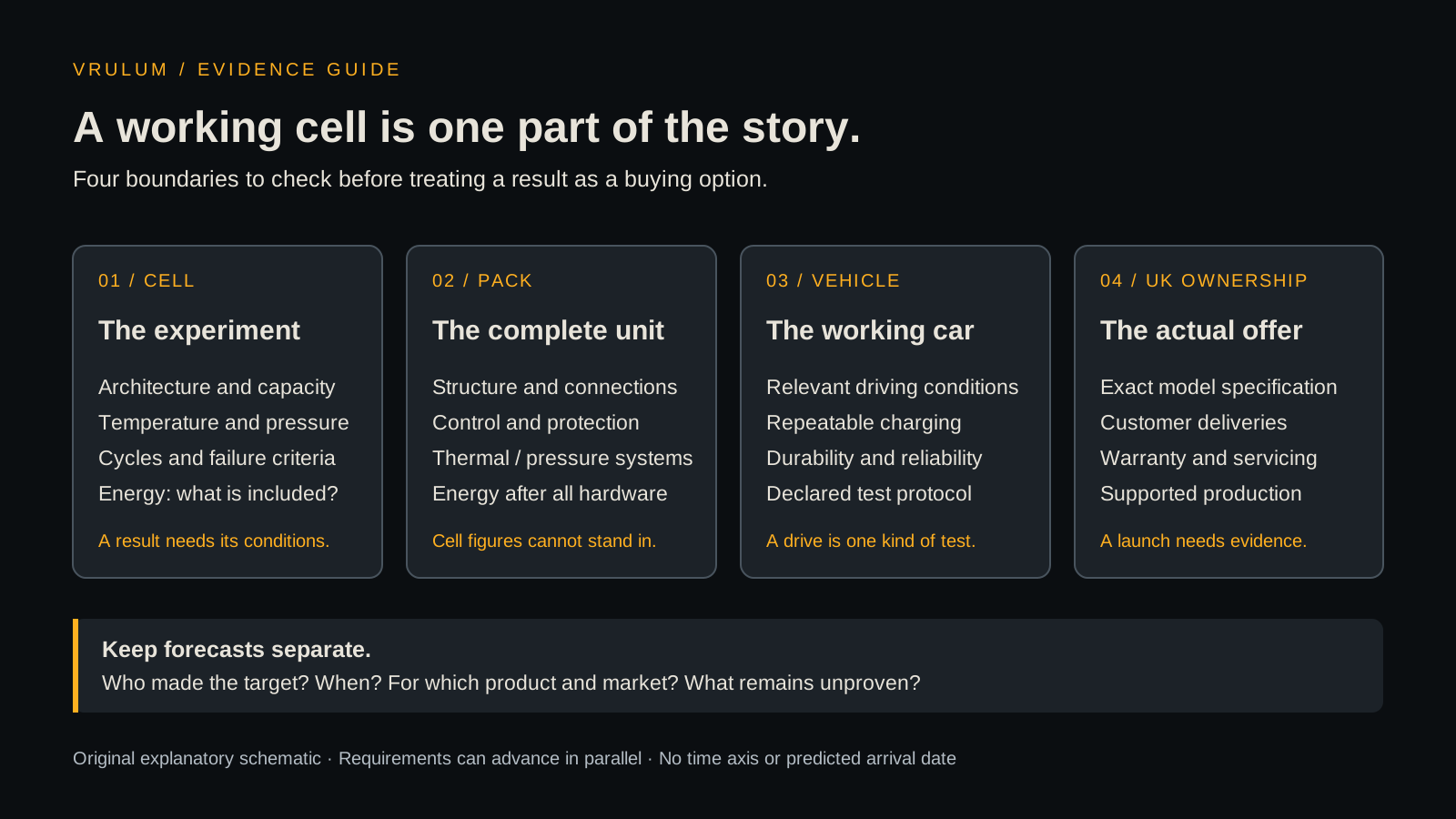
Original Vrulum schematic. This is a guide to evaluating evidence, not a forecast or a photograph of a device.
What the strongest visible results actually show
A 2026 paper: useful progress with consequential test conditions
Sang and colleagues' paper, published in Nature Communications on 14 May 2026, reports all-solid-state pouch cells with 85% capacity retention after 350 cycles at 1C under a stack pressure of 2.5 MPa. The Figure 5 caption specifies 60°C for the pouch-cell tests. A separate high-loading result of 409 Wh/kg is calculated on the mass of the solid electrolyte, lithium metal and positive-electrode materials only. S03
That denominator does not describe an installed vehicle pack. Do not merge energy and endurance experiments into one headline specification. This is a materials result, not a winter-ready, warrantied pack. S03
BMW: a vehicle integration programme, not an order book
BMW's 20 May 2025 release says Solid Power cells are being tested in an i7 operated in the Munich area. It identifies cell expansion, operating pressure and temperature conditions as questions for the programme and says further development steps are needed for a competitive overall storage system. S09
That is more concrete than an illustration or design patent. It remains a manufacturer report about a development vehicle. An independently available test protocol, failure record and production specification would answer different, later questions.
Mercedes and Factorial: a long drive with a different electrolyte category
Mercedes reported that a lightly modified EQS test vehicle drove 1,205 km (749 miles) from Stuttgart to Malmö, via Denmark on motorways, without recharging at the end of August 2025, and says 137 km (85 miles) of range remained. The company says the route was planned with its navigation system taking account of topography, traffic, ambient temperature and heating and cooling needs; the release does not give average speeds or weather for the drive. Its September release identifies FEST cells and pneumatic actuators used to manage cell-volume changes and contact pressure. The reported distance is a single manufacturer-reported route result, not a certified UK consumer range. S10
Factorial describes FEST as quasi-solid and Solstice as sulphide-based all-solid-state. The drive therefore should not be repackaged as a demonstration of Solstice. S11
Stellantis: supplier and vehicle-maker validation
On 24 April 2025, Stellantis and Factorial reported validating 77 Ah FEST cells with 375 Wh/kg, more than 600 cycles and charging from 15% to over 90% in 18 minutes at room temperature. They described progress towards automotive qualification and a plan to put the cells into a demonstration fleet by 2026. This is partner-reported validation, not an independent public replication or a UK delivery record. We have not found a source confirming whether that fleet is now running. S12
QuantumScape: a recent industrial milestone with a different market focus
QuantumScape's 21 October 2026 announcement describes a planned 100 MWh production line with Muehlbauer, targeting start of cell production in 2028 and markets including AI data centres, aerospace and defence. This is a company plan, not output already achieved, and its stated markets do not establish an automotive or UK launch. S14
Its shareholder letter published the same day says the Eagle Line pilot production line, inaugurated in February 2026, has increased the pace of customer sampling. That adds evidence about pilot activity while leaving sustained manufacturing performance and product qualification as separate questions. S15
Why a working cell is still far from an everyday car
Interfaces must survive repeated change
Ning and colleagues' 2023 Nature paper distinguishes the initiation of lithium dendrites from their subsequent propagation in the ceramic electrolyte studied. It links lithium deposition into subsurface pores to crack formation, and identifies mechanical factors, including stack pressure, affecting continued growth. A solid layer is therefore not automatically an impenetrable barrier to a short circuit. We relied on the published abstract; it should not be treated as an audit of every electrolyte. S02
For a reader assessing a new claim, ask whether the experiment used a complete cell, how much capacity moved each cycle and what happened when it failed. A visually intact sample or a short cycling trace is not a lifetime result.
Pressure can improve contact and complicate the pack
The practical question is not simply "does pressure help?" It is how much force the installed design requires, what supplies it and whether that system preserves the claimed benefit. The peer-reviewed pouch example above and BMW's own test objectives show why pressure belongs in the specification. S03, S09
Consider an illustrative calculation, unrelated to any particular manufacturer's pack. A pressure of 2.5 MPa over 100 cm² gives:
Force = pressure × area = 2,500,000 Pa × 0.01 m² = 25,000 N.
That calculation explains why a laboratory pressure figure deserves attention. It is not an estimate of clamping mass, because the mechanical structure, footprint and load paths have not been specified. A design may distribute force in ways this simple calculation does not represent.
Different electrolyte families trade different problems
The 2023 research perspective A Roadmap for Solid-State Batteries discusses polymer, oxide, sulphide and hybrid approaches. It describes temperature and conductivity constraints for polymers, difficult interfaces for stiffer inorganic materials, and the risk that sulphides release toxic hydrogen sulphide on contact with moisture. It also notes that safety issues around lithium-metal anodes remain to be considered. These are design-dependent concerns, not a declaration that one family always wins. S04
The test for a new product is evidence about its particular formulation and pack. "Ceramic", "polymer" and "sulphide" are useful starting points for questions, not substitute safety ratings.
Production capacity has several meanings
Idemitsu announced a final investment decision and construction start for a large solid-electrolyte pilot facility on 29 January 2026. It described expected capacity of several hundred tonnes of solid electrolyte a year, construction completion targeted for 2027 and its aim, with Toyota, to commercialise electric cars with all-solid-state batteries in 2027 to 2028. These are material-supply and project milestones; they are not measurements of completed automotive packs. S06
A meaningful manufacturing update should distinguish nameplate capacity, installed equipment, accepted cells, realised yield and sustained output. These are questions to ask of a programme, not numbers this guide can fill in without evidence.
Durability must survive the intended use
An endurance claim needs its charge rate, discharge rate, depth of discharge, temperature, pressure, retention threshold and number of samples. It also needs an explanation of whether unusually weak cells were excluded. Without those details, two cycle counts are difficult to compare.
The useful ownership question is broader still: what happens after storage, repeated cold starts, fast charging and years of mixed use? A warranty would allocate some of that risk; a laboratory cycle count does not itself specify warranty coverage.
Cell energy density is not pack energy density
Ask what the denominator contains before comparing Wh/kg figures. Does it include only selected materials, a finished cell, a module or an installed pack? A result based on active components should retain that description in every chart and headline.
Here is an invented arithmetic example, not a product specification:
- A 100 kWh collection of cells at 400 Wh/kg would have 250 kg of cell mass.
- Add an assumed 150 kg of structure, electronics, connections and other pack hardware: the illustrative pack becomes 400 kg.
- Its pack-level figure is
100,000 Wh ÷ 400 kg = 250 Wh/kg.
The example does not assert a typical pack overhead. Its purpose is to show why a cell figure cannot be copied directly into a vehicle comparison. The same discipline applies to Wh/L: use a declared volume boundary rather than assuming all manufacturers measure the same object.
Toyota's June 2023 battery roadmap also illustrates a different boundary problem: its projected range improvements explicitly include vehicle efficiency changes such as aerodynamics and weight reduction. Those forecasts cannot be attributed entirely to the battery chemistry. S19
Fast charging: state the window and the power
"Charges in ten minutes" is incomplete. Record the starting and finishing state of charge, usable capacity, temperature and charger conditions. The "15% to over 90%" window in the Stellantis announcement is not the same measurement as a 10% to 80% claim. S12
In another illustrative calculation, a hypothetical 80 kWh usable battery receiving 70% of its usable energy in ten minutes takes in 56 kWh. That requires an average of 56 ÷ (10/60) = 336 kW at the battery. Charger input would also have to accommodate losses; the calculation does not specify peak power or a real charging curve.
The Department for Transport explains that, in its statistics, a charger's power band reflects the maximum potential power of its highest-power connector, and that actual delivery can be lower because of the vehicle, its battery management system, shared power or the electricity supply. A future cell capable of high charging power would not remove those other limits. S17
For a UK driver, the meaningful comparison is a repeatable charging session on a compatible charger in relevant conditions. Ask how much useful energy is added during the stop, rather than comparing only peak kW or an unspecified number of miles.
Published forecasts: who said what, and when?
These are the companies' own targets. Vrulum does not turn them into its own arrival forecast.
| Forecaster | Statement date | Published target | What it does not establish |
|---|---|---|---|
| Toyota and Idemitsu | 12 October 2023 | Commercialisation in 2027 to 2028, followed by full-scale mass production. S05 | UK models, prices, volumes or deliveries. |
| Nissan | 29 November 2021; technology page checked 23 October 2026 | The speech says Nissan will introduce its first all-solid-state battery in 2028; the technology page says Nissan aims to launch an EV with in-house all-solid-state batteries by FY2028. S07, S08 | A calendar-year deadline or UK on-sale commitment. The fiscal-year wording matters. |
| Mercedes-Benz | 9 September 2025 | Aim to bring the technology into series production by the end of the decade. S10 | A fixed model, exact date or customer specification. |
| QuantumScape | 21 October 2026 | Start of cell production targeted for 2028 on the planned 100 MWh line. S14 | A car launch; the announcement names other markets. |
The date of the statement matters. An old target remaining online is evidence that it was stated, not a fresh confirmation that its schedule has been independently audited. Revisions should be recorded alongside the earlier statement rather than quietly replacing history.
What would change our assessment?
The next convincing evidence would answer these questions:
- Architecture: Is the production-intent design all-solid-state, and is that consistent with the disclosure rather than just the marketing name?
- Conditions: Are full-cell performance and failure data available under the temperatures, pressure and charging rates required in the intended product?
- System: Does a complete pack preserve the energy, safety and charging benefit after its supporting hardware is included?
- Durability: Is the performance repeatable across a relevant number of cells, packs and vehicles, with both cycling and storage evidence?
- Manufacture: Are accepted cells being produced consistently, with a stated quality process and evidence beyond equipment installation?
- Ownership: Are there actual UK specifications, normal customer deliveries, warranty terms and a service route?
These are evidential gates, not a demand that every manufacturer disclose commercially sensitive process details. Where information is unavailable, the honest status is that the public record does not answer the question.
What UK buyers should watch
A battery chemistry label alone cannot tell you how a particular car will behave. Energy Saving Trust lists battery size, the vehicle's energy consumption, state of charge, temperature, road type, topography, vehicle and load weight, battery condition, use of climate control and tyre condition among the factors affecting an EV's range. S18
When a solid-state car is announced for the UK, these are the details that would show whether it is a real, supported product:
- A declared range under a stated test procedure, and the conditions behind any longer real-world drive.
- Documented charging behaviour, including the state-of-charge window, rather than only a maximum charger rating.
- Whether the battery is described as all-solid-state, quasi-solid or hybrid in the manufacturer's technical disclosure.
- The actual warranty, battery-health information and service support for the exact UK variant.
- Evidence of normal ordering and customer deliveries in the UK, not only an overseas launch or a demonstration fleet.
This guide does not endorse any solid-state-branded car, charger, power station or aftermarket battery, and it is not buying advice. There are no affiliate links in this guide.
Questions readers are likely to ask
Do solid-state batteries already exist?
Yes. The category includes published laboratory devices and an established commercial polymer lineage. The harder question is which design, in which application, under what conditions and with what delivery evidence. S03, S20
Does a solid electrolyte mean there is no lithium-ion movement?
No. "Solid" describes the electrolyte's physical form. Lithium ions still move between the electrodes through it. Check the design rather than treating solid-state as an entirely separate explanation of how charge is transported. S04, S08
Are they guaranteed to be fireproof?
No such blanket conclusion follows from the sources we reviewed. An electrolyte's flammability, lithium-metal behaviour, cathode reactions and the completed pack's safety evidence are separate questions. Specific formulations need specific tests. S04
Will they automatically double an EV's range?
No automatic multiplier is supported here. Range depends on the complete vehicle; manufacturers can also choose different combinations of capacity, mass and cost. Preserve the assumptions and comparison baseline behind any forecast. S18, S19
Can a current EV simply receive a solid-state replacement pack?
Do not assume that. We found no approved retrofit product. A vehicle-specific engineering and support record would be needed before treating a possible future cell as a replacement option.
Is there a confirmed UK arrival year?
The sources we reviewed establish corporate targets and research milestones, not a confirmed year for this guide's everyday UK ownership endpoint. We will change that assessment only when UK-specific evidence supports it.
Research scope and limitations
This is a source-based desk study, not hands-on testing, independent cell certification or an exhaustive systematic review of every developer. We separate peer-reviewed experiments, research perspectives, corporate announcements and technical disclosures. We read the full text of S03 and S04; for S02 we relied on the published abstract. Several live corporate pages do not give publication dates, and we list them as undated rather than guess.
Commercial output, field durability, UK retail availability and next-generation platform changes remain open questions that we will keep monitoring. Company targets quoted here were current when we checked them on 23 October 2026 and may since have changed.
Sources
All sources last checked 23 October 2026. Dates below are publication or statement dates unless explicitly described otherwise.
- S01: Faraday Institution, SOLBAT programme, undated live research-programme page.
- S02: Ning et al., Dendrite initiation and propagation in lithium metal solid-state batteries, Nature, 7 June 2023; abstract on PubMed.
- S03: Sang et al., Bulk-to-interface fluorination for stable and low-pressure all-solid-state lithium metal batteries, Nature Communications, 14 May 2026; open-access full text.
- S04: Schmaltz et al., A Roadmap for Solid-State Batteries, Advanced Energy Materials, 9 October 2023; research perspective, not a new product test.
- S05: Toyota and Idemitsu, Commercialisation cooperation announcement, 12 October 2023.
- S06: Idemitsu, Investment decision and construction start, 29 January 2026 (the date printed on the document).
- S07: Nissan, Ambition 2030 speech script, 29 November 2021.
- S08: Nissan, All-solid-state batteries, undated technology page; FY2028 wording.
- S09: BMW, Solid Power all-solid-state cells in an i7 test vehicle, 20 May 2025.
- S10: Mercedes-Benz, EQS long-distance test, 9 September 2025.
- S11: Factorial, FEST and Solstice technology descriptions, undated live page.
- S12: Stellantis and Factorial, Cell validation milestone, 24 April 2025.
- S13: QuantumScape, Form 10-K for 2025, filed with the US Securities and Exchange Commission on 25 February 2026.
- S14: QuantumScape, Planned 100 MWh line, 21 October 2026.
- S15: QuantumScape, Third-quarter 2026 shareholder letter, 21 October 2026.
- S16: Ilika, Goliath technology, undated live page.
- S17: Department for Transport, Charging infrastructure statistics FAQ, updated 21 May 2026.
- S18: Energy Saving Trust, Electric vehicle battery basics, updated 16 September 2025.
- S19: Toyota, Battery technology roadmap, 13 June 2023.
- S20: Blue Solutions, Manufacturing and production, undated live page; deployment figures are manufacturer-reported.
Technology profiles
Sources
- https://www.faraday.ac.uk/research/next-generation-tech-demonstrators-transformational-challenges/solid-state-batteries/
- https://pubmed.ncbi.nlm.nih.gov/37286650/
- https://www.nature.com/articles/s41467-026-73012-4
- https://advanced.onlinelibrary.wiley.com/doi/full/10.1002/aenm.202301886
- https://global.toyota/en/newsroom/corporate/39865919.html
- https://www.idemitsu.com/jp/news/2025/260129_en.pdf
- https://www.nissan-global.com/EN/COMPANY/PLAN/AMBITION2030/ASSETS/PDF/20211129Speech_script_en.pdf
- https://www2.nissan-global.com/EN/INNOVATION/TECHNOLOGY/ARCHIVE/ASSB/
- https://www.press.bmwgroup.com/usa/article/detail/T0450262EN_US/bmw-group-and-solid-power-are-testing-all-solid-state-battery-cells-in-a-bmw-i7?language=en_US
- https://media.mbusa.com/news/long-distance-test-successfully-completed-eqs-with-solid-state-battery-covers-749-miles-on-a-single-charge
- https://factorialenergy.com/technology/
- https://www.stellantis.com/en/news/press-releases/2025/april/stellantis-and-factorial-energy-reach-key-milestone-in-solid-state-battery-development
- https://www.sec.gov/Archives/edgar/data/1811414/000119312526071556/qs-20251231.htm
- https://www.quantumscape.com/quantumscape-announces-plans-for-100-mwh-solid-state-battery-production-line-for-ai-data-centers-aerospace-and-defense/
- https://www.sec.gov/Archives/edgar/data/1811414/000119312526427862/qs-ex99_1.htm
- https://www.ilika.com/large-format-solid-state-batteries
- https://www.gov.uk/government/publications/electric-vehicle-charging-device-statistics-information/electric-vehicle-charging-infrastructure-statistics-frequently-asked-questions
- https://energysavingtrust.org.uk/advice/electric-vehicle-battery-basics/
- https://global.toyota/en/newsroom/corporate/39330500.html
- https://www.blue-solutions.com/manufacturing/
Checked against its sources by Claude (check-and-publish session).