OSIRIS-REx samples from asteroid Bennu contain salts from an evaporated ancient brine
What was demonstrated
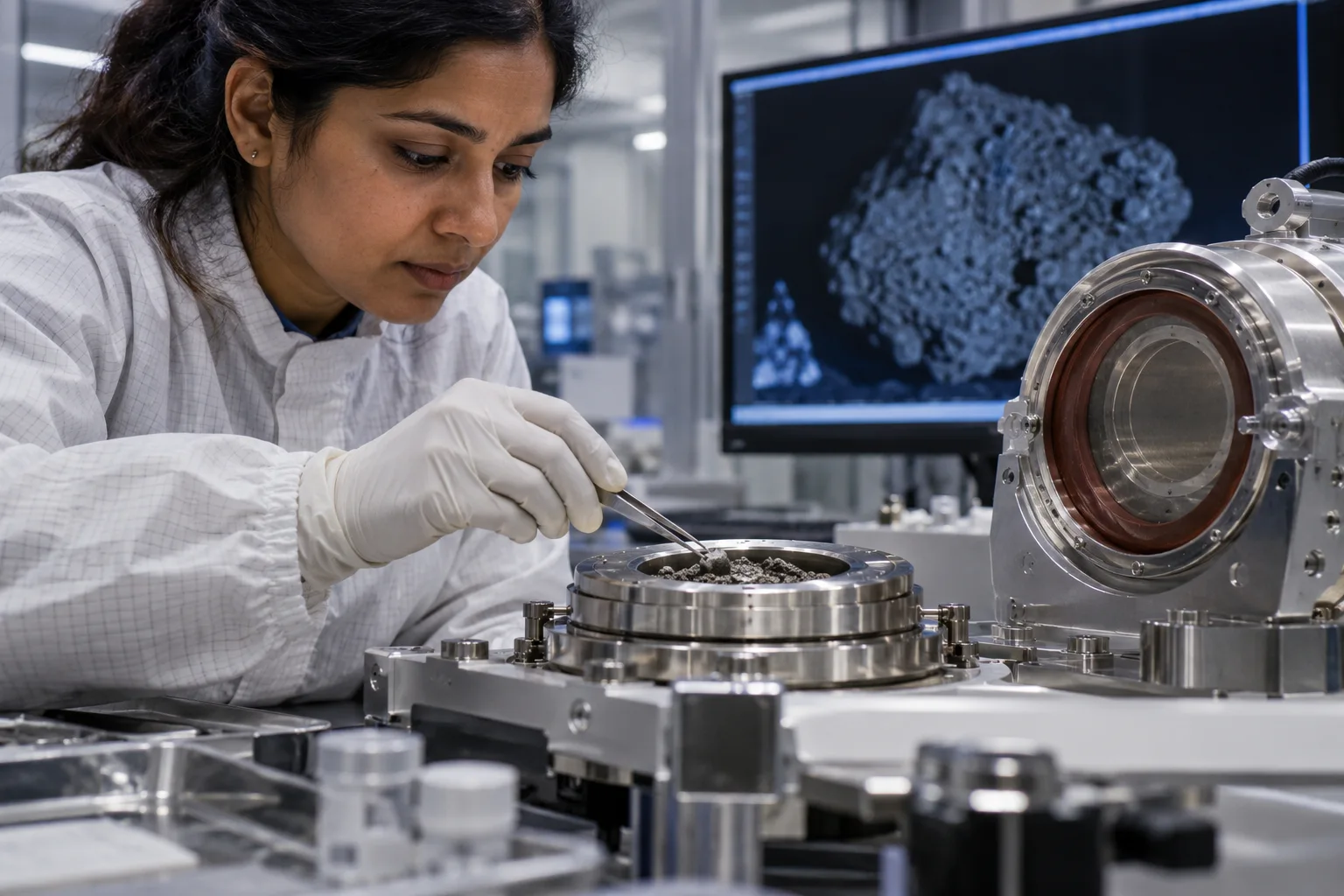
Analysis of samples of asteroid (101955) Bennu returned by NASA's OSIRIS-REx mission found sodium-bearing phosphates and sodium-rich carbonates, sulfates, chlorides and fluorides, interpreted as forming during evaporation of a late-stage brine early in the history of Bennu's parent body.
Why it matters
These salts break down with prolonged exposure to Earth's atmosphere, so the finding depended on sample return and careful curation. It gives direct evidence of brine chemistry on a primitive body and informs models of brines inside Ceres and Enceladus.
Caveats
- Findings come from a small mass of returned material and may not represent the whole asteroid.
- The link to brines on icy moons is an inference from spectra and plume measurements, not a direct comparison of samples.
- This is a planetary science result rather than a new technology; its relevance to Vrulum is the sample return and curation capability.
Technology profiles
Sources
- peer reviewed paper
An evaporite sequence from ancient brine recorded in Bennu samples
T. J. McCoy, S. S. Russell, T. J. Zega et al.. Nature, 29 Jan 2025. DOI: 10.1038/s41586-024-08495-6.
Last reviewed 20 Oct 2026.