Sulfides in Bennu samples point to low-temperature water alteration near 25 °C
What was demonstrated
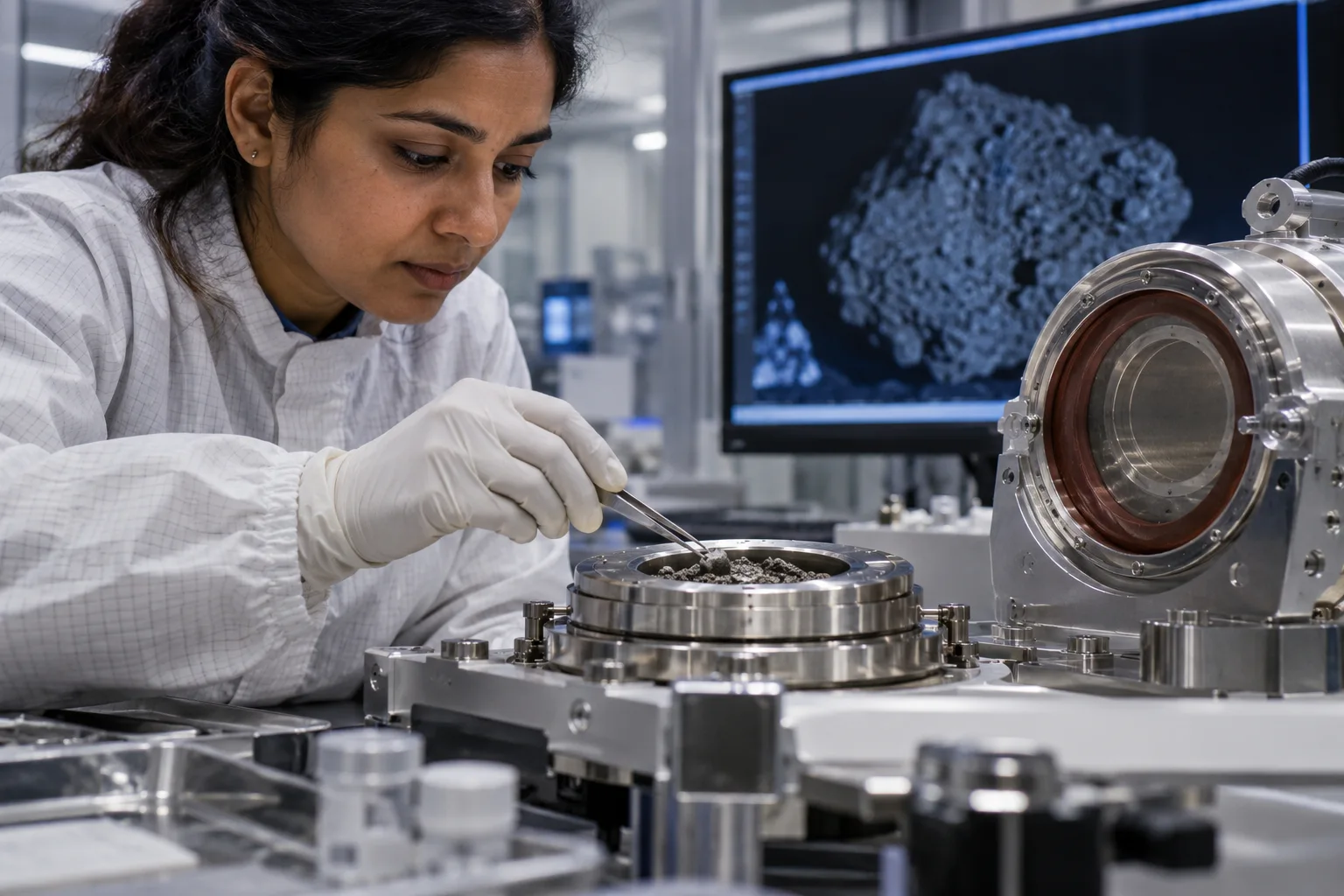
Mineral analysis of samples from asteroid (101955) Bennu, returned by NASA's OSIRIS-REx mission, used X-ray diffraction and electron microscopy. The authors report that sulfide compositions indicate alteration at about 25 °C, similar to conditions inferred for asteroid Ryugu and Ivuna-type (CI) chondrites. They also say the altering fluid probably evolved from neutral to alkaline over time, ending with highly soluble salts.
Why it matters
The result adds mineral evidence that water-rock reactions on Bennu's parent body were cool, close to conditions inferred for Ryugu and CI chondrites. It helps models of how primitive asteroids changed after they formed, though it does not show when the alteration happened.
Caveats
- The 25 °C figure is inferred from sulfide compositions. It is an interpretation of the mineral record, not a direct measurement of the fluid's temperature.
- The abstract gives no sample count or sample mass, and the analysis covers returned material that may not represent the whole asteroid.
- This is a planetary science result rather than a new technology; its relevance to Vrulum is the sample return and curation capability.
Technology profiles
Sources
- peer reviewed paper
Mineralogical evidence for hydrothermal alteration of Bennu samples
T. J. Zega, T. J. McCoy, S. S. Russell et al.. Nature Geoscience, 22 Aug 2025. DOI: 10.1038/s41561-025-01741-0.
Last reviewed 21 Oct 2026.