Can indoor vertical farms compete on price with field and greenhouse crops?
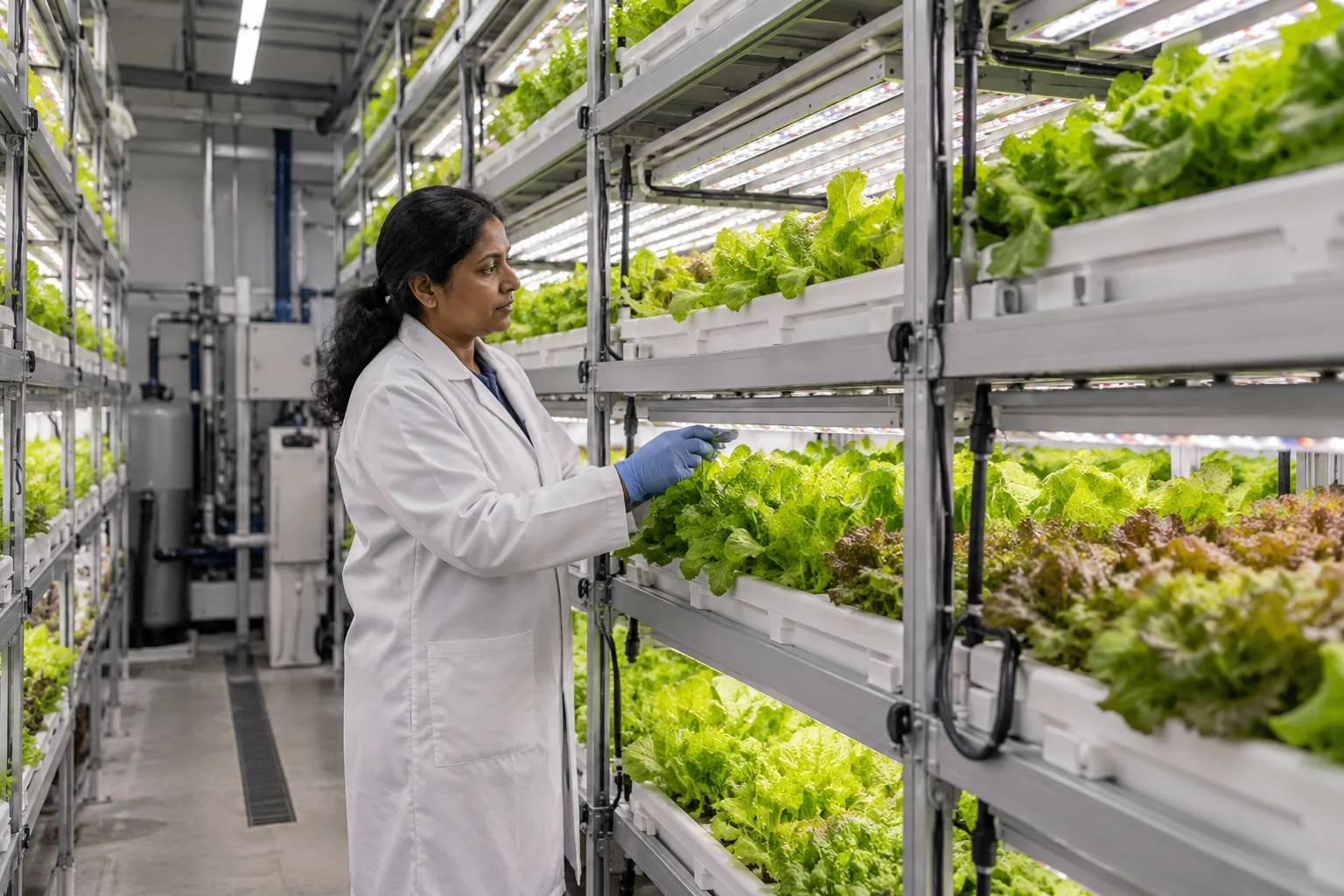
Indoor vertical farms grow leafy crops under artificial light, and several operators have run commercial sites. A peer-reviewed comparison (Graamans and colleagues, 2018) found that plant factories used far more purchased electricity per kilogram of lettuce than greenhouses, which rely mainly on sunlight. Several operators have since failed or closed sites. Infarm closed sites in several European countries in 2023, AeroFarms filed for Chapter 11 bankruptcy in June 2023, and Bowery reportedly ceased operations in late 2024. The sources reviewed do not show a vertical farm producing crops more cheaply than field or greenhouse production.
Close. Early pilots are running in the real world.
Commercial indoor farms have operated, so the growing method itself is past the prototype stage. The sources reviewed name lettuce only in the research studies, and none shows indoor farms selling a range of crops at a price that matches field or greenhouse production. The stage is pilot: commercial operation in niche markets, without proven price parity at scale.
The tech tree
Everything recorded on Vrulum that this future needs, oldest foundations at the top and the goal at the bottom. Lines show what each step requires.
- 2015Modelled land, water and energy comparisonDone Unlocked.
- 2018Electricity per kilogram measured against greenhousesDone Unlocked.
- 2023Operators leaving markets or going bankruptDone Unlocked.
- 2024Large operator ceasing operationsDone Unlocked.
- 2025Energy efficiency gains reviewedIn progress Being researched.
- Date not recordedIndoor farms operating commerciallyDone Unlocked.
- Date not recordedCrop production at field price parityNot started Locked.
- GoalIndoor vertical farms competing on price with field cropsGoalRequires: Vertical farming and controlled-environment agriculture, Indoor farms operating commercially, Electricity per kilogram measured against greenhouses, Modelled land, water and energy comparison, Energy efficiency gains reviewed, Operators leaving markets or going bankrupt, Large operator ceasing operations, Crop production at field price parity. Locked.
The road so far
5 of 7 steps done, 1 in progress.
- DoneIndoor farms operating commercially
Bowery Farming was operating indoor farms before it ceased operations in late 2024, according to Agriculture Dive. The article does not name the crops grown. Lettuce is the crop used in the peer-reviewed energy comparisons reviewed here. [7]
- Done · Feb 2018Electricity per kilogram measured against greenhouses
Graamans and colleagues (2018) compared plant factories with greenhouses. Plant factories used about 247 kWh of purchased electricity per kilogram of dry-weight lettuce. Greenhouses needed 70 kWh in the Netherlands, 111 kWh in the United Arab Emirates and 182 to 211 kWh in Sweden, with and without supplemental lighting. The abstract notes that greenhouses use freely available solar energy for photosynthesis. The full text was not opened, because the publisher returned an access error. [2]
- Done · 16 Jun 2015Modelled land, water and energy comparison
Barbosa and colleagues (2015) modelled hydroponic lettuce in a greenhouse in Yuma, Arizona. They estimated 11 times the yield per square metre and about 82 times the energy per kilogram compared with conventional production. The conventional figures came from crop budgets and government statistics, and the hydroponic figures were theoretical. The comparison is hydroponic greenhouse against conventional production, not vertical farm against greenhouse. [1]
- In progress · 10 Sept 2025Energy efficiency gains reviewed
Aborujilah (2025) systematically reviewed 52 articles from 2014 to early 2024. The review found that efficient LEDs, smart HVAC control and IoT-based irrigation have reduced electricity use. The savings vary with crop, climate, facility design and location, and the review calls for longer field studies and standard reporting. [3]
- Done · Jun 2023Operators leaving markets or going bankrupt
Infarm cut about 500 jobs in November 2022, citing energy prices and tough financial markets. It then closed sites in the UK, France, the Netherlands and Japan in February 2023, and in Frankfurt on 6 April 2023. Copenhagen also closed in 2023, with no date given. AeroFarms filed for Chapter 11 bankruptcy in June 2023, citing significant industry and capital market headwinds. [5][6][4]
- Done · 7 Nov 2024Large operator ceasing operations
Agriculture Dive reported on 7 November 2024 that Bowery Farming was ceasing operations, citing a PitchBook report, and that 187 workers were laid off at its Pennsylvania and Maryland sites. The company's reasons included rising costs, difficulty raising finance and an unsuccessful attempt to sell. Bowery did not respond to press requests, so the closure rests on the reporting rather than a company statement. [7]
- Not startedCrop production at field price parity
No source reviewed shows an indoor vertical farm selling a range of crops at a price that matches field or greenhouse production over a sustained period. The studies reviewed here report energy and resource use rather than price per kilogram. [2]
Why it matters
If vertical farms could match field prices, they could supply fresh produce close to towns and in places with little land or water. If they cannot, investment is likely to stay in niche products and in greenhouses. The answer also affects how much public money and private capital goes into controlled-environment food production.
What stands in the way
- Purchased electricity per kilogram of lettuce is far higher in plant factories than in greenhouses that use sunlight (Graamans and colleagues, 2018).
- Energy prices added to operators' costs. Infarm cited energy prices in 2022 (AgFunderNews, 2022), and Bowery cited rising costs in 2024 (Agriculture Dive, 2024).
- Several operators have struggled to raise finance. Bowery reportedly could not secure financing before it closed (Agriculture Dive, 2024).
- Crop range is narrow. The studies reviewed here all concern lettuce, and no reviewed source gives published energy or cost figures for other crops.
- Reporting standards are inconsistent, and real-world data are limited (Aborujilah, 2025).
Signals to watch
- A peer-reviewed cost per kilogram for an indoor farm, reported against field and greenhouse lettuce in the same region.
- Indoor farms that remain profitable for several years without new capital, or that report audited accounts.
- Published energy-per-kilogram figures for crops other than leafy greens, including tomatoes and strawberries.
- Long-term power purchase agreements at low, stable electricity prices for indoor farms.
- Further closures or consolidation among large indoor farm operators, which would show whether the sector is still shrinking.
Sources
- peer reviewed paper
Comparison of Land, Water, and Energy Requirements of Lettuce Grown Using Hydroponic vs. Conventional Agricultural Methods
Guilherme Barbosa, Francisca Gadelha, Natalya Kublik et al.. International Journal of Environmental Research and Public Health, 16 Jun 2015. - peer reviewed paper
Plant factories versus greenhouses: Comparison of resource use efficiency
Luuk Graamans, Esteban Baeza, Andy van den Dobbelsteen et al.. Agricultural Systems, Feb 2018. - review article
Towards Sustainable Vertical Farming: A Systematic Review of Energy Return on Investment Efficiency and Optimization Strategies
Abdulaziz Aborujilah. Sustainability (MDPI), 10 Sept 2025. - news
AeroFarms files for Chapter 11 bankruptcy protection; CEO Rosenberg steps down
ROI-NJ, 9 Jun 2023. - news
InFarm to lay off 'more than half' of its workforce, downsize operations
AgFunderNews, 29 Nov 2022. - news
Infarm closes Copenhagen operations amid ongoing 'strategy shift'
AgFunderNews, 18 Apr 2023. - news
Celebrity-backed indoor farming company Bowery closes, lays off workers
Agriculture Dive, 7 Nov 2024.
Last reviewed 21 Oct 2026.