Vertical farm inside unused office towers
This is an idea, not a product. Nothing here has been built or tested unless a linked technology profile says so.
The problem
Office districts may have fresh leafy greens on sale nearby but little space to grow them locally, and empty office floors may offer a way to add that space. Indoor growing uses a lot of electricity, so any gain from shorter supply chains may depend on the building's power supply and how the lighting and climate are run.
The idea
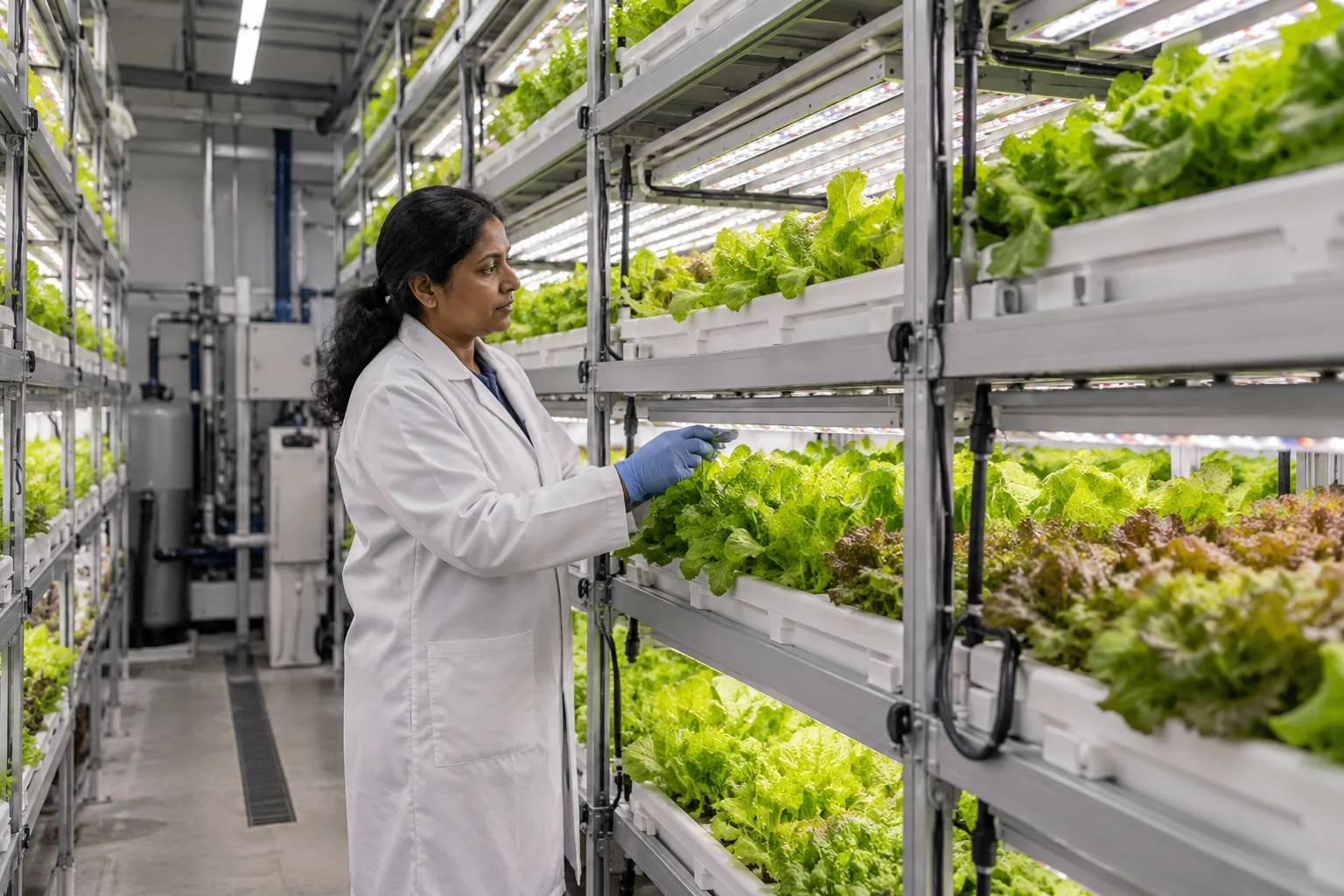
A first version would be a single rack-based growing module for leafy greens, such as lettuce, installed on one vacant floor of a building that already has suitable power, ventilation and water supply. It would run as a pilot to record electricity use per kilogram of crop, yield and crop quality under the building's own heating and cooling, rather than as a full commercial farm. The pilot would test the energy case before any wider fit-out is considered.
Enabling technology
- Vertical farming and controlled-environment agriculture: Vertical farming grows crops indoors in stacked layers under artificial light and controlled climate. It can produce high yields per floor area, but lighting and climate control require substantial energy. Life-cycle studies show that its climate impact depends strongly on the electricity supply, waste-heat recovery, crop and facility design; benefits in one category, such as land use, do not guarantee lower impacts in others.
What stands in the way
- Electricity use for LED lighting and climate control is high, and the sources reviewed in the vertical-farming profile say it weakens the environmental case for these systems (de Carbonnel and colleagues, 2022).
- Energy savings vary with crop, climate, facility layout and geography, so results from one building may not transfer to another (Aborujilah, 2025).
- The clearest energy comparison models a hydroponic greenhouse rather than an indoor vertical farm, so it does not measure the energy cost of an indoor site such as an office floor (Barbosa and colleagues, 2015).
- An office floor would need checking for floor loading, ventilation, water and drainage, and fire-safety rules. The vertical-farming profile does not cover these.
- Upfront costs, a shortage of trained staff and limited real-world data are barriers to wider adoption (Aborujilah, 2025).
A cheap way to test it
On a bench, build one sealed lab-scale growing cabinet with LED lighting, a recirculating nutrient system and a data logger. Place it in a room where temperature and ventilation are logged during the run, so the climate load is recorded. Grow one cycle of lettuce, logging total electricity and fresh crop mass. Before the run, the team writes down the maximum acceptable energy per kilogram and the minimum acceptable harvest mass. The test passes only if both limits are met, and fails if either is missed. No people or human exposure is involved, and electrical and water work follows the lab's own safety rules.