Shipping-container farm for polar stations
This is an idea, not a product. Nothing here has been built or tested unless a linked technology profile says so.
The problem
Crews at remote polar stations may want fresh leafy greens between resupply trips.
The idea
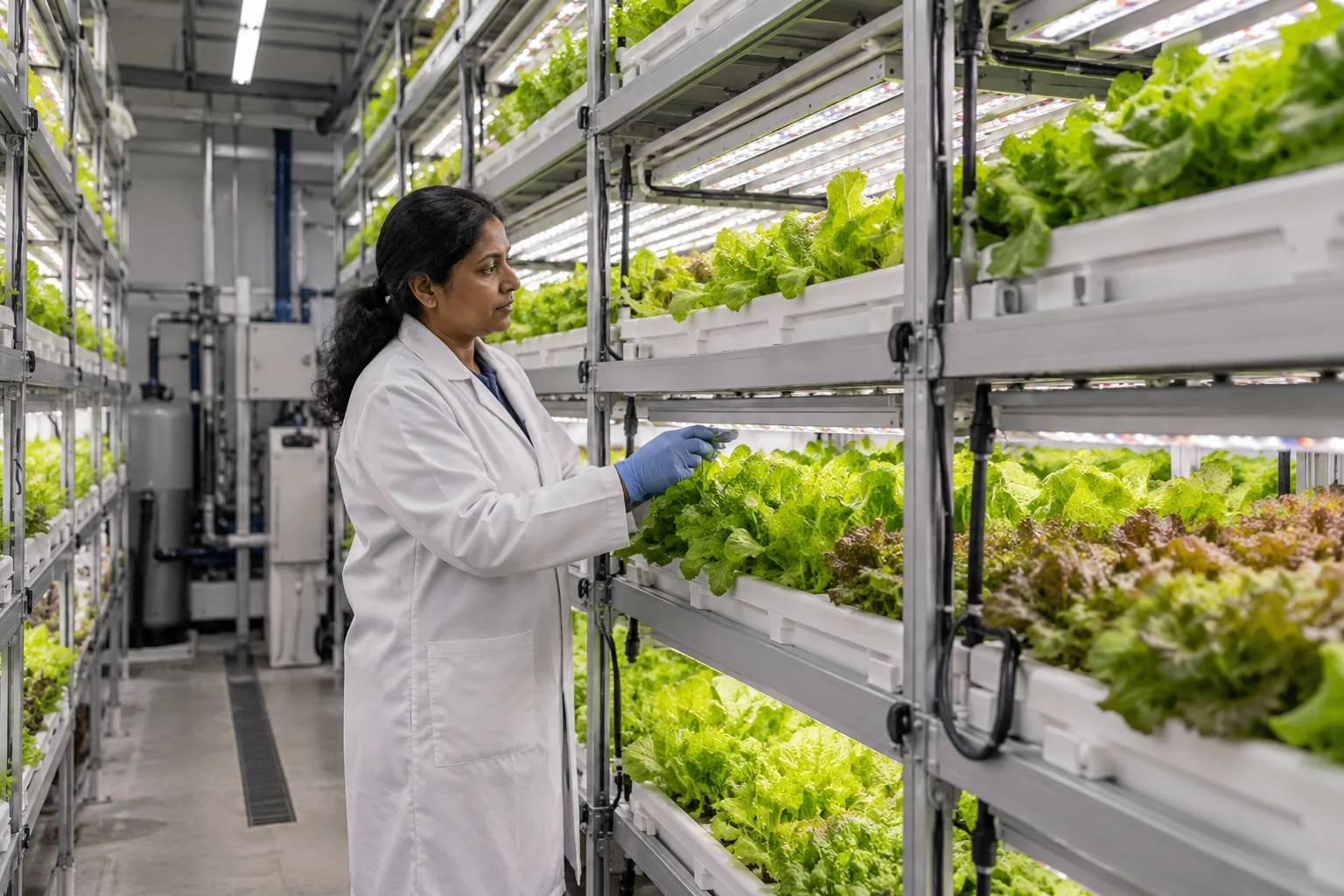
A first version would be a single insulated shipping container with one small LED growing rack, a recirculating water and nutrient loop, and sensors for air, water and energy use. It would grow one or two leafy crops for a small crew and log the energy used for each harvest. It would supplement the station's food supply rather than replace it, and it would not be presented as a full food system.
Enabling technology
- Vertical farming and controlled-environment agriculture: Vertical farming grows crops indoors in stacked layers under artificial light and controlled climate. It can produce high yields per floor area, but lighting and climate control require substantial energy. Life-cycle studies show that its climate impact depends strongly on the electricity supply, waste-heat recovery, crop and facility design; benefits in one category, such as land use, do not guarantee lower impacts in others.
What stands in the way
- Electricity use for lighting and climate control is high, and the vertical farming profile identifies this as the main weakness of the approach. Any polar station would need to test the energy case before a build.
- Energy savings vary with crop, climate, facility layout and geography (Aborujilah, 2025). The profiled systems are not polar facilities, so their results may not transfer to a container in a cold, dark setting.
- Upfront costs, a shortage of trained staff, inconsistent reporting and limited real-world data are the barriers identified for vertical farms (Aborujilah, 2025). A station crew would need simple operation and maintenance that does not depend on outside support.
- The best-known energy comparison models a greenhouse rather than an indoor container farm, and relies on literature values and engineering equations (Barbosa and colleagues, 2015). The sources in the vertical farming profile contain no measured data from a polar container facility.
A cheap way to test it
On a bench, build one insulated box with a small LED rack, a recirculating nutrient loop and a data logger. Keep all mains connections above the water and protect the supply with a residual-current device. Before the test starts, write down a harvest weight for each planted tray and the pass threshold. Run the box at room temperature for two full crop cycles of a leafy green. Pass if every planted tray reaches the harvest weight within the cycle and the logger records the electricity used for each cycle; fail if any tray does not reach the harvest weight or if the energy log is incomplete. Repeat with the box held at a set cool temperature to see whether the heating and lighting load changes the result. No human trial is involved.