Pressure sore early-warning sheet
This is an idea, not a product. Nothing here has been built or tested unless a linked technology profile says so.
The problem
People who spend long periods in bed or in a wheelchair may be at risk of pressure sores, and carers may not notice high pressure on one body area in time to move the person. An early signal may help them change position sooner.
The idea
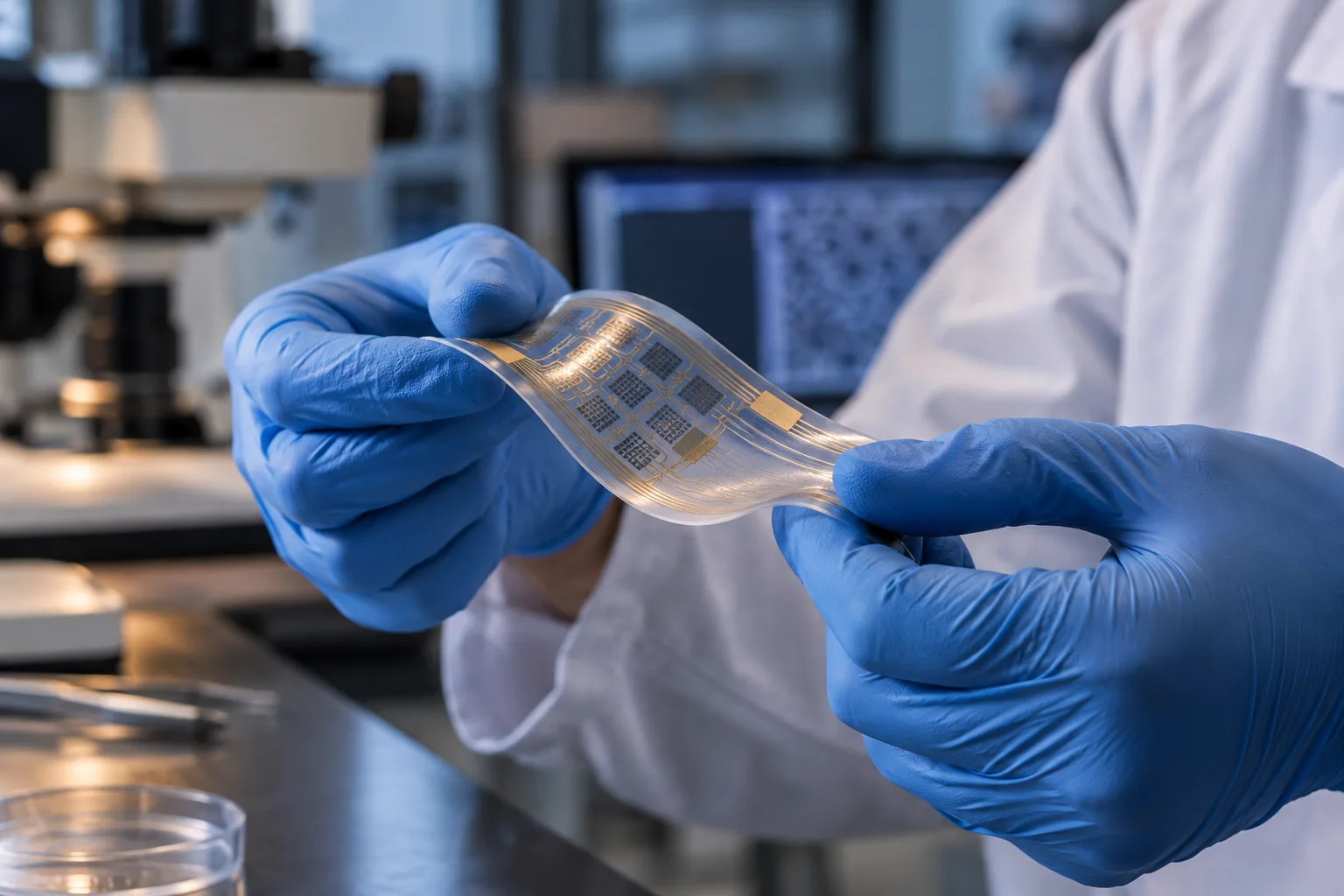
One possible design is a thin, soft sheet placed under a mattress cover or seat pad. It would carry a grid of pressure sensors and a small readout unit. A first version might show a pressure map for one bed or chair and raise an alert when one area stays above a limit, set with clinical input, for longer than a set time. It would report surface pressure only and would not claim to detect tissue damage or to predict pressure sores.
Enabling technology
- Electronic skin: Electronic skin is a family of thin, flexible or stretchable electronic sheets that sense touch, pressure, temperature or body signals in the way human skin does. Laboratory prototypes have shown pressure mapping, skin-mounted health sensing and stretchable transistor circuits. A 2026 study used soft optical waveguides to reconstruct the three-dimensional shape of a sensing sheet, but this remains a research demonstrator rather than a ready-to-wear system.
What stands in the way
- Stretchable transistor arrays change electrical performance under strain, so readings may drift as the sheet is flexed and reused.
- Laboratory e-skin work has shown pressure mapping at small scale. Large-area, reliable and low-cost manufacturing of soft multilayer circuits has not yet been shown at product scale in the sources reviewed.
- Device density in intrinsically stretchable arrays is far below that of silicon electronics. One demonstration reached 347 transistors per square centimetre, so the sensing grid would need a careful choice of sensing points and wiring.
- The sources reviewed cover surface pressure sensing. None tests whether surface readings track loading deeper in the tissue.
- Combining many sensing modes, power, processing and wireless links in one soft sheet remains difficult. The sources reviewed have not yet shown this combination for a product like the one proposed here. Cleaning and durability for bed or seat use would also need testing.
A cheap way to test it
Bench test only, with no people. Build a small test sheet with a grid of sensing points. Before testing, write down the tolerance the team will accept between sensor output and applied load. Using a calibrated indenter or known weights, apply a set of known loads to each sensing point and record each point's output. Pass if every point stays within the written tolerance. Then repeat the loading after a number of flex cycles agreed before testing, and again after wetting the sheet with artificial sweat. Pass if readings stay within the same tolerance. Fail if drift exceeds the tolerance at any point, which would mean the sheet cannot yet be trusted to raise alerts.