Asteroid mining
Also known as Space resource extraction, In-situ asteroid resource utilisation
Asteroid mining would take water, metals or other useful material from small bodies in space and deliver it to a customer. No asteroid extraction, processing or delivery has yet been demonstrated, although missions have collected and returned small samples.

In plain language
Asteroid mining means taking useful material from an asteroid and turning it into something a customer can use. That could be water for rocket fuel or for astronauts, metals for building things in space, or precious metals sent back to Earth. Each option needs a spacecraft to reach the asteroid, gather material, separate the useful part and deliver it somewhere it is needed.
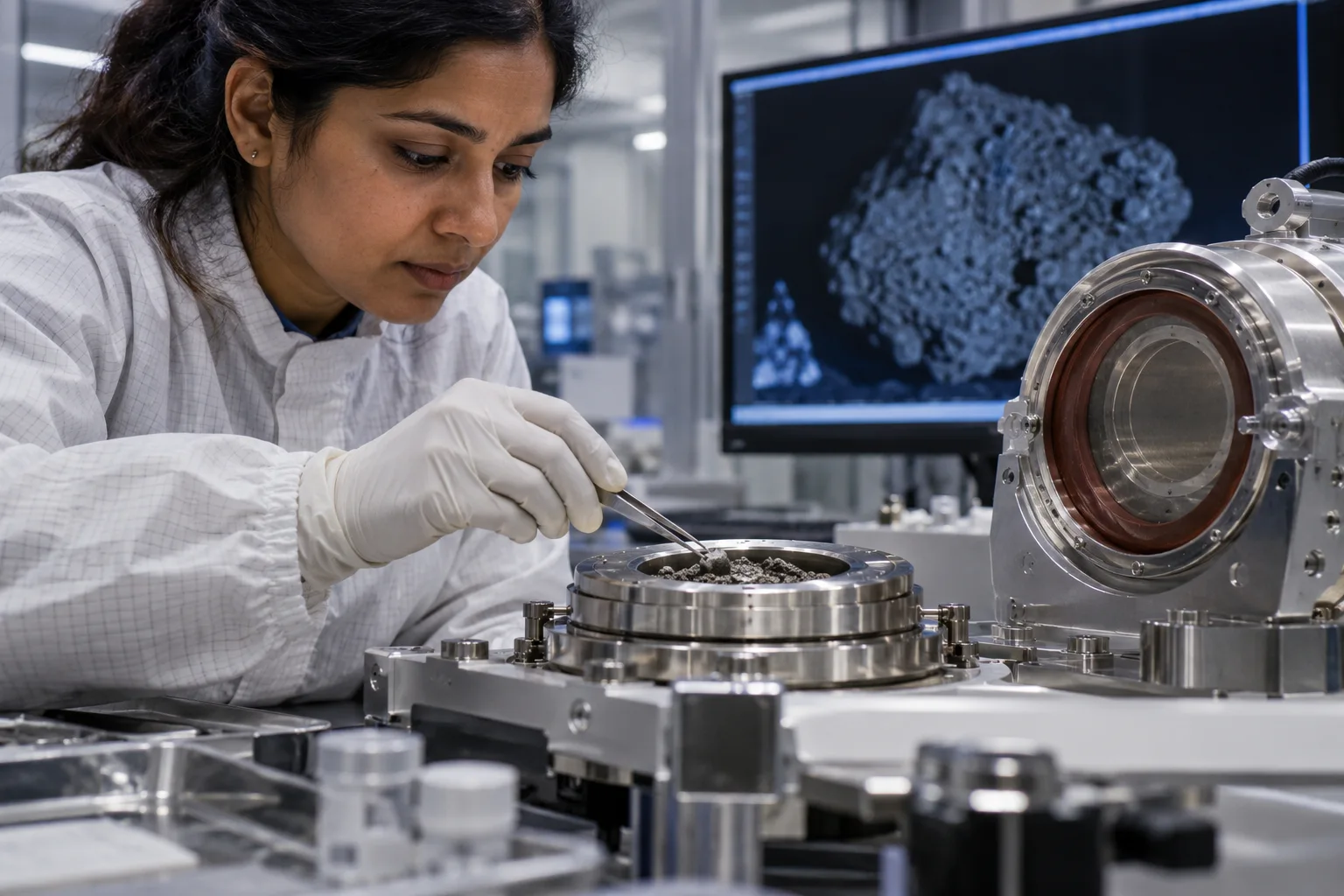
So far, space missions have only brought home small samples: 5.4 grams from the asteroid Ryugu for Japan's Hayabusa2, and 121.6 grams from the asteroid Bennu for NASA's OSIRIS-REx. These samples have taught scientists a great deal, but they are far from a working mine. Asteroid mining is still at the stage of finding out what asteroids contain and whether taking material from them could ever pay.
Technical explanation
Asteroid mining covers four activities of increasing difficulty: prospecting the target, sampling its surface, processing material in space to make a usable product such as water, and returning saleable commodities to Earth. Evidence at one stage does not establish the next. Sample return shows that a spacecraft can collect material and bring it back, but it does not show that a mine can process tonnes, operate for years or make a profit.
Economics dominate the case. A techno-economic analysis by Hein, Matheson and Fries, posted as an arXiv preprint in October 2018, names throughput rate and the number of spacecraft per mission as key technological drivers. Its sensitivity analysis covers throughput rate, spacecraft mass and resource price. Its conclusions therefore depend on assumed inputs, not on observed prices or performance from an operating asteroid mine.
Environmental effects are also modelled rather than measured. A 2019 arXiv study by Fladeland, Boley and Byers simulated debris from four asteroids. It found that streams can form when a few per cent or more of an asteroid's mass is lost, and that these streams may exceed background meteoroid flux for some meteoroid sizes during stream crossings. Capture and waste handling would therefore need design attention before any large-scale operation.
What the evidence says
Each statement is typed by the strength of its evidence and linked to the source that supports it.
Demonstrated Shown in a published experiment, test or shipping product.
Japan's Hayabusa2 returned 5.4 grams of material from the asteroid Ryugu, which JAXA describes as rich in water and organic matter.
Sources: [2] · Sample weight and analysis summaryNASA reports that the OSIRIS-REx bulk sample from the asteroid Bennu weighs 121.6 grams, listed in its mission timeline under 15 February 2024.
Sources: [1] · Milestone timelineSample-return missions have collected grams of asteroid material. None of the sources reviewed here reports an asteroid resource extracted, processed and delivered to a customer.
Sources: [1], [2]Luxembourg's 2017 law states that space resources are capable of being owned and that no person can explore or use them without a written mission authorisation, under continuing supervision by the ministers.
Sources: [6] · Articles 1, 2 and 15Reported, unverified Stated by a company or team but not independently confirmed.
AstroForge reports that its DeepSpace-2 spacecraft, of roughly 200 kilograms, is planned to launch in the fourth quarter of 2026 to rendezvous with and image a near-Earth asteroid.
Sources: [5] · Mission description · medium confidenceAstroForge's stated near-term objective for DeepSpace-2 is rendezvous and imaging of a near-Earth asteroid. The company update also lists resource prospecting and extraction, and mining systems, among possible future payloads. The launch and flight outcome were not known at the time of the update.
Sources: [5] · Mission description and payloadSpeculative An idea or possible use. Not evidence of anything.
A 2018 arXiv techno-economic analysis of asteroid mining names throughput rate and the number of spacecraft per mission as key technological drivers. Its sensitivity analysis covers throughput rate, spacecraft mass and resource price, so its conclusions depend on assumed inputs.
Sources: [3] · Abstract · medium confidenceIn simulations, high-volume asteroid mining that removes a few per cent or more of an asteroid's mass could form debris streams that may exceed background meteoroid flux for some meteoroid sizes during stream crossings.
Sources: [4] · Abstract · medium confidenceLimitations and open problems
- No asteroid extraction, processing or delivery to a customer has been demonstrated. Sample return has returned grams of material, not tonnes.
- Results from two sample-return missions may not describe other asteroids, and the sources reviewed here do not show how sampling would perform on other asteroid surfaces.
- Economic results from the Hein, Matheson and Fries preprint are conditional on assumed inputs. They are not observed prices or performance from a working asteroid operation.
- High-volume extraction can release debris that forms meteoroid streams in simulations, so capture and waste management are needed before industrial-scale work.
- The Luxembourg law records one national position on owning space resources. It does not create an international consensus on who may extract, own or use them.
Possible future uses
Ideas, not predictions. None of these has been demonstrated.
- Water supplied from a near-Earth asteroid as propellant or life-support consumable to a depot in orbit.
- Metal feedstock for building structures in orbit, if a named customer needs that material and a processing system can supply it reliably.
- Large-scale return of precious metals to Earth, which would depend on mining cost, transport, re-entry and how far the market price would fall.
Timeline
- 20 Jul 2017Luxembourg's law on the exploration and use of space resources is dated 20 July 2017. It states that space resources can be owned and that a written mission authorisation is required. Sources: [6]
- Oct 2018Hein, Matheson and Fries submit 'A Techno-Economic Analysis of Asteroid Mining' to arXiv on 9 October 2018. Sources: [3]
- Nov 2019Fladeland, Boley and Byers submit to arXiv (28 November 2019) simulations of meteoroid streams that could form from high-volume asteroid resource extraction. Sources: [4]
- Dec 2020Hayabusa2 returns 5.4 grams of material from the asteroid Ryugu. JAXA later reports, in December 2021, that the sample is rich in water and organic matter. Sources: [2]
- 15 Feb 2024NASA's OSIRIS-REx mission timeline lists the bulk sample from the asteroid Bennu as 121.6 grams. Sources: [1]
- 3 Jun 2026AstroForge publishes a company update, dated 3 June 2026, saying its DeepSpace-2 spacecraft is planned to launch in the fourth quarter of 2026 to rendezvous with and image a near-Earth asteroid. Sources: [5]
Futures this could help bring about
Glossary
- In-situ resource utilisation
- Using resources found in space, such as water or minerals, rather than launching everything from Earth.
- Volatiles
- Substances such as water that evaporate or are released when a material is heated.
- Sample return
- A mission that collects material from a body and brings it back to Earth for laboratory analysis.
- Meteoroid stream
- A band of small debris that shares a similar orbit around the Sun.
Sources
- government report
NASA's OSIRIS-REx Mission to Asteroid Bennu
NASA Science, 30 Sept 2026. Accessed 21 Oct 2026. - government report
Ryugu is a primitive asteroid rich in water and organic matter
JAXA Institute of Space and Astronautical Science, 22 Dec 2021. Accessed 21 Oct 2026. - preprint
A Techno-Economic Analysis of Asteroid Mining
Andreas M. Hein, Robert Matheson, Dan Fries. arXiv, Oct 2018. Accessed 21 Oct 2026. - preprint
Meteoroid Stream Formation Due to the Extraction of Space Resources from Asteroids
Logan Fladeland, Aaron C. Boley, Michael Byers. arXiv, Nov 2019. Accessed 21 Oct 2026. - company announcement
We Built the Spacecraft
AstroForge, 3 Jun 2026. Accessed 21 Oct 2026. - government report
Law of July 20th 2017
Luxembourg Space Agency, 20 Jul 2017. Accessed 21 Oct 2026.
Revision history
3 changes since this profile was created.