Sodium-ion batteries
Also known as Na-ion batteries, SIBs
Sodium-ion batteries store energy by shuttling sodium ions between two electrodes, much as lithium-ion batteries do with lithium. They use abundant materials and manufacturers now claim early mass production, but they still store less energy per kilogram than the best lithium-ion cells.
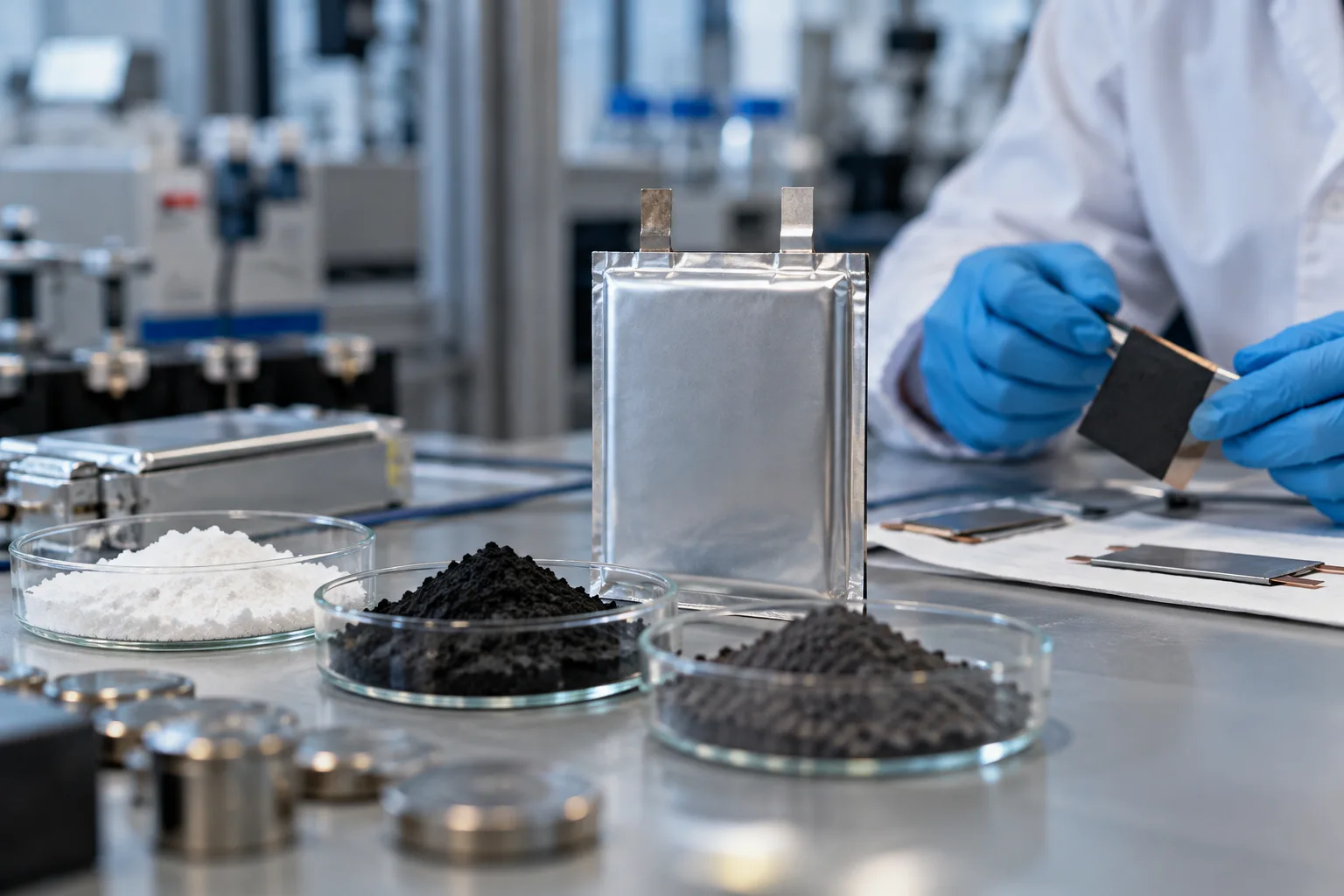
In plain language
A rechargeable battery works by moving charged atoms, called ions, from one side of the cell to the other as it charges and back again as it discharges. Sodium-ion batteries do this with sodium, the same element found in table salt, instead of lithium. Because sodium is plentiful and widely spread around the world, the hope is that these batteries can be cheaper and less exposed to supply problems.
The trade-off is weight. Sodium atoms are heavier and larger than lithium atoms, so a sodium-ion cell usually holds less energy for its weight. That makes them a better fit today for uses such as grid storage, starter batteries and smaller or shorter-range vehicles, where cost, safety and cold-weather performance matter more than squeezing out every last kilometre of range.
Technical explanation
Sodium-ion cells follow the same 'rocking-chair' principle as lithium-ion cells: Na+ ions move through a liquid electrolyte between a cathode and an anode, while electrons flow through the external circuit. Cathode families studied include layered transition-metal oxides, polyanionic phosphates, Prussian blue analogues such as Prussian white, and organic compounds. Graphite, the standard lithium-ion anode, stores sodium poorly, so most cells use hard carbon, a disordered carbon whose pores and defects can host sodium ions.
Commercial announcements have centred on Prussian white or layered-oxide cathodes paired with hard carbon. CATL's 2021 first-generation cell and Northvolt's 2023 cell, developed with Altris, were both reported at around 160 Wh/kg at cell level, and CATL's 2025 Naxtra product is claimed at 175 Wh/kg. These figures are company-reported. A sodium-ion chemistry can also avoid lithium, nickel, cobalt and graphite, which reduces exposure to those supply chains.
The main technical gap is energy density, which drives how much material is needed per kilowatt-hour. A 2025 techno-economic study in Nature Energy modelled more than 6,000 scenarios and found that a near-term price advantage over low-cost lithium-ion cells is difficult, with cost parity more plausible in the 2030s if research raises energy density, and with timelines highly sensitive to lithium, graphite and nickel supply chains.
What the evidence says
Each statement is typed by the strength of its evidence and linked to the source that supports it.
Demonstrated Shown in a published experiment, test or shipping product.
Sodium is abundant and sodium-ion cell chemistry closely resembles lithium-ion chemistry; the research literature reports working cathodes based on layered oxides, phosphates and organic compounds, and anodes based on carbons, metal oxides and sulfides, intermetallics and organics.
Sources: [1] · AbstractReported, unverified Stated by a company or team but not independently confirmed.
CATL reported that its first-generation sodium-ion cell (2021) reaches up to 160 Wh/kg, charges to 80% state of charge in 15 minutes at room temperature, and keeps more than 90% of its capacity at -20 °C, using a Prussian white cathode and a porous hard carbon anode.
Sources: [2] · medium confidenceNorthvolt reported a sodium-ion cell with a hard carbon anode and a Prussian white-based cathode, free of lithium, nickel, cobalt and graphite, validated at over 160 Wh/kg at its own Västerås laboratories and aimed first at energy storage.
Sources: [4] · medium confidenceCATL claims its Naxtra passenger-vehicle sodium-ion battery reaches 175 Wh/kg, exceeds 10,000 cycles, supports a 500 km range and keeps 90% of usable power at -40 °C, and describes it as mass produced.
Sources: [3] · medium confidenceCATL stated in 2021 that its next-generation sodium-ion cell would target energy density above 200 Wh/kg.
Sources: [2] · low confidenceProposed A design or plan that has not yet been built or tested.
The review literature identifies cell design and electrode balancing as remaining obstacles for practical sodium-ion cells, alongside the need for suitable electrolytes, additives and binders.
Sources: [1] · AbstractAcross more than 6,000 modelled scenarios, several sodium-ion development pathways could reach cost parity with low-cost lithium-ion variants in the 2030s, provided targeted research makes substantial progress; the timelines are highly sensitive to lithium, graphite and nickel supply chains.
Sources: [5] · Abstract · medium confidenceA near-term price advantage for sodium-ion over low-cost lithium-ion looks difficult, and raising sodium-ion energy density to cut material intensity is among the most effective ways to improve competitiveness.
Sources: [5] · Abstract · medium confidenceLimitations and open problems
- Lower gravimetric energy density than mainstream lithium-ion cells: the best company-reported figures (about 160 to 175 Wh/kg) are at or below lithium iron phosphate levels.
- A near-term cost advantage over low-cost lithium-ion is not assured; modelled cost parity depends on research progress and on lithium, graphite and nickel supply chains.
- Many headline performance figures, such as cycle life above 10,000 cycles and cold-weather power retention, are company claims without full independent test data.
- Graphite does not work well as a sodium host, so cells depend on hard carbon anodes, whose supply chain and cost are less mature.
- Cell design and electrode balancing remain open engineering problems identified in the research literature.
Possible future uses
Ideas, not predictions. None of these has been demonstrated.
- Low-cost home and community batteries that pair with rooftop solar in regions where lithium-ion supply is expensive.
- Mixed packs that combine sodium-ion and lithium-ion cells so a vehicle gets better cold-weather behaviour without giving up all its range.
- Battery storage for hot climates where better thermal safety could reduce cooling and fire-protection costs.
Timeline
- Jun 2017A major Chemical Society Reviews article surveys sodium-ion electrode materials and makes the case for sodium-ion batteries as an alternative to lithium-ion for energy storage. Sources: [1]
- 29 Jul 2021CATL unveils its first-generation sodium-ion battery, reporting up to 160 Wh/kg at cell level. Sources: [2]
- 21 Nov 2023Northvolt reports a sodium-ion cell, developed with Altris, validated at over 160 Wh/kg at its own laboratories. Sources: [4]
- 13 Jan 2025Researchers publish a Nature Energy analysis of more than 6,000 scenarios for sodium-ion cost competitiveness. Sources: [5]
- 21 Apr 2025CATL launches Naxtra, a sodium-ion battery for passenger vehicles claimed at 175 Wh/kg, describing it as mass produced. Sources: [3]
Futures this could help bring about
Related breakthroughs
Glossary
- Energy density (Wh/kg)
- How much energy a battery stores for each kilogram of weight. Higher numbers mean a lighter battery for the same energy.
- Hard carbon
- A disordered form of carbon with many small pores that can store sodium ions; it is the usual anode in sodium-ion cells.
- Prussian white
- A low-cost cathode material built from iron, sodium and cyanide groups arranged in an open framework that sodium ions can move through.
- Lithium iron phosphate (LFP)
- A widely used, relatively low-cost lithium-ion chemistry that is the main cost competitor for sodium-ion cells.
Sources
- review article
Sodium-ion batteries: present and future
Jang-Yeon Hwang, Seung-Taek Myung, Yang-Kook Sun. Chemical Society Reviews (Royal Society of Chemistry), 19 Jun 2017. DOI: 10.1039/c6cs00776g. Accessed 20 Oct 2026. - company announcement
CATL Unveils Its Latest Breakthrough Technology by Releasing Its First Generation of Sodium-ion Batteries
CATL, 29 Jul 2021. Accessed 20 Oct 2026. - company announcement
Naxtra Battery Breakthrough & Dual-Power Architecture: CATL Pioneers the Multi-Power Era
CATL, 21 Apr 2025. Accessed 20 Oct 2026. - company announcement
Northvolt develops state-of-the-art sodium-ion battery validated at 160 Wh/kg
Northvolt, 21 Nov 2023. Accessed 20 Oct 2026. - peer reviewed paper
Critically assessing sodium-ion technology roadmaps and scenarios for techno-economic competitiveness against lithium-ion batteries
Adrian Yao, Sally M. Benson, William C. Chueh. Nature Energy, 13 Jan 2025. DOI: 10.1038/s41560-024-01701-9. Accessed 20 Oct 2026.
Revision history
3 changes since this profile was created.
What it took to get here
The inventions this technology was built on, oldest foundations at the top. Lines show what each one required.
- 2017Sodium-ion batteriesPilot and early commercialRequires: Lithium-ion batteries. Unlocked.