Cryonics preservation damage: where the problems arise
Cryonics preservation involves several physical and biological challenges. A specimen has a starting condition; chemicals used to limit ice can affect tissue; exposure may vary across a large specimen; and cooling or warming can add physical stress. A report must show what was measured at each step. Naming a method cannot establish recoverability.
Damage can be assessed through structural change, cell viability or tissue function. Retention of information relevant to personal identity is a further question; these are not interchangeable endpoints. The cryonics overview sets out the larger evidence chain.
Starting condition and controlled samples
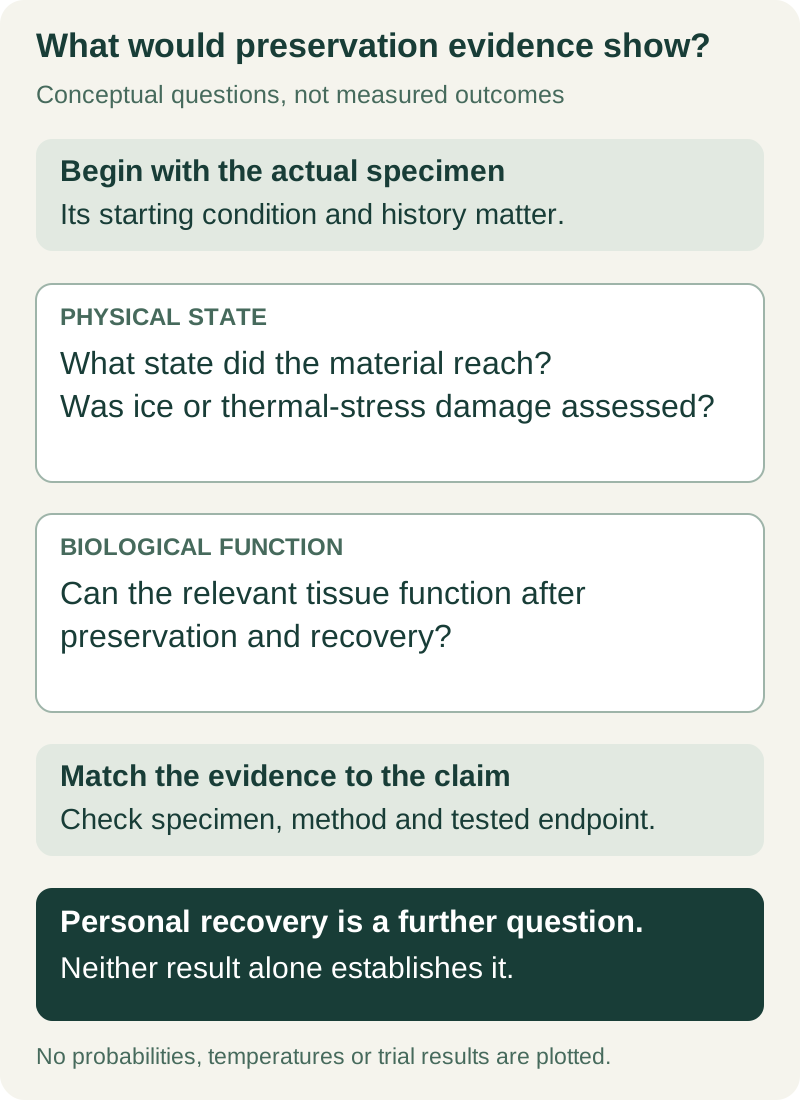
Laboratory studies can begin with selected samples under specified conditions. An individual postmortem case has its own condition and history. Later observations cannot, by themselves, establish what was present at the start or when a change occurred. Case records can document observations and timing, but do not reveal the condition of every region. A controlled experiment also cannot establish that a separate case began in the same state.
This is a conceptual distinction; the reviewed evidence provides no universal description of individual cases. The preservation-report guide explains how to separate planned steps, recorded observations and inferences.
Protectants, distribution and scale
Vitrification aims to form an amorphous, glass-like state rather than crystalline ice. Cryoprotective agents support that physical aim, but exposure can injure tissue. Loading and removal also involve movement of water and dissolved substances. For a larger specimen, the intended exposure at one location does not show what reached the interior; delivery through blood vessels differs from direct exposure of a thin sample.
Han and colleagues’ 2023 rat-kidney study treated cryoprotectant injury as a limiting problem. After vitrification, storage, nanowarming and transplantation, five recipients of nanowarmed kidneys survived the 30-day follow-up, following initial graft dysfunction. This is a functional result for rat kidneys under that protocol, not evidence about every tissue or a human cryonics case. Study
Gangwar and colleagues’ 2025 study reported physical vitrification of selected cryoprotectant volumes up to three litres and nanowarming up to two litres. Porcine livers were vitrified but not rewarmed in that work. Physical scale-up did not demonstrate biological recovery in a large organ. Study record
Ice, warming and the endpoint
Vitrification aims to avoid ice, but does not prove every region reached or retained that state. Warming must also be sufficiently rapid and uniform to limit crystallisation and thermal-stress damage. A 2017 study of inductive heating with magnetic nanoparticles investigated tissue preservation and a warming method, not human revival. Manuchehrabadi and colleagues
| Ask | The answer can show | It leaves open |
|---|---|---|
| What material and starting condition? | Context for later observations | Unmeasured regions and other cases |
| What physical state and warming were assessed? | Conditions measured | Biological function |
| What function was tested after warming? | The tested outcome in that model | Recovery of a person or personal memories |
Physical, structural and biological tests address different endpoints. Even selected functional recovery would not establish personal recovery or continuity of memory. See cryonics, memory and personal continuity and the organ-cryopreservation article for their distinct scopes.
Source scope: scientific sources were reviewed on 22 October 2026 in the canonical cryonics record. This article was adapted on 27 October; the adaptation is not fresh source verification.
Technology profiles
Making sense of biotechnology and synthetic biology
Begin by identifying what is being engineered: a molecule, a cell, a microbial culture or a larger biological system. Then follow the evidence from the experiment to its proposed use. Keep the test setting visible throughout that journey. A result in a controlled culture, an animal study and a human application each answers a different question, with different limits on what can be concluded.
What to check in this field
Questions to take to the evidence
- What biological system was studied, with which controls and endpoints? Check whether the claimed benefit was directly measured or inferred from a related marker.
- Can the process be repeated across batches? Ask about contamination control, stability, separation of the final product and the inputs needed to make it.
- What oversight would the intended use require? Look for the stated containment, environmental assessment or clinical pathway, and keep unresolved requirements visible.
What would make the future useful?
Biological engineering could support new ways to make useful substances or study disease. Assess each proposed use through its own performance, containment and validation requirements; do not assume that success in one organism or application transfers to another.
Explore the field: Precision fermentation · Base and prime gene editing.
Sources
- https://pmc.ncbi.nlm.nih.gov/articles/PMC5470364/
- https://www.nature.com/articles/s41467-023-38824-8?error=cookies_not_supported
- https://pubmed.ncbi.nlm.nih.gov/41006284/
Checked against its sources by Independent AI review and concise edit; adapted from the cryonics source review of 22 October 2026.