Precision fermentation
Also known as Biomanufacturing of animal-identical proteins, Animal-free dairy protein fermentation, Recombinant food proteins, Fermentation-produced whey proteins
Precision fermentation uses microorganisms engineered to make specific animal proteins, such as whey protein, without farmed animals. The FDA's public GRAS notice inventory records 'no questions' responses for some fermentation-made beta-lactoglobulin ingredients with stated food uses. Lab-scale work has also produced recombinant casein at low titre. Evidence on cost and scale-up is still limited.
In plain language
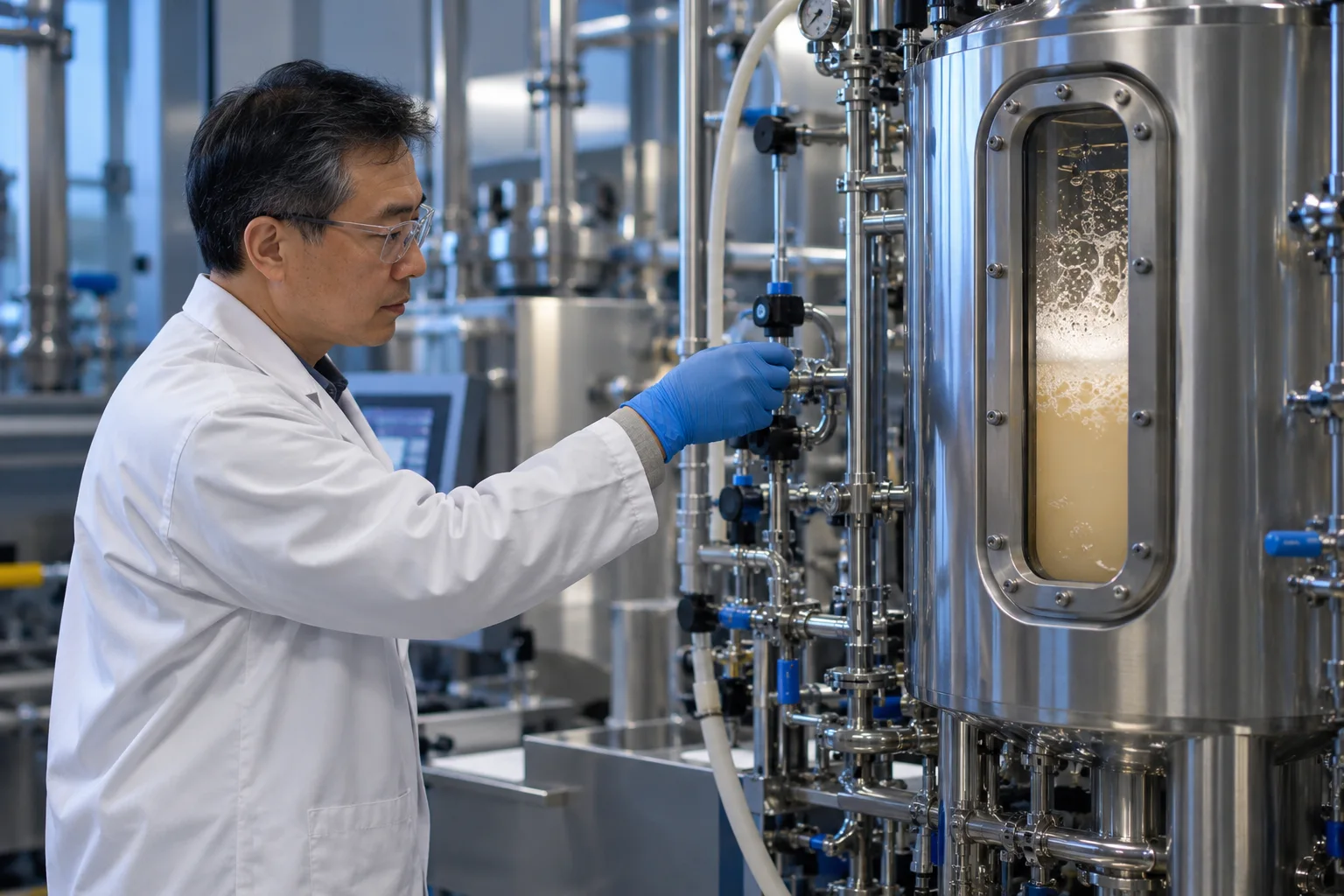
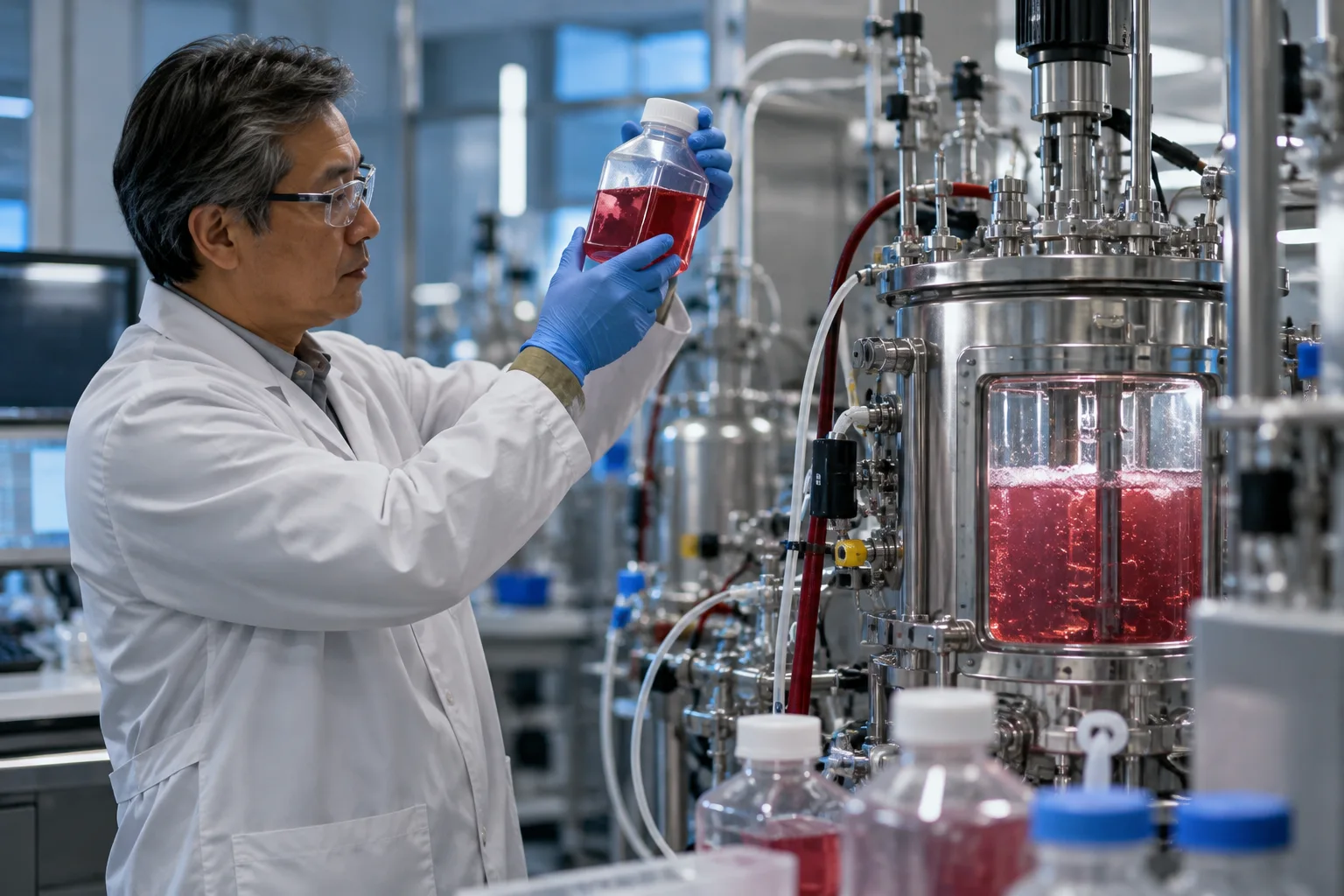
Precision fermentation works a bit like brewing. Scientists give a microorganism, such as a yeast or fungus, the genetic instructions to make one specific protein, for example the main protein found in cow's milk whey. The microorganism is grown in a large tank with sugars and nutrients, and the protein is then filtered out and dried into a powder.
The result can be an ingredient that is chemically the same as the animal version, but without cows being involved in making it. Companies have announced such proteins for dairy products, and US regulatory records now show some of these ingredients with 'no questions' responses from the FDA. Much of the commercial detail still comes from the companies themselves, and the cost of making the proteins at large scale is still an open question.
Technical explanation
The method uses recombinant DNA to place a gene for a target protein, such as beta-lactoglobulin (BLG), into a host organism. Ranjbar (2025) describes how such hosts can produce animal-identical dairy proteins including whey, casein and lactoferrin, and covers host selection, fermentation design, regulatory approval and scale-up as the main technical areas.
Process research is at an earlier stage for some proteins. Biermann and colleagues (2025) produced bovine alpha-S1-casein in a genome-reduced strain of Bacillus subtilis. In high cell-density fed-batch cultures they report a volumetric casein titre of 56.9 mg/L and a yield of 1.6 mg per gram of cell dry weight, after reducing the host's own protein content. The protein was found in the insoluble protein fraction, and its particle size and zeta potential differed from native bovine casein in a pH-dependent way.
Regulatory status is a central issue. In the US, many new food ingredients enter the market through the GRAS (Generally Recognized as Safe) route. The FDA's public GRAS notice inventory lists GRN 1200, a beta-lactoglobulin produced by Komagataella phaffii strain VIPLA and notified by Vivici B.V. The FDA response is recorded as 'no questions', with the inventory closure date of 28 February 2025. The notified intended uses include milk products and substitutes, cheese and substitutes, yoghurt and substitutes, and some meat, fish and egg substitutes, with one maximum use level of up to 50% by weight. Vivici's own announcement, dated 9 April 2025, describes the same clearance. FoodNavigator reports that Verley received an FDA no-questions letter in September 2025 for its FermWhey Native protein, under GRN 1241, after submitting a GRAS notification in early 2025. The article attributes most of the detail to Verley's chief executive. This Verley letter has not yet been checked against the FDA inventory in this profile.
The FDA inventory also holds earlier notices for beta-lactoglobulin from other hosts, including Perfect Day's Trichoderma reesei product (FDA response letter dated 25 March 2020) and company notices for Aspergillus oryzae (dated 11 May 2023) and Komagataella phaffii yRMK-66 (dated 4 March 2022). These notices are company-submitted, so their process and safety conclusions are the notifiers' own.
Demand and perception are also being studied. Broad and colleagues (2022) ran 10 virtual focus groups with 42 participants in the US, UK, Germany and Singapore. Of these, 34 participants from eight early-adopter groups were analysed. Participants raised questions about process, safety, regulation, nutrition and price, and found animal welfare claims the most convincing positive argument. The authors' small sample means the findings describe views rather than measured market demand.
What the evidence says
Each statement is typed by the strength of its evidence and linked to the source that supports it.
Demonstrated Shown in a published experiment, test or shipping product.
Engineered microorganisms can be used to produce animal-identical dairy proteins, including whey, casein and lactoferrin.
Sources: [1]Ranjbar (2025) covers host selection, fermentation design, regulatory approval and scale-up challenges for animal-identical dairy proteins.
Sources: [1] · medium confidenceThe FDA GRAS notice inventory records a 'no questions' response for GRN 1200, a beta-lactoglobulin produced by Komagataella phaffii strain VIPLA and notified by Vivici B.V. Vivici's 2025 announcement says the US FDA has issued a GRAS no-questions letter for its precision-fermented beta-lactoglobulin, Vivitein BLG.
Sources: [6], [4] · FDA GRAS notice inventory, entry GRN 1200, closure date 28 February 2025The GRN 1200 inventory entry lists intended uses that include nutritional beverages and bars, milk products and substitutes, yoghurt and cheese with substitutes, desserts, bakery mixes, and meat, fish and egg substitutes, with a single maximum use level of up to 50% by weight.
Sources: [6] · FDA GRAS notice inventory, entry GRN 1200Recombinant bovine alpha-S1-casein was produced in Bacillus subtilis strain IIG-Bs-20-5-1 in high cell-density fed-batch cultivation, with a volumetric casein titre of 56.9 mg/L and a yield of 1.6 mg casein per gram of cell dry weight, after the host's protein contamination was reduced.
Sources: [5] · AbstractThe casein was detected in the insoluble protein fraction of the genome-reduced strain IIG-Bs-20-5-1, and the recombinant protein showed pH-dependent differences in aggregation behaviour compared with native bovine alpha-S1-casein, measured by zeta potential and particle size.
Sources: [5] · Abstract · medium confidenceFDA's 2020 letter for GRN 000863 says that FDA has no questions at this time about Perfect Day's GRAS conclusion for beta-lactoglobulin produced by Trichoderma reesei, for use as a source of protein in food at levels up to 35%. The notifier states that this substance is not intended for infant formula or products regulated by the USDA.
Sources: [9] · FDA response letter, first pageReported, unverified Stated by a company or team but not independently confirmed.
Verley reports that the FDA sent it a no-questions letter in September 2025 (GRN 1241) for FermWhey Native, after a GRAS notification submitted in early 2025; the figure comes from the company as reported by FoodNavigator.
Sources: [3] · medium confidenceIn a 2022 focus group study with 34 early-adopter participants, people raised questions about process, safety, regulation, nutrition and price, and found animal welfare claims the most convincing positive argument.
Sources: [2] · medium confidenceA 2018 UK survey cited by Broad and colleagues found that 28% of respondents were willing to buy 'synthetic milk' and about 40% rejected it outright.
Sources: [2] · low confidenceThe FDA's 2020 letter for GRN 000863 records Perfect Day's statement that its fermentation-made beta-lactoglobulin is identical to bovine beta-lactoglobulin and will produce a milk-protein allergy in individuals with milk allergies. The GRN 1056 and GRN 1145 notices make similar milk-protein allergy statements.
Sources: [7], [8], [9]The Imagindairy notice describes a manufacturing sequence of fermentation, biomass separation, purification, ultrafiltration or diafiltration, sterile filtration and spray drying, and describes the powder as 60% total protein, of which beta-lactoglobulin is not less than 85%.
Sources: [7] · Manufacturing process and product specification sections · medium confidenceProposed A design or plan that has not yet been built or tested.
Precision fermentation has been proposed as a way to make dairy proteins without dairy cows.
Sources: [1]Limitations and open problems
- Commercial claims beyond the FDA inventory entry for GRN 1200 are company-reported and not confirmed by an independent regulator's public record in this profile (FoodNavigator, 2025; Vivici, 2025). The Verley letter (GRN 1241) is reported by FoodNavigator and has not been checked against an FDA record.
- Clearance in one country, such as the US, does not by itself cover other markets.
- An FDA 'no questions' response covers the notifier's GRAS conclusion, the stated intended uses and use levels, and the conditions described. It does not approve other proteins, production strains or finished products (FDA GRN 1200 inventory entry; FDA letter for GRN 000863, 2020).
- Scale-up from laboratory to industrial production remains an open technical question (Ranjbar, 2025).
- Biermann and colleagues (2025) report a casein titre of 56.9 mg/L in one laboratory study. The protein was found in an insoluble fraction, which adds cell disruption and purification steps. The source does not assess recovery at industrial scale.
- Notifiers describe beta-lactoglobulin as a major milk allergen, and state that the fermentation-made protein can produce a milk-protein allergic response (GRN 1145; GRN 1056; GRN 000863). Notifiers state that labelling will identify the milk allergen, so food allergen labelling requirements still apply.
- Consumer views are mixed, and the best-documented studies are small, with 34 participants analysed in the Broad and colleagues (2022) early-adopter groups.
- A 2018 UK survey cited by Broad and colleagues found that about 28% of respondents were willing to buy 'synthetic milk', while about 40% rejected it outright.
- The sources in this profile do not provide a full life-cycle comparison for a precision-fermented dairy protein. Environmental benefit depends on feedstock, electricity, yield, downstream recovery and the product displaced.
Possible future uses
Ideas, not predictions. None of these has been demonstrated.
- Full dairy product ranges, such as cheese and ice cream, made with only fermentation-derived proteins.
- Egg-white proteins made by fermentation for bakery and food service use.
- Fermentation-made lactoferrin as an ingredient in infant formula, if regulatory routes allow it.
- Fermentation-made casein assembled into micelle-like structures with cheese-making performance.
Product concepts: CO2-to-protein reactor
Timeline
- 25 Mar 2020The FDA sends a response letter on GRN 000863, Perfect Day's beta-lactoglobulin from Trichoderma reesei for use as a source of protein in food at levels up to 35%, stating that it has no questions at this time about the notifier's GRAS conclusion. Sources: [9]
- 4 Mar 2022Remilk Ltd. dates its GRAS notice GRN 1056 for beta-lactoglobulin from Komagataella phaffii strain yRMK-66. Sources: [8]
- 3 Oct 2022Broad and colleagues publish a focus group study on how potential early adopters view precision fermentation for animal-free dairy. Sources: [2]
- 11 May 2023Imagindairy dates its GRAS notice GRN 1145 for beta-lactoglobulin from Aspergillus oryzae strain Ao_st0002, which describes a fermentation, purification and spray-drying process. Sources: [7]
- 2 Jan 2025Biermann and colleagues publish a laboratory study reporting recombinant bovine alpha-S1-casein in Bacillus subtilis, at 56.9 mg/L in fed-batch culture. Sources: [5]
- 28 Feb 2025The FDA GRAS notice inventory closes GRN 1200, a beta-lactoglobulin from Komagataella phaffii strain VIPLA notified by Vivici B.V., with a 'no questions' response. Sources: [6]
- 9 Apr 2025Vivici announces the US commercial launch of its precision-fermented beta-lactoglobulin, and states that the US FDA has issued a GRAS no-questions letter for the product. Sources: [4], [6]
- Sept 2025Verley reports that the FDA issued a no-questions letter (GRN 1241) for its precision-fermented whey proteins, as reported by FoodNavigator. Sources: [3]
Futures this could help bring about
Related breakthroughs
Glossary
- Precision fermentation
- Growing microorganisms that have been engineered to make a specific protein, which is then recovered and used as a food ingredient.
- Beta-lactoglobulin (BLG)
- The main protein in whey, the liquid left over from cheese making.
- Casein
- A family of milk proteins that assemble with minerals into structures important to dairy foods.
- GRAS
- Generally Recognized as Safe, a US status under which a food ingredient can be marketed without a formal premarket approval, based on expert review of its safety.
- No-questions letter
- An FDA response saying the agency has no questions at that time about a notifier's GRAS conclusion under the conditions described. It is not a general approval of the ingredient.
- Host organism
- The microorganism, such as a yeast or fungus, that is engineered to carry the gene for the target protein and produce it.
- Titre
- The concentration of a target product in a fermentation broth or other process stream.
- Downstream processing
- Recovery, purification, concentration and formulation steps after fermentation.
Sources
- review article
Precision Fermentation: The Path to Animal-Identical Dairy Solutions
Reza Ranjbar. IntechOpen, 6 Feb 2025. DOI: 10.5772/intechopen.1009019. Accessed 21 Oct 2026. - peer reviewed paper
Framing the futures of animal-free dairy: Using focus groups to explore early-adopter perceptions of the precision fermentation process
Garrett M. Broad, Oscar Zollman Thomas, Courtney Dillard et al.. Frontiers in Nutrition, 3 Oct 2022. DOI: 10.3389/fnut.2022.997632. Accessed 21 Oct 2026. - company announcement
The New Standard of Protein Has Arrived in the U.S.
Vivici, 9 Apr 2025. Accessed 21 Oct 2026. - peer reviewed paper
Recombinant Production of Bovine αS1-Casein in Genome-Reduced Bacillus subtilis Strain IIG-Bs-20-5-1
Lennart Biermann, Lea Rahel Tadele, Elvio Henrique Benatto Perino et al.. MDPI (Microorganisms), 2 Jan 2025. DOI: 10.3390/microorganisms13010060. Accessed 21 Oct 2026. - government report
GRAS Notice No. 1200: Beta-lactoglobulin produced by Komagataella phaffii strain VIPLA
US Food and Drug Administration, 28 Feb 2025. Accessed 21 Oct 2026. - other
GRAS Notice (GRN) No. 1145: Beta-lactoglobulin produced from Aspergillus oryzae
Imagindairy Ltd. (notice hosted by US FDA), 11 May 2023. Accessed 21 Oct 2026. - other
GRAS Notice (GRN) No. 1056: Non-animal beta-lactoglobulin whey protein from fermentation by Komagataella phaffii
Remilk Ltd. (notice hosted by US FDA), 4 Mar 2022. Accessed 21 Oct 2026. - government report
GRAS Notice No. GRN 000863: FDA response letter on beta-lactoglobulin produced by Trichoderma reesei
US Food and Drug Administration, 25 Mar 2020. Accessed 21 Oct 2026.
Revision history
3 changes since this profile was created.