Fin-array water harvester prototype projects 5.8 litres per kg per day
What was demonstrated
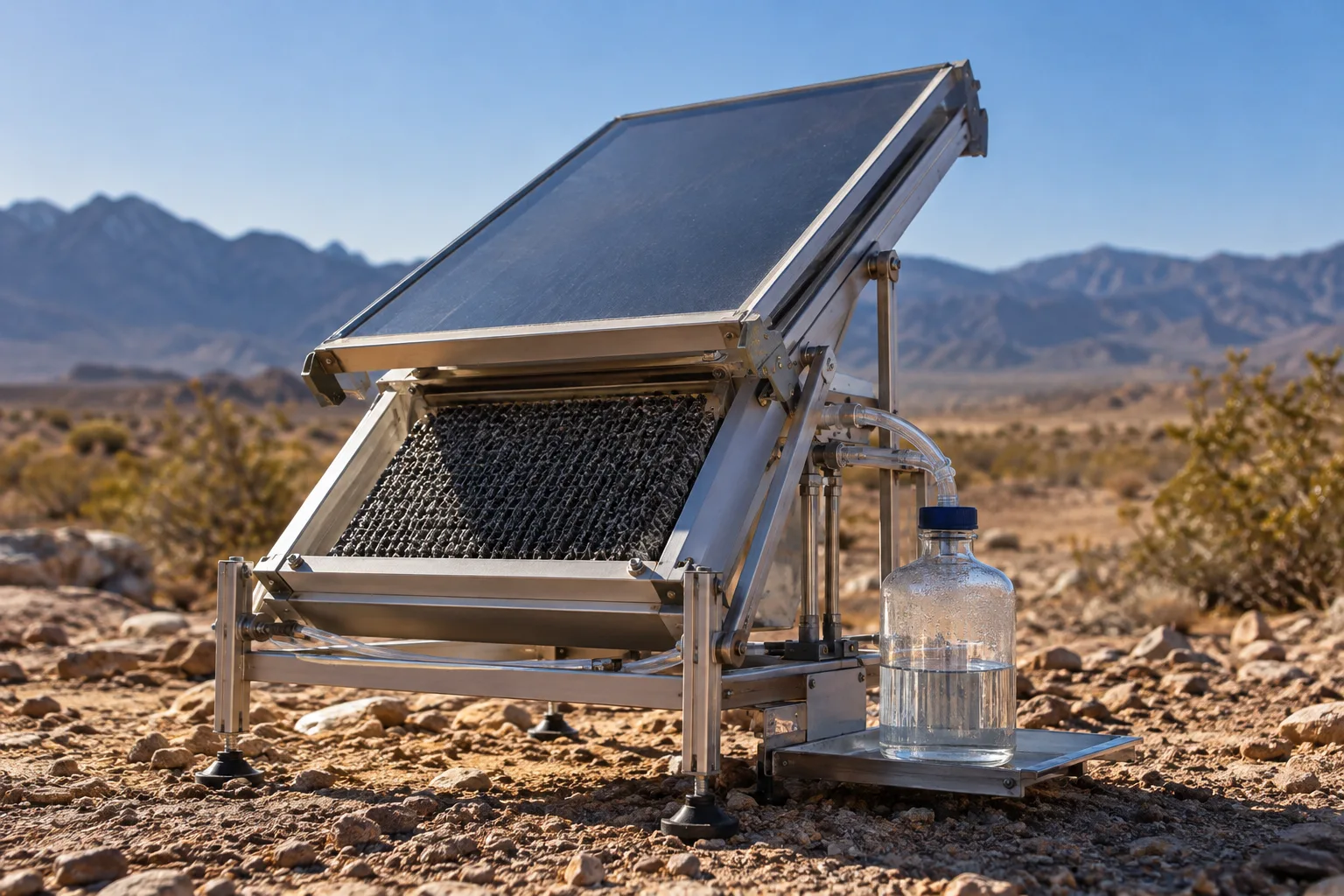
A 10-fin prototype, made from a copper sheet between copper foam layers and coated with AQSOA Z02 zeolite, was tested at small scale. Adsorption reached saturation within 30 minutes in experiment and simulation, and condensate was collected, with heat losses and a lag between vapour generation and collection noted. The authors project that a 1 litre bed holding 230 g of sorbent would yield 5.826 litres of water per kg of sorbent per day at 30% relative humidity, or about 1.3 litres per day per device. These yield figures are modelled and extrapolated from the small prototype, not measured at full size. Desorption was tested experimentally with cartridge heaters in a sealed enclosure, and simulated at 90 degrees C using high-density waste heat, which was not tested.
Why it matters
The fin-array sorbent bed is designed to give high water output per unit of sorbent, which matters where water is scarce. The yield is a design projection that depends on a waste-heat source, and its real output in the field remains untested.
Caveats
- The headline yields (5.826 litres per kg of sorbent per day and about 1.3 litres per day per device) are modelled from a 10-fin prototype and are not measured at 1 litre scale.
- Desorption at 90 degrees C is simulated for high-density waste heat, which was not tested. Experiments used cartridge heaters. Waste heat may not be available in arid or off-grid settings.
- Simulations assume a simplified sorbent isotherm and a sealed desorption system. Field performance under changing outdoor conditions is not reported.
Technology profiles
Sources
- peer reviewed paper
Design of a Compact Multicyclic High-Performance Atmospheric Water Harvester for Arid Environments
Xiangyu Li, Bachir El Fil, Buxuan Li et al.. ACS Energy Letters, 26 Jun 2024. DOI: 10.1021/acsenergylett.4c01061.
Last reviewed 22 Oct 2026.