Genome-reduced Bacillus subtilis reaches 56.9 mg/L of alpha-S1-casein in fed-batch
What was demonstrated
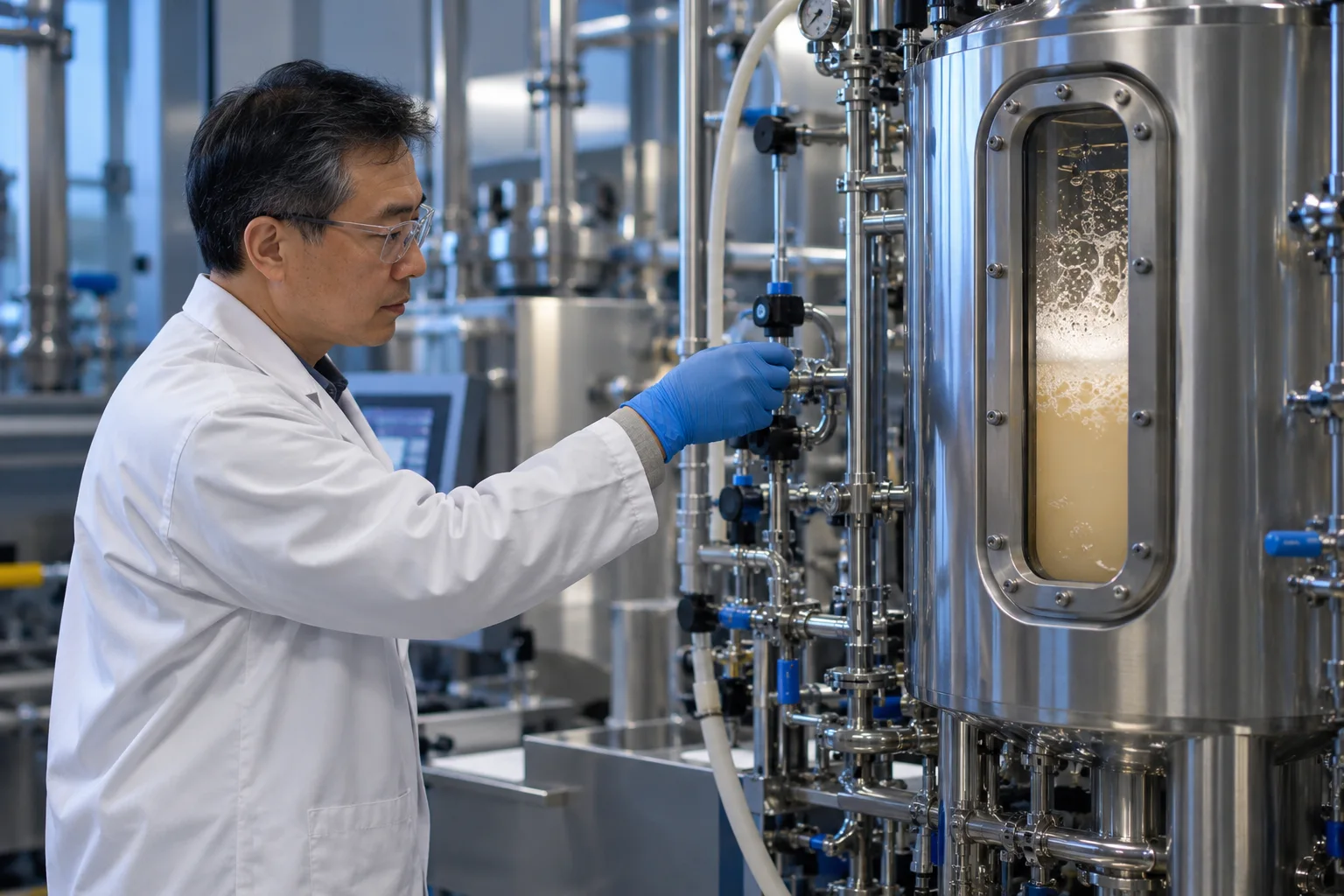
In a 42 litre fed-batch fermenter run in biological duplicate, the genome-reduced Bacillus subtilis strain IIG-Bs-20-5-1 reached a maximum alpha-S1-casein content of 56.9 ± 11.6 mg/L of bovine alpha-S1-casein, measured 22 hours after induction. The paper reports a yield of 2.16 mg casein per gram of cell dry weight, and 1.6 mg per gram after reducing the host's own protein content. It does not clearly state which processing step the 2.16 figure refers to. Casein was detectable only in the insoluble protein fraction, and only in this strain; the non-sporulating comparison strain BMV9 gave no detectable casein.
Why it matters
Producing a food protein in microbes is a separate engineering problem from making a food. The study highlights low titre and an insoluble product as the constraints to solve. The strain comparison suggests the host's background may affect recombinant casein production, but this rests on one pair of strains in one laboratory study.
Caveats
- These are laboratory-scale results from a 42 litre fed-batch run in biological duplicate. The authors did not test a production process or an industrial-scale run.
- The enriched material was about 46.5% pure, with residual B. subtilis proteins still present. The pre-cleanup used urea denaturation, which the authors did not optimise.
- Recombinant and native alpha-S1-casein differed in particle size and zeta potential, with pH-dependent aggregation. The study did not test cheese-making or other food function.
- The paper does not report production cost, energy use or life-cycle impacts.
Technology profiles
Sources
- peer reviewed paper
Recombinant Production of Bovine αS1-Casein in Genome-Reduced Bacillus subtilis Strain IIG-Bs-20-5-1
Lennart Biermann, Lea Rahel Tadele, Elvio Henrique Benatto Perino et al.. MDPI, Microorganisms, 2 Jan 2025. DOI: 10.3390/microorganisms13010060.
Last reviewed 21 Oct 2026.