How close are fridges, heat pumps and air conditioners that avoid high-global-warming-potential refrigerant gases?
Many cooling systems use hydrofluorocarbon (HFC) refrigerants, which the Kigali Amendment is phasing down because they warm the climate. Solid-state methods avoid these gases. Elastocaloric and magnetocaloric prototypes have been tested in the laboratory, and a kilowatt-scale elastocaloric device has been reported. Micro-scale thermoelectric coolers and passive radiative cooling have also shown results. None of the sources reviewed shows a solid-state appliance that matches conventional cooling on efficiency, lifetime and cost, and no commercial product with verified figures was found.
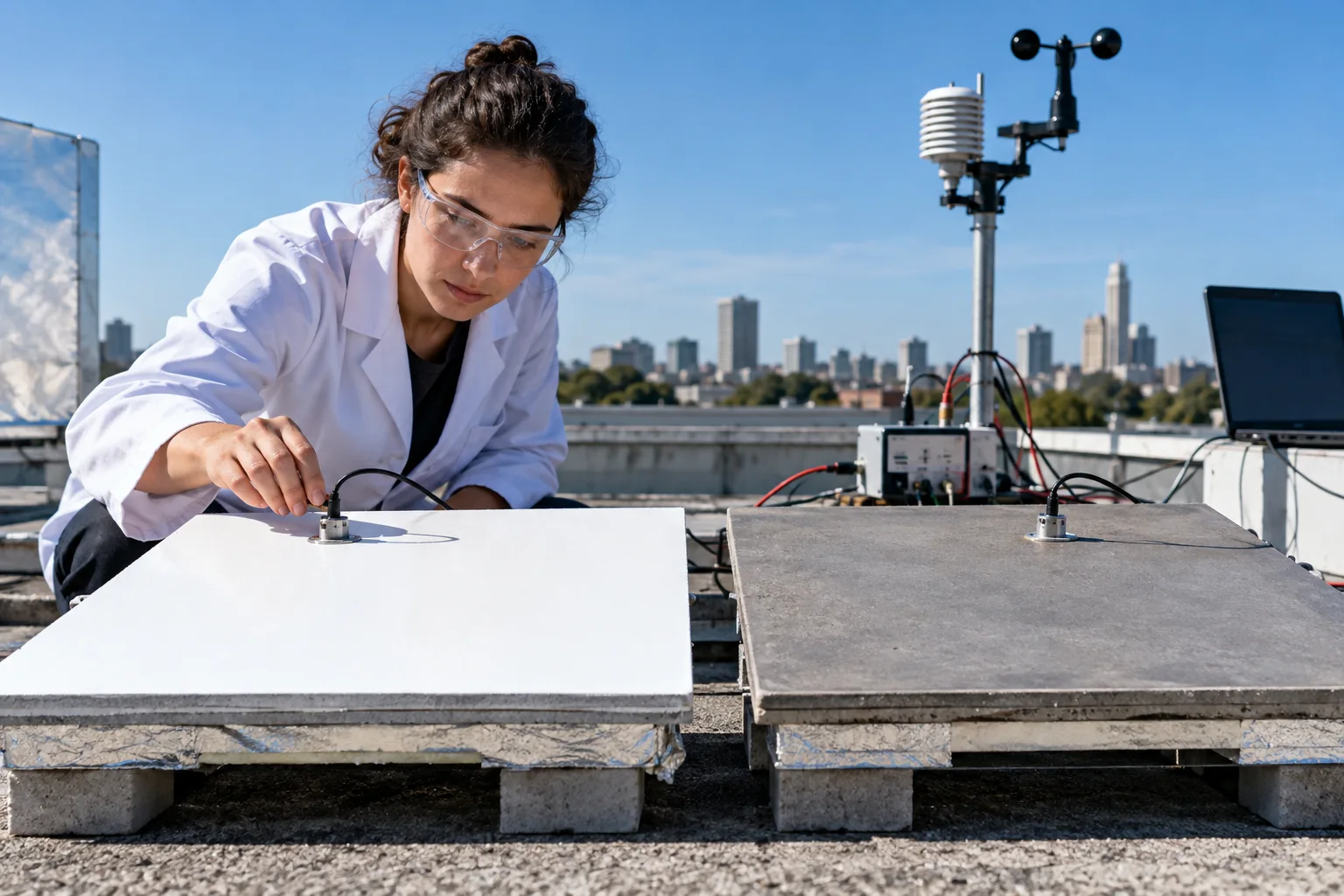
Getting closer. Prototypes exist, but not in real-world use.
Several solid-state cooling devices have been built and tested. Elastocaloric and magnetocaloric systems have been run at kilowatt scale or with measured temperature spans, but in laboratory conditions with short-duration or narrow test results. Thermoelectric coolers have shown high temperature differences only at micro scale. None of the sources reviewed reports an appliance-scale system with full-system efficiency, lifetime and cost data, so the stage is engineering prototype rather than pilot.
The tech tree
Everything recorded on Vrulum that this future needs, oldest foundations at the top and the goal at the bottom. Lines show what each step requires.
- 2008Thermoelectric generatorsPilot and early commercial Unlocked.
- 2014Passive daytime radiative coolingResearch and prototypes Being researched.
- 2023Elastocaloric coolingResearch and prototypes Being researched.
- 2016Phase-down of HFCs agreedDone Unlocked.
- 2018Passive radiative cooling below ambient in outdoor testsDone Unlocked.
- 2024Micro-scale thermoelectric coolers with high temperature differenceDone Unlocked.
- 2025Kilowatt-scale elastocaloric deviceDone Unlocked.
- 2025Magnetocaloric prototype near room temperatureIn progress Being researched.
- Date not recordedFull-system efficiency and lifetime under appliance conditionsNot started Locked.
- Date not recordedCommercial solid-state appliance on saleNot started Locked.
- GoalCooling without climate-warming refrigerantsGoalRequires: Elastocaloric cooling, Thermoelectric generators, Passive daytime radiative cooling, Phase-down of HFCs agreed, Micro-scale thermoelectric coolers with high temperature difference, Passive radiative cooling below ambient in outdoor tests, Magnetocaloric prototype near room temperature, Kilowatt-scale elastocaloric device, Full-system efficiency and lifetime under appliance conditions, Commercial solid-state appliance on sale. Locked.
The road so far
4 of 7 steps done, 1 in progress.
- Done · 2016Phase-down of HFCs agreed
The Kigali Amendment to the Montreal Protocol was adopted on 15 October 2016 and entered into force on 1 January 2019. It covers HFCs. UNEP says developed countries will start reducing HFCs as early as 2019, developing countries follow a later schedule, and all countries will cut HFCs by more than 80 per cent over the next 30 years. [1]
- Done · 4 Dec 2024Micro-scale thermoelectric coolers with high temperature difference
A research highlight in National Science Review describes micro-scale thermoelectric coolers from work by Zhuang et al. It reports a peak temperature difference of up to about 89.3 K and a COP of about 6.6, and says these surpass conventional Bi2Te3 devices, without giving a numerical baseline. The highlight does not give cooling power or the operating conditions for the COP. [4]
- Done · 2018Passive radiative cooling below ambient in outdoor tests
A 2018 Nature Communications study reported a directional passive radiative cooler with a minimum temperature 6 °C below ambient and a maximum cooling power of 45 W/m², measured around solar noon with a polished aluminium disk and an infrared-transparent cover. It is a test device, not a refrigerator or air conditioner. [5]
- In progress · Oct 2025Magnetocaloric prototype near room temperature
A 2025 Case Studies in Thermal Engineering paper describes a reciprocating magnetic refrigerator with a linearly moving Halbach magnet array and gadolinium. It reached a temperature span of 2.197 K with no load, and a maximum cooling power of 7.90 W when the span was close to 0 K. Its best COP was 1.32 at moderate cooling. The useful span and cooling power have not been shown together in the sources reviewed. [3]
- Done · Mar 2025Kilowatt-scale elastocaloric device
Zhou et al. report a multi-cell elastocaloric device made of tubular nickel-titanium alloy, with a specific cooling power of 12.3 W/g at 3.5 Hz and a fluid-side cooling power of 1,284 W at zero temperature lift during the first 500,000 cycles. The authors say existing devices are limited to about 300 W or less. The 1,284 W figure is a fluid-side value at zero lift, not a full-system rating. [2]
- Not startedFull-system efficiency and lifetime under appliance conditions
The sources reviewed give COP values only at specific test conditions. They do not report full-system COP across a range of operating conditions, nor fatigue or lifetime testing of a complete appliance-scale elastocaloric or magnetocaloric unit. [2][3]
- Not startedCommercial solid-state appliance on sale
No commercial fridge, heat pump or air conditioner using a solid-state method with verified cooling figures was found in the sources opened for this page. Any company claim would need to be labelled as a claim and checked against independent test data.
Why it matters
Cooling equipment that uses HFCs adds to warming, and the Kigali Amendment sets a schedule for cutting those gases. UNEP says the phase-down is expected to avoid up to 0.5 °C of global warming by the end of the century. Solid-state or passive cooling could remove the need for these gases, but only if it reaches the efficiency, cost and reliability that buyers expect.
What stands in the way
- Fatigue of shape-memory alloys under repeated loading has not been shown over an appliance lifetime in the sources reviewed.
- The magnetocaloric prototype reached a span of 2.197 K with no load and 7.90 W of cooling power at a span close to 0 K. A useful span and useful cooling power have not been reported together.
- Thermoelectric results so far are at micro scale. Coefficient of performance at appliance scale is not reported in the sources reviewed.
- Passive radiative cooling depends on the sky and the surface, and the 2018 result was measured around solar noon under set conditions.
- Elastocaloric cooling powers are reported at zero temperature lift, so a full-system rating for a building or appliance is still needed.
Signals to watch
- A full-system COP and lifetime test for an elastocaloric or magnetocaloric appliance, published with its operating conditions.
- A magnetocaloric prototype that reports a useful temperature span and cooling power in the same test.
- A peer-reviewed thermoelectric result at larger scale, with stated COP and temperature span.
- Independent test data for any commercial solid-state product, not only company claims.
- Changes to the HFC phase-down schedule published by the UNEP Ozone Secretariat.
Sources
- government report
Kigali Amendment to the Montreal Protocol
UNEP Ozone Secretariat, 2016. - peer reviewed paper
Achieving kilowatt-scale elastocaloric cooling by a multi-cell architecture
Guoan Zhou, Lingyun Zhang, Zexi Li et al.. Nature, Mar 2025. - peer reviewed paper
Experimental investigation and performance analysis of a reciprocating magnetic refrigerator
H. Aras, A. Zaim. Case Studies in Thermal Engineering, Oct 2025. - other
Cooler, stronger, smaller: improving thermoelectric cooling
Nagendra Singh Chauhan, Takao Mori. National Science Review, 4 Dec 2024. - peer reviewed paper
Passive Directional Sub-Ambient Daytime Radiative Cooling
Bikramjit S. Bhatia, Arny Leroy, Yichen Shen et al.. Nature Communications, 27 Nov 2018.
Last reviewed 22 Oct 2026.