Passive daytime radiative cooling
Also known as PDRC, Daytime radiative cooling, Sub-ambient radiative cooling, Cooling paint
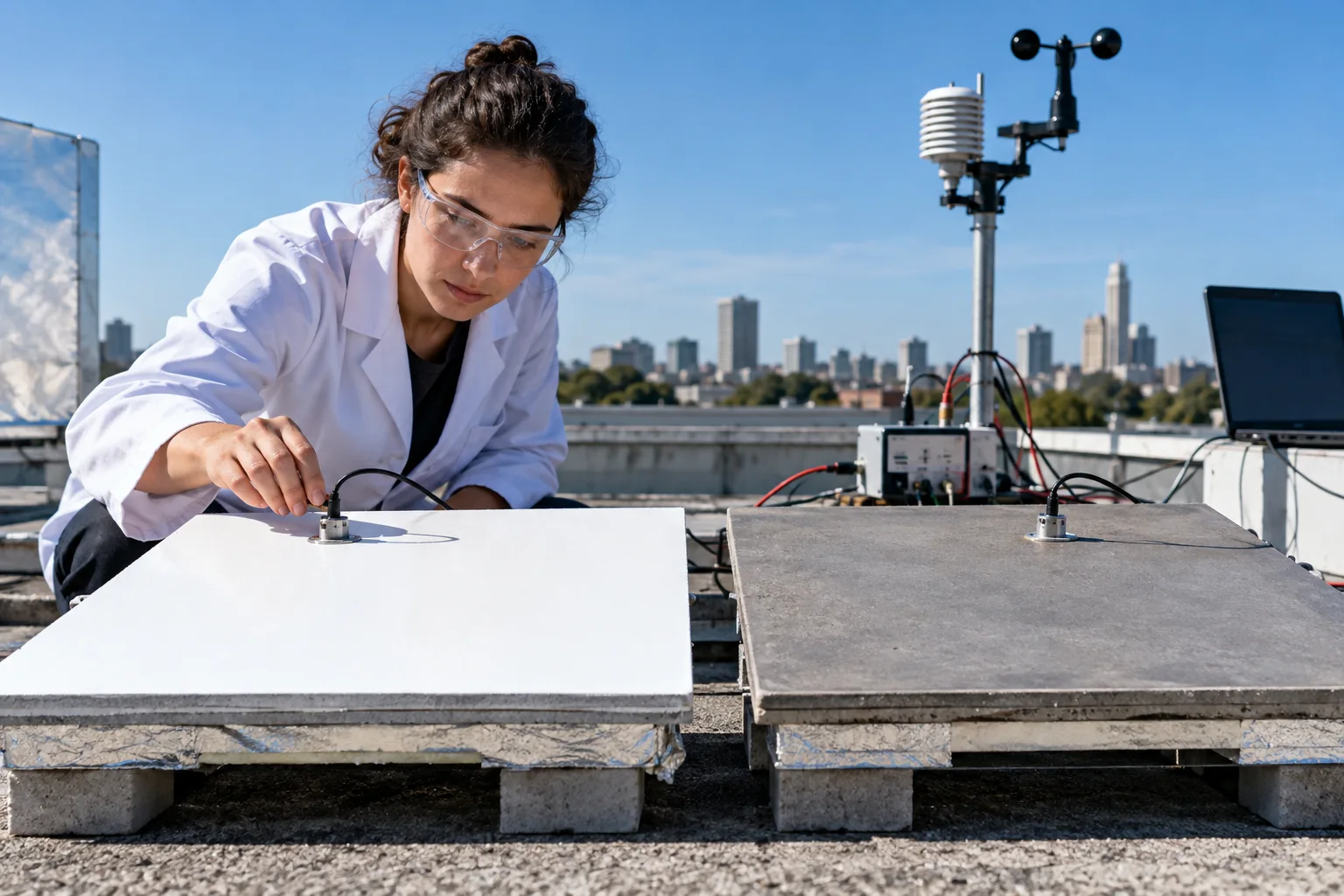
Passive daytime radiative cooling uses surfaces that reflect almost all sunlight while giving off heat as infrared light that escapes through the atmosphere into space. Laboratory and rooftop tests have cooled surfaces several degrees below the surrounding air in full sun without using electricity.
In plain language
Everything warm gives off heat as invisible infrared light. On a clear night, a roof or car can lose so much heat this way that it becomes colder than the air around it, which is why frost can form even when the air is above freezing. During the day, though, sunlight usually heats surfaces far more than they can shed.
Radiative cooling materials solve this by doing two things at once. They reflect nearly all incoming sunlight, so they barely warm up, and they strongly give off infrared heat at wavelengths the atmosphere lets straight through into cold outer space. The result is a surface that can sit below air temperature even at midday, with no power supply. Examples range from layered optical films to very white paints.
Technical explanation
Sub-ambient daytime cooling needs a surface with very high solar reflectance and high thermal emittance in the 8 to 13 µm atmospheric window, where the clear sky is largely transparent and the surface can radiate towards the cold of space. Net cooling power is the emitted thermal radiation minus absorbed sunlight, absorbed atmospheric radiation and heat gained from the surrounding air by convection and conduction. Because sunlight delivers far more power than the surface can radiate, even a few per cent of absorbed sunlight can cancel the cooling.
The first daytime demonstration, published in 2014, used a seven-layer hafnium oxide and silicon dioxide photonic stack that reflected 97% of sunlight and cooled 4.9 °C below ambient under more than 850 W/m² of sunlight. Later work moved to scalable materials: a polymer film filled with glass microspheres and backed with silver (93 W/m² at noon, made roll-to-roll), porous fluoropolymer coatings made by phase inversion (about 6 °C below ambient), and barium sulfate paints that reflect up to 98.1% of sunlight.
Field performance depends strongly on humidity, cloud cover, wind and how the surface is insulated from the air. Coatings also face ultraviolet damage, thermal ageing, dirt and chemical attack, all of which reduce reflectance over time. Reviews call for common lab, field and simulation protocols so that results and economic claims can be compared fairly.
What the evidence says
Each statement is typed by the strength of its evidence and linked to the source that supports it.
Demonstrated Shown in a published experiment, test or shipping product.
A seven-layer hafnium oxide and silicon dioxide photonic structure reflected 97% of sunlight and cooled 4.9 °C below ambient air temperature under direct sunlight above 850 W/m² on a rooftop, with a cooling power of 40.1 W/m² at ambient temperature.
Sources: [1] · AbstractA polymer film embedded with randomly placed glass microspheres and backed with silver reached an infrared emissivity above 0.93 and a noontime radiative cooling power of 93 W/m² under direct sunshine, and was produced by roll-to-roll manufacturing.
Sources: [2] · AbstractPorous P(VdF-HFP) polymer coatings made by phase inversion showed solar reflectance of 0.96 ± 0.03 and long-wave infrared emittance of 0.97 ± 0.02, giving sub-ambient temperature drops of about 6 °C under 890 W/m² of sunlight and cooling powers of about 96 W/m² under 750 W/m².
Sources: [3] · AbstractBarium sulfate nanoparticle films reached 97.6% solar reflectance and 0.96 sky-window emissivity, staying more than 4.5 °C below ambient in field tests or giving an average cooling power of 117 W/m²; a barium sulfate acrylic paint at 60% volume concentration reached 98.1% solar reflectance and 0.95 emissivity.
Sources: [4] · AbstractUltraviolet exposure, thermal ageing, surface contamination and chemical corrosion degrade the high solar reflectance that radiative cooling coatings depend on.
Sources: [6] · Abstract · medium confidenceA hierarchically structured PMMA film with micropores and nanopores was reported for daytime and night-time passive radiative cooling.
Sources: [8]A nanoprocessed silk textile was reported for sub-ambient daytime radiative cooling.
Sources: [9]Reported, unverified Stated by a company or team but not independently confirmed.
The Purdue team reports that higher barium sulfate concentrations make the paint easier to break or peel, leaving little room to make it whiter without compromising it.
Sources: [5] · medium confidenceProposed A design or plan that has not yet been built or tested.
Purdue researchers estimate that covering a roof of about 1,000 square feet with their barium sulfate paint could give around 10 kW of cooling power; this is a projection rather than a measured building result.
Sources: [5] · medium confidenceDaytime radiative cooling for the built environment is described as still in its infancy, and reviewers call for uniform lab, field and simulation protocols so that performance and economic claims can be compared.
Sources: [7] · Abstract · medium confidenceLimitations and open problems
- Cooling power is modest, roughly 40 to 120 W/m² in the reported tests, so large areas are needed to make a meaningful difference to building loads.
- Performance falls in humid or cloudy conditions, where the atmospheric window is less transparent.
- Ultraviolet exposure, thermal ageing, dirt and chemical corrosion can reduce solar reflectance over time, and small losses in reflectance cut cooling sharply.
- Very high filler loadings that maximise whiteness make paints more prone to cracking or peeling.
- Results are hard to compare because test methods, climates and reporting differ between studies.
- A cool surface does not necessarily cool a building interior or device; thermal coupling and insulation determine useful system performance.
- Laboratory and outdoor sample tests do not establish durability, maintenance needs or energy savings over the life of a commercial installation.
Possible future uses
Ideas, not predictions. None of these has been demonstrated.
- Cool roofs on homes in hot regions that cut or replace air-conditioning use during peak demand.
- Coatings for solar panels and battery enclosures that lower operating temperatures and slow heat-driven degradation.
- Radiative cooling panels that chill water or air for buildings with little or no electricity.
- City-wide use on roofs and pavements to reduce urban heat island effects.
Product concepts: Robotic cool-roof coating applicator, Sun-reflective cooling panels for outdoor clothing, Rechargeable drinks bottle that cools itself
Timeline
- 26 Nov 2014Researchers publish the first demonstration of radiative cooling below ambient air temperature under direct sunlight. Sources: [1]
- 10 Mar 2017A glass-polymer hybrid metamaterial film shows 93 W/m² noontime cooling and is made by roll-to-roll manufacturing. Sources: [2]
- 19 Oct 2018Hierarchically porous polymer coatings made by a simple phase-inversion process show about 6 °C sub-ambient cooling. Sources: [3]
- 12 Jan 2021A structured PMMA film for daytime and night-time passive radiative cooling is reported in Nature Communications. Sources: [8]
- 15 Apr 2021Purdue University reports barium sulfate paints reflecting up to 98.1% of sunlight, with barium sulfate films staying more than 4.5 °C below ambient in field tests. Sources: [4], [5]
- 16 Aug 2021Researchers report a nanoprocessed silk textile designed for sub-ambient daytime radiative cooling. Sources: [9]
- 26 Dec 2023A review in Advanced Science sets out environmental ageing as a key barrier and surveys strategies for durable coatings. Sources: [6]
Futures this could help bring about
Related breakthroughs
Glossary
- Atmospheric window
- A range of infrared wavelengths, roughly 8 to 13 micrometres, at which the clear atmosphere lets heat radiation pass out to space.
- Solar reflectance
- The fraction of incoming sunlight a surface reflects instead of absorbing.
- Thermal emittance
- How effectively a surface gives off heat as infrared radiation compared with an ideal emitter.
- Sub-ambient cooling
- Cooling a surface to a temperature below that of the surrounding air.
- Emissivity
- How effectively a surface emits thermal radiation compared with an ideal emitter at the same temperature.
Sources
- peer reviewed paper
Passive radiative cooling below ambient air temperature under direct sunlight
Aaswath P. Raman, Marc Abou Anoma, Linxiao Zhu et al.. Nature, 26 Nov 2014. DOI: 10.1038/nature13883. Accessed 20 Oct 2026. - peer reviewed paper
Scalable-manufactured randomized glass-polymer hybrid metamaterial for daytime radiative cooling
Yao Zhai, Yaoguang Ma, Sabrina N. David et al.. Science (AAAS), 10 Mar 2017. DOI: 10.1126/science.aai7899. Accessed 20 Oct 2026. - peer reviewed paper
Hierarchically porous polymer coatings for highly efficient passive daytime radiative cooling
J. Mandal, Y. Fu, A. C. Overvig et al.. Science (AAAS), 19 Oct 2018. DOI: 10.1126/science.aat9513. Accessed 20 Oct 2026. - peer reviewed paper
Ultrawhite BaSO4 Paints and Films for Remarkable Daytime Subambient Radiative Cooling
Xiangyu Li, Joseph Peoples, Peiyan Yao et al.. ACS Applied Materials & Interfaces, 15 Apr 2021. DOI: 10.1021/acsami.1c02368. Accessed 20 Oct 2026. - university press release
The whitest paint is here – and it's the coolest. Literally.
Kayla Wiles. Purdue University News Service, 15 Apr 2021. Accessed 20 Oct 2026. - review article
Anti-Environmental Aging Passive Daytime Radiative Cooling
J. Song, Q. Shen, H. Shao et al.. Advanced Science, 26 Dec 2023. DOI: 10.1002/advs.202305664. Accessed 20 Oct 2026. - review article
Daytime Radiative Cooling: A Perspective toward Urban Heat Island Mitigation
I. Kousis, R. D'Amato, A. L. Pisello et al.. ACS Energy Letters, 5 Jul 2023. DOI: 10.1021/acsenergylett.3c00905. Accessed 20 Oct 2026. - peer reviewed paper
A structural polymer for highly efficient all-day passive radiative cooling
Xiaobo Li, Jingyu Peoples, Po-Chun Hsu et al.. Nature Communications, 12 Jan 2021. DOI: 10.1038/s41467-020-20646-7. Accessed 22 Oct 2026. - peer reviewed paper
Subambient daytime radiative cooling textile based on nanoprocessed silk
Lili Cai, Aaswath P. Raman, Shanhui Fan. Nature Nanotechnology, 16 Aug 2021. DOI: 10.1038/s41565-021-00987-0. Accessed 22 Oct 2026.
Revision history
5 changes since this profile was created.