How far are we from humans landing on Mars?
Four people flew around the Moon on Artemis II in April 2026, but no crewed mission has yet travelled to Mars. NASA's architecture pages give no date for a human Mars landing. SpaceX has set out a plan with dates, but Musk has since said that its first uncrewed Starships are more likely about three and a half years away than in 2026. The main gaps are reusable heavy rockets, refuelling in orbit and life support for multi-month missions.
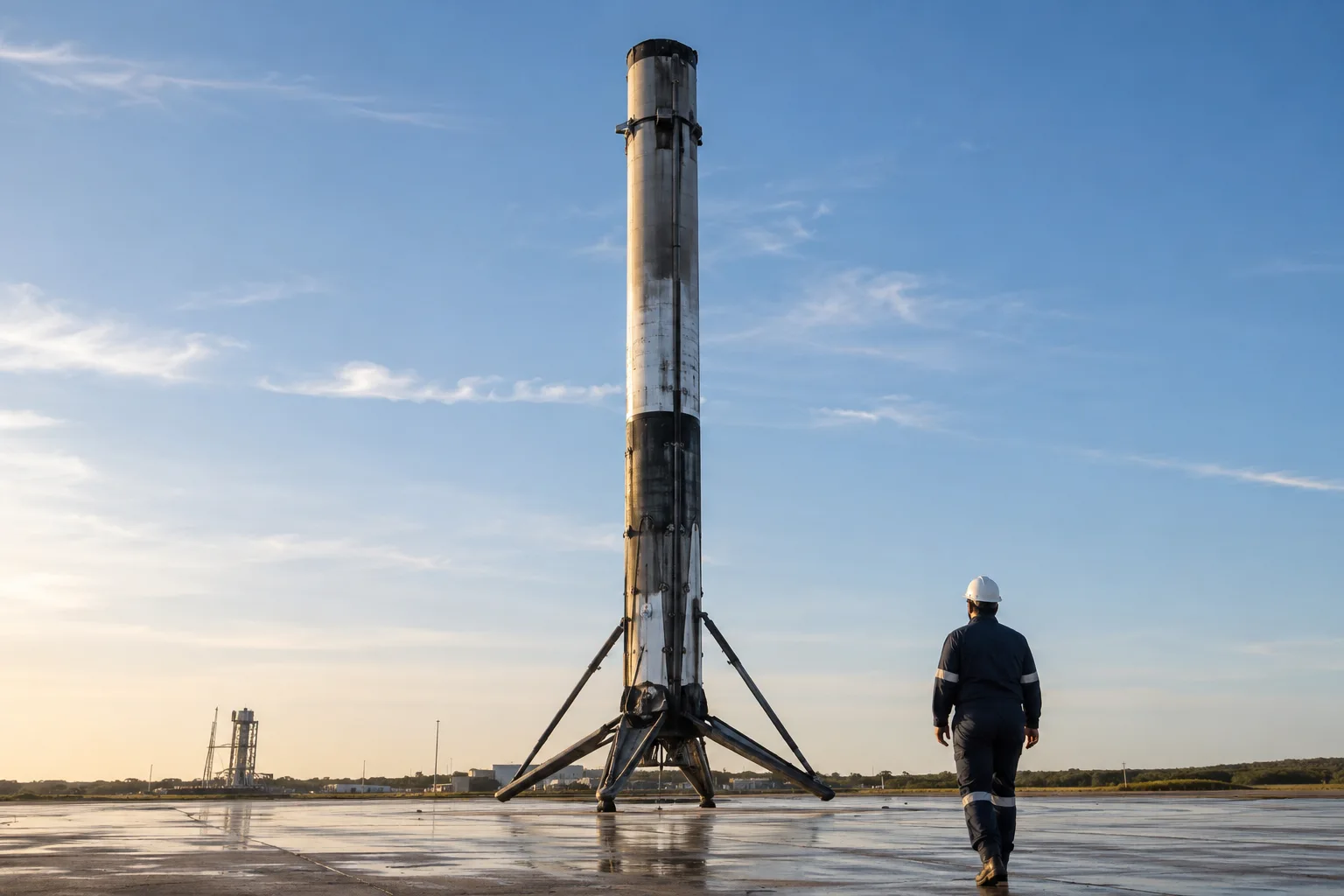
Getting closer. Prototypes exist, but not in real-world use.
Crewed flight beyond low Earth orbit has been shown, most recently on Artemis II in April 2026. Rockets intended for Mars are still in flight testing, and transfer of propellant between two spacecraft in orbit, which a Mars mission would need, has not been shown. No crewed spacecraft has been built or flown for Mars, so the stage is engineering prototype.
The tech tree
Everything recorded on Vrulum that this future needs, oldest foundations at the top and the goal at the bottom. Lines show what each step requires.
- 1964Reusable launch vehiclesPilot and early commercialRequires: In-space manufacturing. Unlocked.
- 2021Making oxygen and fuel on MarsResearch and prototypes Being researched.
- 2024Propellant transfer inside one spacecraftDone Unlocked.
- 2026Crewed flight beyond low Earth orbitDone Unlocked.
- Date not recordedCrewed lunar surface missionsNot started Locked.
- Date not recordedPropellant transfer between two spacecraft in Earth orbitNot started Locked.
- Date not recordedUncrewed spacecraft reaching MarsNot started Locked.
- Date not recordedCrewed landing on MarsNot started Locked.
- Date not recordedCrewed return from MarsNot started Locked.
- GoalHumans landing on MarsGoalRequires: Reusable launch vehicles, Making oxygen and fuel on Mars, Crewed flight beyond low Earth orbit, Crewed lunar surface missions, Propellant transfer inside one spacecraft, Propellant transfer between two spacecraft in Earth orbit, Uncrewed spacecraft reaching Mars, Crewed landing on Mars, Crewed return from Mars. Locked.
The road so far
2 of 7 steps done.
- Done · 1 Apr 2026Crewed flight beyond low Earth orbit
NASA's Artemis II carried four crew members on a crewed lunar flyby. It launched on 1 April 2026 and splashed down on 10 April 2026, after a flight of 9 days, 1 hour and 32 minutes. [1]
- Not startedCrewed lunar surface missions
NASA's architecture places Mars after a sequence of lunar missions, including missions that extend surface operations. Crewed lunar surface missions have not yet been carried out under that programme. [2]
- Done · 2024Propellant transfer inside one spacecraft
SpaceX moved 5 metric tonnes of propellant between two tanks within one Starship in 2024, according to Aerospace America. [4]
- Not startedPropellant transfer between two spacecraft in Earth orbit
A Mars-bound ship needs its tanks refilled in orbit from tanker flights. SpaceX has said a full-scale transfer between two Starships is planned for 2026. The sources reviewed show that it has not yet been demonstrated. [4]
- Not startedUncrewed spacecraft reaching Mars
SpaceX has proposed sending uncrewed Starships to Mars in the 2026 Earth-Mars launch window. Musk later said that this was more likely in about three and a half years, according to Aerospace America. [4]
- Not startedCrewed landing on Mars
No crewed mission has been designed to land on Mars and flown there. SpaceX has put forward a plan for a first crewed landing, and NASA's architecture pages give no date for one. [3][4]
- Not startedCrewed return from Mars
Crews would need a way to leave the surface or a return vehicle prepared in advance. No such system has been tested at Mars.
Why it matters
A crewed Mars landing would test life support, radiation protection, long transit times and return launches, all far from quick help. What is learned would shape how space agencies and companies plan later missions. It would also move Mars from a target for robots to a place where people work.
What stands in the way
- Refuelling in Earth orbit has not been demonstrated, and a Mars-bound ship would need many tanker flights to fill.
- No crewed Mars mission has yet tested radiation shielding, which matters over months of transit and on the surface.
- Life support and food must work for years without resupply from Earth.
- Landing a heavy crewed vehicle on Mars has not been tested, and Mars entry is harder than a lunar landing.
- A return from Mars must be planned and tested before crews are sent.
Published forecasts
What others have predicted. These are their estimates, not ours.
| Who | Forecast | Timeframe | Made |
|---|---|---|---|
| Elon Musk (SpaceX) | First humans could land on Mars as soon as 2029, under a step-by-step plan that Musk described. Musk later said the uncrewed 2026 target was more likely in about three and a half years, and that the next flight carrying humans was about five and a half years away. [4] | 2029 | 1 Oct 2025 |
Signals to watch
- A full-scale transfer of propellant between two spacecraft in Earth orbit.
- An uncrewed spacecraft reaching Mars and landing intact.
- NASA setting a dated schedule for a crewed Mars mission in place of the open-ended segment.
- Crewed lunar surface missions completed, which would test landing and surface operations first.
- Life support and radiation protection flight-tested on a mission lasting several months.
Sources
- government report
Artemis II: NASA's First Crewed Lunar Flyby in 50 Years
NASA, 6 Oct 2026. - government report
Moon to Mars Architecture - Components
NASA, 25 Mar 2026. - government report
Architecture White Papers
NASA, 19 Oct 2026. - news
A Closer Look at SpaceX's Mars Plan
Jon Kelvey. Aerospace America (AIAA), 1 Oct 2025.
Last reviewed 21 Oct 2026.