How far are we from removing a billion tonnes of CO2 a year?
Direct air capture plants are operating, but the largest one in the International Energy Agency's 2022 count captured about 4,000 tonnes of CO2 a year. That count listed 18 operating facilities in Canada, Europe and the United States. A billion tonnes a year is roughly 250,000 times the capacity of that largest plant.
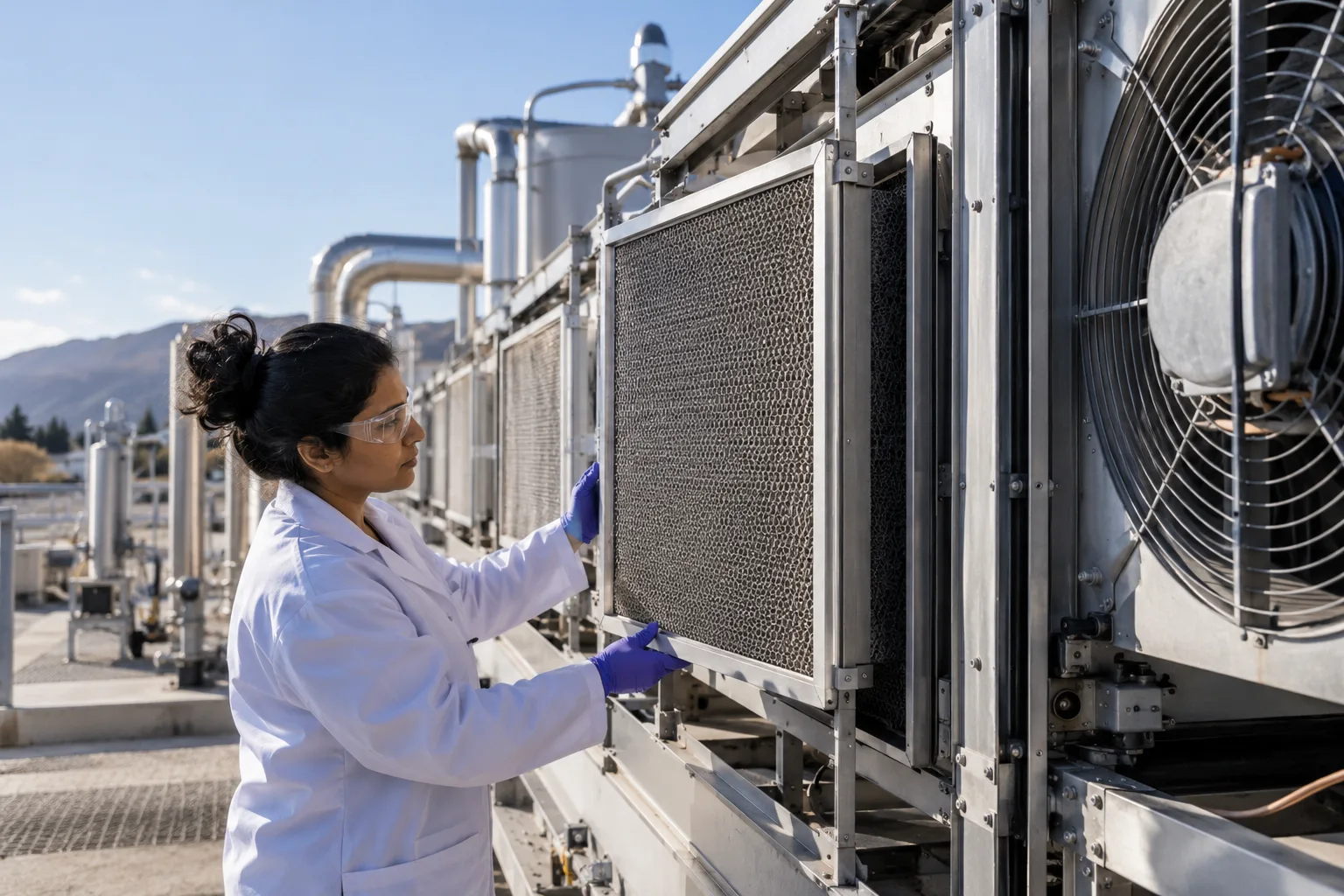
Close. Early pilots are running in the real world.
Several plants capture CO2 from air and store it, and the IEA counted 18 operating facilities in 2022. The largest of these captured about 4,000 tonnes a year for storage. The sources reviewed show storage in basalt rock has been demonstrated at a single injection site in Iceland, and that the US government has announced funding for four hubs designed to capture at least 1 Mt a year each. No plant at that size is shown as operating in the sources reviewed, so the stage is pilot rather than scaling.
The tech tree
Everything recorded on Vrulum that this future needs, oldest foundations at the top and the goal at the bottom. Lines show what each step requires.
- 2016Permanent mineral storage demonstrated in basaltDone Unlocked.
- 2018Process design for capturing CO2 from ambient air publishedDone Unlocked.
- 2022Operating direct air capture plants in placeDone Unlocked.
- Date not recordedUS regional DAC hubs announcedIn progress Being researched.
- Date not recordedSingle plant capturing 1 Mt of CO2 a yearNot started Locked.
- Date not recordedMore than 85 Mt of CO2 a year from DAC in the IEA scenario for 2030Not started Locked.
- Date not recordedAround 980 Mt of CO2 a year from DAC in the IEA scenario for 2050Not started Locked.
- Date not recordedVerified removal and storage across many sitesNot started Locked.
- GoalRemoving a billion tonnes of CO2 a yearGoalRequires: Direct air capture of CO2, Process design for capturing CO2 from ambient air published, Permanent mineral storage demonstrated in basalt, Operating direct air capture plants in place, US regional DAC hubs announced, Single plant capturing 1 Mt of CO2 a year, More than 85 Mt of CO2 a year from DAC in the IEA scenario for 2030, Around 980 Mt of CO2 a year from DAC in the IEA scenario for 2050, Verified removal and storage across many sites. Locked.
The road so far
3 of 8 steps done, 1 in progress.
- Done · Aug 2018Process design for capturing CO2 from ambient air published
Keith and colleagues published A Process for Capturing CO2 from the Atmosphere in Joule in 2018. The sources reviewed do not show a plant using that process operating. [1]
- Done · Jun 2016Permanent mineral storage demonstrated in basalt
At the CarbFix site in Iceland, over 95% of the injected CO2 mineralised into carbonate minerals in less than two years, according to the Science paper. The result depends on basalt rock that reacts quickly with CO2. [2]
- Done · 2022Operating direct air capture plants in place
The IEA counted 18 operating DAC facilities in Canada, Europe and the United States in its 2022 report. The largest, in Iceland, captured about 4,000 tonnes of CO2 a year for storage. [3]
- In progressUS regional DAC hubs announced
The US Department of Energy's Regional DAC Hubs programme plans four hubs, each with the potential to capture at least 1 Mt of CO2 a year. A $1.8 billion funding announcement was issued in December 2024. The page reviewed does not name any selected hubs. [4]
- Not startedSingle plant capturing 1 Mt of CO2 a year
No operating DAC plant at this capacity appears in the sources reviewed.
- Not startedMore than 85 Mt of CO2 a year from DAC in the IEA scenario for 2030
The IEA Net Zero Emissions by 2050 Scenario has DAC capturing more than 85 Mt of CO2 a year in 2030. This is a scenario projection, not a measured outcome.
- Not startedAround 980 Mt of CO2 a year from DAC in the IEA scenario for 2050
The IEA Net Zero Emissions by 2050 Scenario has DAC capturing around 980 Mt of CO2 a year in 2050. This is a scenario projection, not a measured outcome.
- Not startedVerified removal and storage across many sites
Needs independent measurement of net removal and of storage at many sites. The sources reviewed do not show this yet.
Why it matters
Removing CO2 that is already in the air is one way to lower atmospheric CO2 over time, and it could offset emissions that are hard to cut. The IEA's Net Zero Emissions by 2050 Scenario includes direct air capture at a large scale, so the gap between today's plants and that scenario is a measure of how much work remains. Tracking that gap tells people whether the technology is growing in step with climate goals or falling behind them.
What stands in the way
- Scale gap: the largest plant in the IEA's 2022 count captured about 4,000 tonnes a year, against a scenario figure of around 980 Mt a year in 2050.
- Energy demand: the IEA says DAC has higher energy needs and costs than other capture applications, and that its costs depend on the price of heat and electricity.
- Storage geology: the CarbFix result depends on basalt rock. Other sites need their own proof of storage.
- Funding timing: the DOE page reviewed does not name selected hubs, so the timing of new large plants is open.
- Verification: the sources reviewed do not show independent measurement of net removal at scale.
Published forecasts
What others have predicted. These are their estimates, not ours.
| Who | Forecast | Timeframe | Made |
|---|---|---|---|
| International Energy Agency, Net Zero Emissions by 2050 Scenario | Scenario projection of more than 85 Mt of CO2 a year captured by DAC in 2030 [3] | 2030 | 2022 |
| International Energy Agency, Net Zero Emissions by 2050 Scenario | Scenario projection of around 980 Mt of CO2 a year captured by DAC in 2050 [3] | 2050 | 2022 |
Signals to watch
- A plant publishes measured annual CO2 removal that an independent party has verified.
- DOE names selected Regional DAC Hubs and they reach construction.
- An updated IEA or similar report gives DAC capacity figures for a stated year after 2022.
- Storage results from a second site outside basalt, with published monitoring data.
- Plant operators publish cost per tonne using a stated method.
Sources
- peer reviewed paper
A Process for Capturing CO2 from the Atmosphere
David W. Keith, Geoffrey Holmes, David St. Angelo et al.. Joule (Cell Press), Aug 2018. - peer reviewed paper
Rapid carbon mineralization for permanent disposal of anthropogenic carbon dioxide emissions
JM Matter, M Stute, SÓ Snæbjörnsdottir et al.. Science (AAAS), Jun 2016. - government report
Direct Air Capture 2022
International Energy Agency, 2022. - government report
Regional Direct Air Capture Hubs
US Department of Energy, Office of Clean Energy Demonstrations, Dec 2024.
Last reviewed 21 Oct 2026.