Direct air capture of CO2
Also known as Direct air capture, DAC, Atmospheric CO2 capture
Direct air capture uses chemical sorbents to pull carbon dioxide from ambient air and concentrate it for storage. The technology is at an early commercial stage, and cost per tonne and energy use are the main open questions.
In plain language
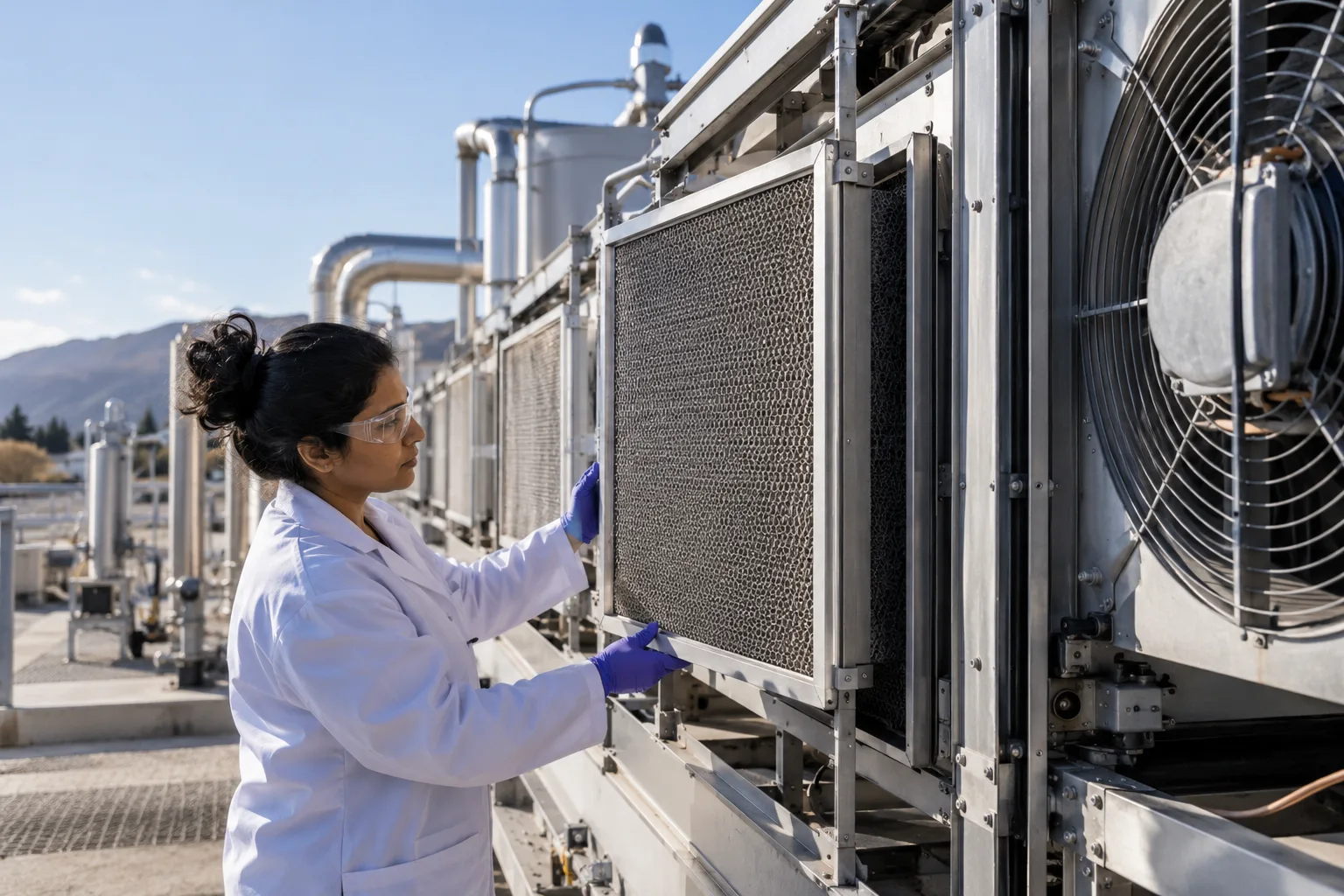
Carbon dioxide is present in air at a low concentration, so a capture machine has to move a large volume of air to collect a useful amount. Direct air capture plants use a material that binds CO2 as air passes over it. The material is then heated or treated to release a concentrated stream of CO2, which can be stored underground.
This differs from capturing CO2 at a power station chimney, where the gas is far more concentrated. Because direct air capture starts from a low concentration, it needs more energy and equipment for each tonne removed. The US National Academies treat it as one of four categories of negative emissions technologies, meaning methods that remove carbon from the air rather than only reducing new emissions.
Technical explanation
The sources reviewed here describe chemical capture using sorbents, which are solid or liquid materials that take up CO2 from air. Sanz-Pérez and colleagues (2016) review direct capture of CO2 from ambient air in Chemical Reviews. After capture comes regeneration, usually using heat or a change in conditions, which releases concentrated CO2 and lets the sorbent be reused.
The National Academies (2019) describe chemical direct air capture as a way to capture CO2 directly from the air and then sequester it in geologic reservoirs. Keith and colleagues (2018) propose a process design for capturing CO2 from the atmosphere. The design shows how the individual steps could be connected, but its performance has not been demonstrated at commercial scale in the sources reviewed here.
Laboratory work is also testing new sorbent designs. Li and colleagues (2024) report charged sorbents in Nature: activated carbon cloth loaded with hydroxide ions by electrochemical charging. The loaded material binds CO2 from air as bicarbonate or carbonate, and the conductive carbon can be regenerated by passing an electric current through it (Joule heating), at 90 to 100 °C as stated in the paper's abstract. These are small laboratory samples. The study shows material-level behaviour, not a complete capture plant, and it does not establish energy use or cost at system scale.
In September 2024 the US Department of Energy issued a notice of intent for its Regional Direct Air Capture Hubs programme. The notice anticipates up to US$1.8 billion for Regional Direct Air Capture Hubs, with a minimum 50% cost-sharing from awardees. It anticipates mid-scale facilities capturing 2,000 to 25,000 tons of CO2 per year and large-scale facilities capturing at least 25,000 tons per year. These are planned topic areas, not results.
What the evidence says
Each statement is typed by the strength of its evidence and linked to the source that supports it.
Demonstrated Shown in a published experiment, test or shipping product.
The National Academies' 2019 preface describes chemical direct air capture as using chemical processes to capture CO2 directly from the air and then sequester it in geologic reservoirs.
Sources: [3] · PrefaceLi and colleagues (2024) prepared charged sorbents by applying +0.565 volts versus the standard hydrogen electrode for four hours in 6 M potassium hydroxide to activated carbon cloth, then washing and drying the electrode.
Sources: [5] · Methods, sorbent preparationLi and colleagues (2024) report that the charged sorbent captured CO2 from ambient air through (bi)carbonate formation, and that it can be regenerated at 90 to 100 °C, including by direct Joule heating.
Sources: [5] · AbstractIn a simulated temperature-pressure swing test, the charged sorbent completed 150 adsorption and desorption cycles, with adsorption at 30 °C and desorption at 100 °C, using dry 30% CO2 in nitrogen. This is a simulated gas mixture with much higher CO2 than air, not a field test.
Sources: [5] · Simulated temperature-pressure swing experimentIn thermogravimetric tests with 400 ppm CO2 in simulated dry air at 30 °C, the charged sorbent captured about 0.2 mmol of CO2 per gram, and this capacity was stable over repeated cycles. These are laboratory measurements on small samples.
Sources: [5] · Ambient-air (direct air capture) tests · medium confidenceWater vapour reduces CO2 uptake in the charged sorbent. Under direct-air-capture conditions in the authors' humidity tests, capacity fell from roughly 0.14 to 0.08 mmol of CO2 per gram as relative humidity rose from 11% to 38%. The authors attribute this mainly to water filling the pores and blocking access to hydroxide sites, rather than to material degradation.
Sources: [5] · Humidity experiments · medium confidenceThe authors report about 10% loss of CO2 capacity after the charged sorbent was stored for 14 months following preparation.
Sources: [5] · Storage stability tests · medium confidenceIn the authors' kinetic measurements, the charged sorbent saturates rapidly, so a relatively short adsorption cycle time should be used.
Sources: [5] · Discussion and limitationsReported, unverified Stated by a company or team but not independently confirmed.
The authors estimate a minimum sorbent heating energy of 6.5 GJ per tonne of CO2 at 11% relative humidity and 11.4 GJ per tonne at 38% relative humidity, and describe this as comparable to other DAC processes. The estimate covers sorbent heating only.
Sources: [5] · Energy estimate · medium confidenceProposed A design or plan that has not yet been built or tested.
Keith and colleagues (2018) propose a process for capturing CO2 from the atmosphere.
Sources: [2] · TitleThe US Department of Energy anticipates up to US$1.8 billion for Regional Direct Air Capture Hubs, with a minimum 50% cost-sharing from awardees.
Sources: [4] · Notice summary, Anticipated Funding Amount and Expected Funding sectionsThe Department of Energy notice anticipates mid-scale facilities capturing 2,000 to 25,000 tons of CO2 per year and large-scale facilities capturing at least 25,000 tons per year.
Sources: [4] · Expected topic areas · medium confidenceLimitations and open problems
- Cost per tonne is the central barrier. The sources reviewed here do not give verified cost figures.
- CO2 is dilute in air, so large volumes of air must be handled. The energy and equipment needed per tonne are not quantified in the sources reviewed.
- Captured CO2 must be stored or used. Without a storage route, capture does not remove carbon from the atmosphere permanently.
- The Department of Energy figures come from a notice of intent. They describe planned funding and expected facility sizes, not awarded projects or built plants.
- Sorbent durability over many capture and release cycles is an open engineering question. The 2024 charged-sorbent study reports 150 cycles, but in a simulated gas mixture with 30% CO2. Its ambient-air capture cycling covered ten cycles, so long-term durability in ambient air is not shown.
- The charged-sorbent results come from small laboratory samples of activated carbon cloth. The study does not show uniform charging or performance across larger sheets or packed beds.
- The authors report lower saturation capacity than the benchmark sorbents they compare against and say the material saturates quickly, so short adsorption cycles are needed. Capacity must rise to improve energy efficiency, according to the authors.
- Water vapour reduces CO2 uptake in the charged-sorbent tests, mainly by blocking hydroxide sites in the pores. Humidity has to be managed in any real air-handling system.
- The authors estimate a minimum sorbent heating energy of 6.5 GJ per tonne of CO2 at 11% relative humidity and 11.4 GJ per tonne at 38% relative humidity. This covers sorbent heating only, so it does not give the energy for the full process.
Possible future uses
Ideas, not predictions. None of these has been demonstrated.
- Shared CO2 processing hubs where several capture units feed one storage or conversion site, similar to the infrastructure scaling platforms described in the DOE notice.
- Pairing capture units with geothermal or waste-heat sources to supply the heat needed for sorbent regeneration.
- Supplying captured CO2 as a feedstock for fuels or building materials where storage is not the chosen route.
- Modular capture cartridges that hold charged sorbent and are regenerated with renewable electricity through direct Joule heating. This is a product hypothesis from laboratory work and has not been demonstrated.
Timeline
- 25 Aug 2016Sanz-Pérez and colleagues publish a review of direct capture of CO2 from ambient air in Chemical Reviews. Sources: [1]
- Aug 2018Keith and colleagues publish a process design for capturing CO2 from the atmosphere in Joule. Sources: [2]
- 2019The National Academies publish a research agenda on negative emissions technologies that treats direct air capture as one of four categories. Sources: [3]
- 5 Jun 2024Li and colleagues publish charged sorbents in Nature: electrochemically loaded activated carbon that captures CO2 from air and regenerates at 90 to 100 °C in laboratory tests. Sources: [5]
- 20 Sept 2024The US Department of Energy issues a notice of intent planning up to US$1.8 billion for regional direct air capture hubs. Sources: [4]
Futures this could help bring about
Related breakthroughs
Glossary
- Sorbent
- A material that takes up a gas or liquid on its surface or within its structure.
- Negative emissions
- Removing carbon dioxide from the atmosphere, rather than only reducing new emissions.
- Regeneration
- Releasing captured CO2 from a sorbent so that the sorbent can be used again.
- Geologic storage
- Injecting CO2 into deep rock formations where it is kept out of the atmosphere.
- Charged sorbent
- A porous material loaded with reactive ions by electrochemical charging, so that it can bind CO2 when exposed to air.
- Joule heating
- Heating caused by electrical current passing through a resistive material.
- Capture capacity
- The amount of CO2 a given mass of sorbent can bind under specified conditions.
Sources
- review article
Direct Capture of CO2 from Ambient Air
Eloy S. Sanz-Pérez, Christopher R. Murdock, Stephanie A. Didas et al.. Chemical Reviews, 25 Aug 2016. DOI: 10.1021/acs.chemrev.6b00173. Accessed 21 Oct 2026. - peer reviewed paper
A Process for Capturing CO2 from the Atmosphere
David W. Keith, Geoffrey Holmes, David St. Angelo et al.. Joule, Aug 2018. DOI: 10.1016/j.joule.2018.05.006. Accessed 21 Oct 2026. - other
Negative Emissions Technologies and Reliable Sequestration: A Research Agenda
National Academies Press, 2019. Accessed 21 Oct 2026. - government report
Notice of Intent to Issue Funding Opportunity: Regional Direct Air Capture Hubs – Recurring Program
US Department of Energy, Office of Clean Energy Demonstrations, 20 Sept 2024. Accessed 21 Oct 2026. - peer reviewed paper
Capturing carbon dioxide from air with charged-sorbents
Huaiguang Li, Mary E. Zick, Teedhat Trisukhon et al.. Nature, 5 Jun 2024. DOI: 10.1038/s41586-024-07449-2. Accessed 21 Oct 2026.
Revision history
6 changes since this profile was created.