How far are we from organ-on-chip and organoid tests replacing animal tests in drug development?
Lab models built from human cells have shown useful results in drug safety testing. A double-blind study of a liver organ-on-chip reported strong results for predicting drug-induced liver injury, but on a subset of the drugs tested and with wide uncertainty. Bill text for the FDA Modernization Act 2.0, which was enacted as part of Public Law 117-328 in December 2022, replaces the explicit reference to animal tests in one drug-approval provision with the term 'nonclinical tests'. In April 2025 the FDA set out a plan to reduce, refine or potentially replace animal tests, starting with monoclonal antibodies. The plan is a roadmap, not a completed rule change. As of the most recent source reviewed, the liver chip had been accepted into an FDA pilot at the letter-of-intent stage but had not reached full qualification. The sources reviewed do not show animal testing replaced for most uses.
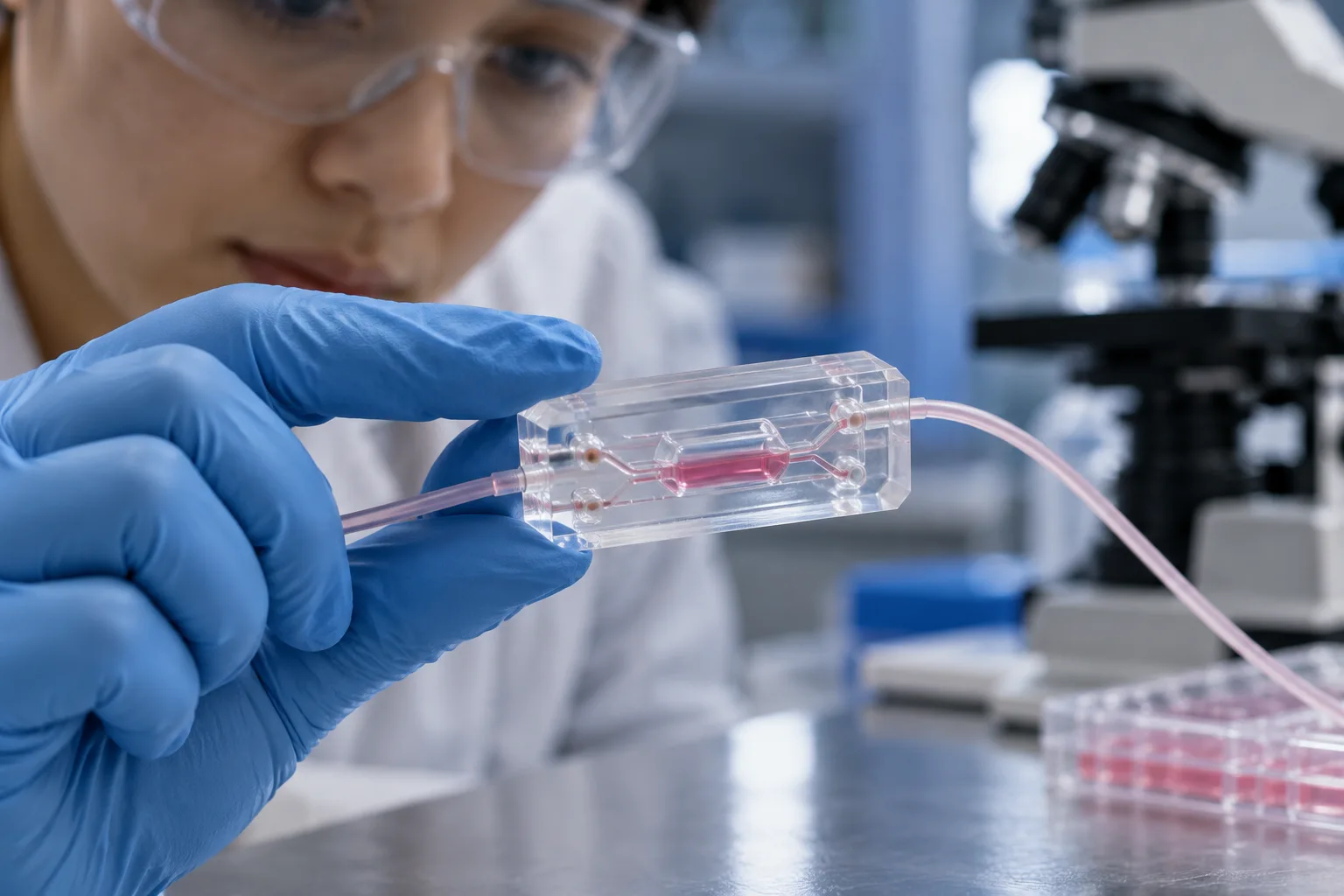
Close. Early pilots are running in the real world.
The science has been shown for one organ and one class of drugs: a double-blind study of 870 Liver-Chips across 27 small-molecule drugs reported results for predicting liver injury. Several of the paper's authors are affiliated with pharmaceutical companies. The FDA has announced a pilot for monoclonal antibody developers, but the sources reviewed do not confirm that it has started. Formal regulatory qualification of a chip for a defined use has not been granted in the sources reviewed, and the FDA roadmap has not yet been turned into rules, so the stage is pilot rather than widespread use.
The tech tree
Everything recorded on Vrulum that this future needs, oldest foundations at the top and the goal at the bottom. Lines show what each step requires.
- 2010Organ-on-a-chipPilot and early commercial Unlocked.
- 2013Brain organoidsLab demonstration Being researched.
- 2022Human liver chip predicts drug liver injury in a double-blind studyDone Unlocked.
- 2022Bill text replaces animal-test wording in the drug application rulesDone Unlocked.
- 2024Liver chip accepted into FDA ISTAND pilot at letter-of-intent stageDone Unlocked.
- 2025FDA roadmap to reduce animal testing for monoclonal antibodiesDone Unlocked.
- Date not recordedPilot for monoclonal antibody developers using mainly non-animal testingIn progress Being researched.
- Date not recordedFull FDA qualification of an organ chip for a defined useNot started Locked.
- Date not recordedValidation for large molecules and biologicsNot started Locked.
- GoalReplacing animal testing with lab-grown human tissueGoalRequires: Organ-on-a-chip, Brain organoids, Human liver chip predicts drug liver injury in a double-blind study, Bill text replaces animal-test wording in the drug application rules, FDA roadmap to reduce animal testing for monoclonal antibodies, Pilot for monoclonal antibody developers using mainly non-animal testing, Liver chip accepted into FDA ISTAND pilot at letter-of-intent stage, Full FDA qualification of an organ chip for a defined use, Validation for large molecules and biologics. Locked.
The road so far
4 of 7 steps done, 1 in progress.
- Done · Dec 2022Human liver chip predicts drug liver injury in a double-blind study
A double-blind study of 870 Liver-Chips across 27 small-molecule drugs reported 87% sensitivity and 100% specificity for predicting drug-induced liver injury. The 87% and 100% figures come from the authors' two-donor analysis of 18 drugs. The 95% confidence interval for sensitivity is wide, from 61.5% to 96.0%. [4]
- Done · 29 Dec 2022Bill text replaces animal-test wording in the drug application rules
The FDA Modernization Act 2.0 bill text reviewed (S. 5002) replaces 'preclinical tests (including tests on animals)' with 'nonclinical tests' in a drug-approval provision. It defines nonclinical tests as tests conducted in vitro, in silico or in chemico, and says these may include animal tests. The enacted law is Public Law 117-328, enacted on 29 December 2022. The enacted section was not checked line by line, so the final wording in the law is not confirmed. [2][3]
- Done · 10 Apr 2025FDA roadmap to reduce animal testing for monoclonal antibodies
On 10 April 2025 the FDA announced a plan to reduce, refine or potentially replace animal testing requirements in drug development, starting with monoclonal antibodies. The release names AI-based toxicity models, cell line and organoid testing, and organ-on-a-chip systems as alternatives. It is a plan, and the release says guidance updates are expected to roll out in phases. [1]
- In progressPilot for monoclonal antibody developers using mainly non-animal testing
The FDA said it aims to launch, over the coming year, a pilot for select monoclonal antibody developers using a primarily non-animal testing strategy under close FDA consultation. The sources reviewed do not confirm that the pilot has started or reported results. [1]
- Done · Nov 2024Liver chip accepted into FDA ISTAND pilot at letter-of-intent stage
Emulate's Liver-Chip S1 was accepted into the FDA ISTAND pilot programme at the letter-of-intent stage. ISTAND has three stages: letter of intent, qualification plan and full qualification. The company's article says the chip has moved on to the qualification plan stage. Acceptance is not full qualification. [5]
- Not startedFull FDA qualification of an organ chip for a defined use
Full qualification would let a chip be used in regulatory submissions within a stated context of use. It depends on qualification plan results showing reproducibility across laboratories and hepatocyte donors, which have not been reported in the sources reviewed. [5]
- Not startedValidation for large molecules and biologics
The Liver-Chip study tested only small-molecule drugs. The authors say performance against large molecules and biologics should be investigated further. Monoclonal antibodies are biologics, so this gap bears directly on the FDA plan. [4]
Why it matters
Animal tests do not always predict human outcomes. Models built from human cells could help identify some drug risks earlier and reduce the number of animals used. For patients, that could mean safer drugs reaching trials sooner. For researchers and companies, it would change which tests are needed before a drug is first used in people.
What stands in the way
- The chip's PDMS plastic may bind some small-molecule drugs, which could lower the dose the cells receive. The authors say this may matter for a subset of compounds, but they found it did not greatly reduce predictive value, and they recommend checking binding.
- The Liver-Chip study tested only small molecules. The authors say large molecules and biologics need further investigation, and monoclonal antibodies are biologics.
- The chip includes Kupffer cells but no wider immune component. The authors say adding resident and circulating immune cells could improve predictive power, and they excluded one immune-mediated drug from the study.
- Results depend on the cell donor. The study used hepatocytes from three donors, and some drugs were toxic in only one donor.
- Formal regulatory qualification is incomplete. In the most recent source reviewed, the liver chip had passed only the letter-of-intent stage of the ISTAND pilot.
Published forecasts
What others have predicted. These are their estimates, not ours.
| Who | Forecast | Timeframe | Made |
|---|---|---|---|
| US Food and Drug Administration | The FDA said that over the coming year it aims to launch a pilot for select monoclonal antibody developers using a primarily non-animal testing strategy. The release says guidance updates are expected to roll out in phases, but it does not give dates for them. [1] | 2025–2026 | 10 Apr 2025 |
Signals to watch
- Results from the FDA pilot for monoclonal antibody developers.
- A chip reaching full FDA qualification for a stated context of use.
- Qualification plan data showing results across several laboratories and hepatocyte donors.
- FDA guidance updates that accept non-animal data in drug applications.
- Validation studies covering biologics rather than only small molecules.
- Published data showing that a chip predicts human outcomes for drugs that animal tests got wrong.
Sources
- government report
FDA Announces Plan to Phase Out Animal Testing Requirement for Monoclonal Antibodies and Other Drugs
U.S. Food and Drug Administration, 10 Apr 2025. - government report
Consolidated Appropriations Act, 2023 (Public Law 117-328)
U.S. Government Publishing Office (GovInfo), 29 Dec 2022. - government report
FDA Modernization Act 2.0, S. 5002, 117th Congress (bill text)
U.S. Government Publishing Office (GovInfo), 2022. - peer reviewed paper
Performance assessment and economic analysis of a human Liver-Chip for predictive toxicology
Communications Medicine, 6 Dec 2022. - company announcement
Emulate Liver-Chip S1 Accepted into FDA's ISTAND Pilot Program. What's Next?
Emulate, Inc., 6 Nov 2024.
Last reviewed 21 Oct 2026.