How far are we from storing the world's archives in DNA?
DNA can hold digital files, and research teams have stored more than 200 MB in synthetic DNA and retrieved single files from it. Writing DNA is the main bottleneck. A 2022 review puts current writing speeds in the kilobytes-per-second range and cost at about 800 million US dollars per terabyte. The only fully automated write, store and read cycle in the sources opened covers a 5-byte message, so DNA is still a research technology rather than an archive option.
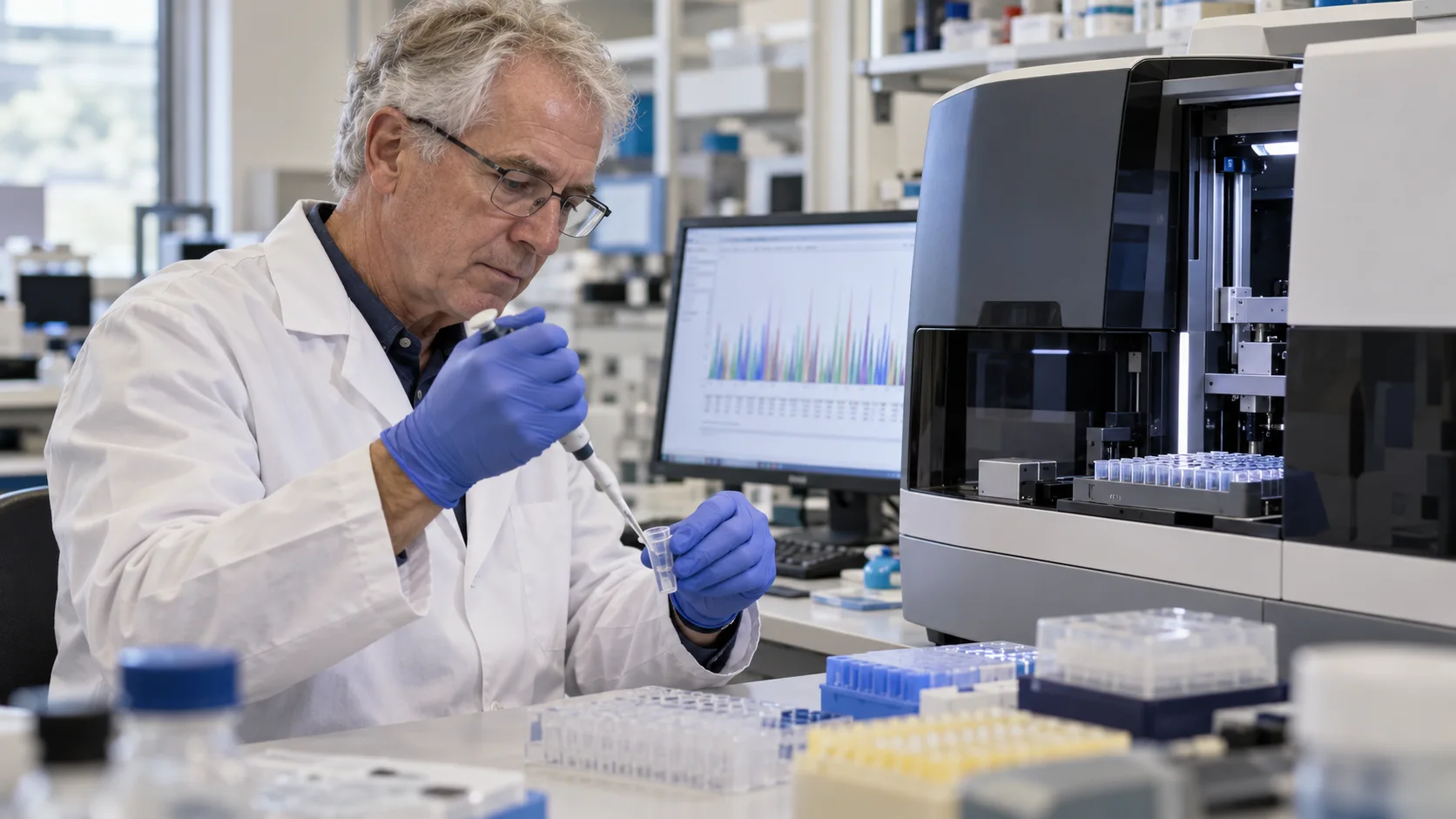
Getting closer. Prototypes exist, but not in real-world use.
Prototypes exist for most stages of the cycle. Writing, storing and reading have each been shown, and a custom device has run a full automated cycle, but only for a 5-byte message. The largest random-access result opened for this page stored more than 200 MB in a research setting. The sources opened describe no pilot archive, commercial product or industry standard, so the stage is engineering prototype rather than pilot.
The tech tree
Everything recorded on Vrulum that this future needs, oldest foundations at the top and the goal at the bottom. Lines show what each step requires.
- 2012DNA data storageResearch and prototypes Being researched.
- 2016Laser-written glass data storageResearch and prototypes Being researched.
- 2015Encapsulated DNA survives an accelerated ageing testDone Unlocked.
- 2017About 2 MB of files stored and fully recoveredDone Unlocked.
- 2018More than 200 MB stored, with single files retrievedDone Unlocked.
- 2019Fully automated write, store and read cycleDone Unlocked.
- 2022Writing at archive speed and costNot started Locked.
- 2022Reading back at practical speedNot started Locked.
- 2024Writing without making each strand from scratchIn progress Being researched.
- GoalStoring the world's archives in DNAGoalRequires: DNA data storage, Laser-written glass data storage, Encapsulated DNA survives an accelerated ageing test, About 2 MB of files stored and fully recovered, More than 200 MB stored, with single files retrieved, Fully automated write, store and read cycle, Writing without making each strand from scratch, Writing at archive speed and cost, Reading back at practical speed. Locked.
The road so far
4 of 7 steps done, 1 in progress.
- Done · 4 Feb 2015Encapsulated DNA survives an accelerated ageing test
Grass and colleagues stored 83 kB in DNA encapsulated in silica, encoded in 4,991 DNA segments, and recovered it after one week at 70 degrees C. The authors propose that this test is equivalent to about 2,000 years of storage in central Europe. That equivalence is their proposal from one accelerated test, not observed ageing. [2]
- Done · 1 Mar 2017About 2 MB of files stored and fully recovered
The DNA Fountain scheme stored about 2.14 million bytes, including an operating system and a film, and recovered all of it from sequencing coverage equal to one Illumina tile. The paper reports a density of 215 petabytes per gram of DNA. That is a density figure, not an amount stored. [3]
- Done · 19 Feb 2018More than 200 MB stored, with single files retrieved
Organick and colleagues stored 35 files totalling over 200 MB in more than 13 million oligonucleotides. Each file was retrieved individually without errors, using primer-based random access. This is the largest stored-and-retrieved amount in the peer-reviewed papers opened for this page. [4]
- Done · 21 Mar 2019Fully automated write, store and read cycle
Takahashi and colleagues demonstrated an automated device that writes a 5-byte message with a custom synthesiser, stores it, and reads it back with nanopore sequencing. No automated cycle at archive scale appears in the sources opened. [5]
- In progress · 23 Oct 2024Writing without making each strand from scratch
Zhang and colleagues wrote about 275,000 bits (roughly 34 kilobytes) by adding epigenetic marks to premade DNA template carriers, which were chemically synthesised in advance, and read them with nanopore sequencing. This is a laboratory result at very small scale. The paper reports only short heat tests of the marks and no long-term stability data. [6]
- Not started · 18 Oct 2022Writing at archive speed and cost
A 2022 review puts current DNA archive writing speeds in the order of kilobytes per second, and estimates cost at about 800 million US dollars per terabyte. The same review gives tape at roughly 15 to 16 US dollars per terabyte. These are reported estimates, and the review notes they cite earlier work. For comparison, a 2026 Nature paper on laser-written glass reports a peak write rate of 25.6 Mbit/s per beam (about 3.2 MB/s), under different conditions and at a different scale. [1][7]
- Not started · 18 Oct 2022Reading back at practical speed
The 2022 review says reading is much slower than standard silicon-based storage. It notes that, without random access, retrieving one file would mean reading the whole database. Reading needs sequencing plus heavy computational decoding. [1]
Why it matters
Libraries, museums and governments hold records that must survive for decades or longer. DNA is very dense, so a small volume could in principle hold a large archive. Knowing where the gaps lie shows whether DNA is close to practical archiving or still at the bench, and how it compares with tape and glass.
What stands in the way
- Writing is the main bottleneck. A 2022 review puts current archive writing speeds in the kilobytes-per-second range.
- The same review estimates about 800 million US dollars per terabyte to write DNA, or about 800 US dollars per megabyte (our conversion, in decimal units). Tape is given at roughly 15 to 16 US dollars per terabyte in the same review.
- Reading needs sequencing and heavy decoding. The review says reading is much slower than silicon-based storage, and without random access retrieving one file would mean reading the whole database.
- Long-term life is inferred from accelerated tests. The 2,000-year equivalence is the authors' proposal from one week at 70 degrees C, not measured ageing.
- The sources opened describe no commercial archival product, standard or integration with existing archive systems.
Signals to watch
- A write speed or cost per megabyte measured at archive scale and reported in a peer-reviewed paper, replacing estimates.
- Random access or a fully automated write, store and read cycle run on hundreds of megabytes or more.
- Non-synthesis writing methods, such as epigenetic printing, shown at larger scale with read-out and stability data.
- A new review that updates the 2022 cost and speed figures.
- Laser-written glass moving from research to a product or release date, as a comparison point for the archive gap.
Sources
- review article
Emerging Approaches to DNA Data Storage: Challenges and Prospects
Doricchi A et al.. ACS Nano, 18 Oct 2022. - peer reviewed paper
Robust chemical preservation of digital information on DNA in silica with error-correcting codes
Grass RN, Heckel R, Puddu M et al.. Angewandte Chemie International Edition, 4 Feb 2015. - peer reviewed paper
DNA Fountain enables a robust and efficient storage architecture
Erlich Y, Zielinski D. Science, 1 Mar 2017. - peer reviewed paper
Random access in large-scale DNA data storage
Organick L et al.. Nature Biotechnology, 19 Feb 2018. - peer reviewed paper
Demonstration of End-to-End Automation of DNA Data Storage
Takahashi CN, Nguyen BH, Strauss K et al.. Scientific Reports, 21 Mar 2019. - peer reviewed paper
Parallel molecular data storage by printing epigenetic bits on DNA
Zhang C, Wu R, Sun F et al.. Nature, 23 Oct 2024. - peer reviewed paper
Laser writing in glass for dense, fast and efficient archival data storage
Microsoft Research Project Silica Team. Nature, 18 Feb 2026.
Last reviewed 21 Oct 2026.