Dissolving battery for temporary in-body sensors
This is an idea, not a product. Nothing here has been built or tested unless a linked technology profile says so.
The problem
Temporary in-body sensors may need a battery that has to be removed by a second operation, which can add procedural risk. A battery that breaks down in the body may remove that step.
The idea
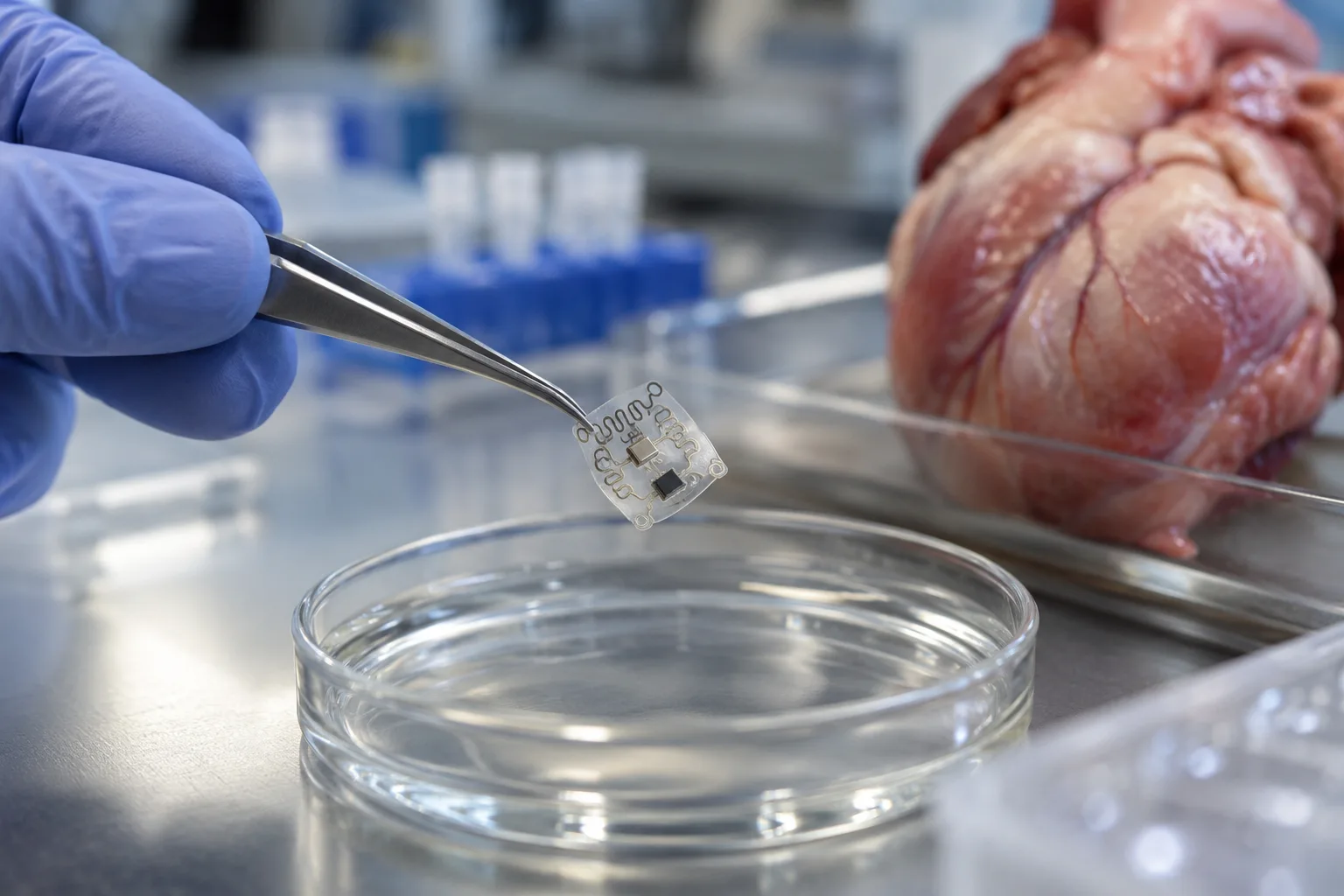
A first version would be a small galvanic cell with a magnesium or zinc anode, a molybdenum trioxide cathode and body fluid as the electrolyte, as used in the 2025 millimetre-scale bioresorbable pacemaker. It would power a short-term bioresorbable sensor or stimulator for days, with its working life set by a bioresorbable encapsulation layer. The first version would be designed for use inside the body only; batteries that dissolve after use in consumer products are a later, speculative step and are not part of this concept.
Enabling technology
- Bioresorbable (transient) electronics: Bioresorbable electronics are working circuits, sensors and stimulators made from materials designed to dissolve in the body after a set time. They aim to provide temporary implants, such as short-term pacemakers or brain pressure monitors, that never need surgical removal.
What stands in the way
- Working life in animals is short: the 2021 pacemaker paced rats reliably for about 4 days, and the 2025 magnesium-based and zinc-based versions worked in rats for up to 6 and 20 days. A battery for longer use is not yet shown.
- Full resorption has not been measured in the body. The 2025 device's resorption was estimated at about 1.2 to 2.5 years from accelerated laboratory tests, which may be too slow for a battery meant to dissolve after use.
- Fibrous tissue formed around the 2021 pacemaker within about 4 weeks in rats, which can decouple electrodes from tissue and slow resorption.
- The enabling technology profile does not give the galvanic cell's energy output or capacity, so a first version cannot be sized from them. Light or wireless switching also still needs external hardware.
- No fully implanted bioresorbable device in the profile has completed human clinical trials, and all degradation products would need to be shown safe at clinical scale.
A cheap way to test it
On the bench and not in animals, build small galvanic cells with magnesium and zinc anodes and molybdenum trioxide cathodes, each with two encapsulation thicknesses. Run them under a fixed resistive load in phosphate-buffered saline at 37 °C and log the voltage daily. Before testing starts, write down the target working time and the minimum acceptable voltage, and include an unencapsulated set to check that the encapsulation sets the lifetime. Pass only if the encapsulated cells reach the target working time at or above the minimum voltage. As a reference point, not a target, the 2023 printed zinc study reported about 28 days to a 90% loss of conductivity with a 30 µm encapsulation layer (its Methods section gives about 35 µm). At the end of the test, analyse the buffer for metal ions and fail the design if the breakdown products are not the expected anode and cathode metals and their salts.