Bioresorbable (transient) electronics
Also known as Transient electronics, Dissolvable electronics, Biodegradable implantable electronics
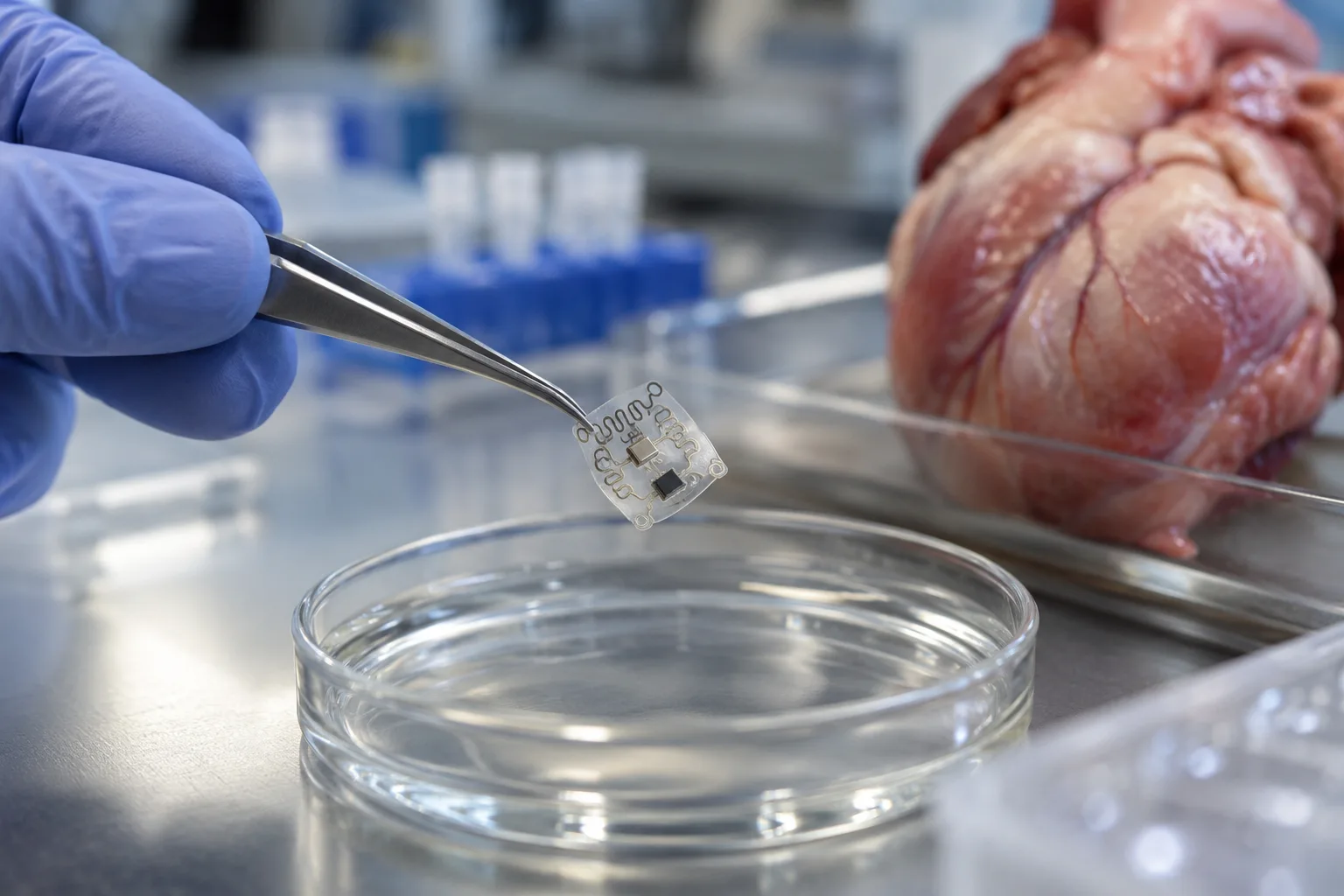
Bioresorbable electronics are working circuits, sensors and stimulators made from materials designed to dissolve in the body after a set time. They aim to provide temporary implants, such as short-term pacemakers or brain pressure monitors, that never need surgical removal.
In plain language
Some medical implants are only needed for days or weeks, for example a temporary pacemaker after heart surgery. Today these devices have wires or parts that must be pulled out later, which carries risks such as infection or bleeding. Bioresorbable electronics are designed to do their job and then slowly break down in body fluids, like dissolving stitches.
The approach is to build the circuit from unusual materials: extremely thin silicon sheets, metals such as magnesium, molybdenum or tungsten, and biodegradable plastics or silk. Researchers have shown dissolving brain sensors and pacemakers in animals and in donated human heart tissue. None of these devices is yet an approved medical product.
Technical explanation
The approach rests on the finding that silicon nanomembranes, tens to hundreds of nanometres thick, hydrolyse slowly in biofluids to silicic acid. In the 2012 Science paper that first demonstrated physically transient silicon electronics, complete dissolution of 35 to 100 nm silicon membranes at 37 °C was predicted in roughly 14 to 19 days, against hundreds of years for bulk silicon. Conductors use magnesium, molybdenum, tungsten or zinc; dielectrics use magnesium oxide or silicon dioxide; and encapsulation uses silk fibroin, poly(lactic-co-glycolic acid) (PLGA) or bioresorbable polyurethanes. Operating life is set mainly by how long the encapsulation keeps water out, and can be tuned by thickness and polymer chemistry.
Silicon is not the only route. A 2023 study reported a biodegradable elastomer, poly(L-lactide-co-ε-caprolactone) (PLCL), that stretches to about 1600% strain in the authors' tests and can be combined with a conductive composite. A 2023 printed process also sintered zinc microparticles into conductive traces of up to 5.62 × 10⁶ S/m. The authors say the process delivers less photonic energy to the substrate than earlier zinc photonic sintering methods. In that study, unencapsulated zinc traces lost about an order of magnitude of conductivity in phosphate-buffered saline at 37 °C in 46.6 hours on average.
Powering is a central design problem. The 2012 wireless heater and the 2021 leadless pacemaker both received power wirelessly by inductive coupling to a bioresorbable receiver coil. The 2022 closed-loop system paired a bioresorbable epicardial pacemaker with skin-mounted sensors and a handheld controller that adjusted pacing to heart rate and activity. A 2025 Nature paper described a 1.8 x 3.5 x 1 mm pacemaker powered by a galvanic cell (a magnesium or zinc anode and a molybdenum trioxide cathode using body fluid as electrolyte), switched on and off by near-infrared light through tissue.
Open problems include short and variable functional lifetimes in vivo (days in several rat studies), fibrous tissue encapsulation that can decouple electrodes and slow resorption, long or unmeasured full resorption times for some designs, and the need to show that all degradation products are safe at clinical scale. Human evidence so far is limited to ex vivo human heart tissue and healthy volunteers wearing the skin-mounted parts of a system.
What the evidence says
Each statement is typed by the strength of its evidence and linked to the source that supports it.
Demonstrated Shown in a published experiment, test or shipping product.
Silicon nanomembranes dissolve by hydrolysis in buffered solution at body temperature; complete dissolution of 35 to 100 nm membranes was predicted in about 14 to 19 days, compared with more than about 600 years for a bulk silicon piece of similar lateral size.
Sources: [1] · Dissolution studies and modellingA silk-packaged transient wireless heater made from magnesium coils and doped silicon was implanted under the skin of a rat and produced a local temperature rise of about 5 °C; devices implanted in mice left only faint residues after 3 weeks.
Sources: [1] · In vivo demonstration sectionBioresorbable silicon sensors measured intracranial pressure and temperature in the brains of rats and were designed to be absorbed by the body after use; the press release reports that they transmitted accurate pressure and temperature readings.
Sources: [2] · Press release describing Kang et al., Nature 2016 · medium confidenceA leadless, battery-free bioresorbable pacemaker about 250 µm thick and weighing about 0.3 g paced ex vivo mouse, rabbit and human heart slices and in vivo rat and dog hearts; in rats it paced reliably for about 4 days and was no longer visible on CT by day 46.
Sources: [3] · Results: device design, in vivo pacing and resorptionFibrous tissue formed around the 2021 pacemaker within about 4 weeks in rats, decoupling it from the heart and slowing resorption.
Sources: [3] · Discussion of chronic studiesA closed-loop system combining a bioresorbable epicardial pacemaker with skin-mounted sensors and a handheld controller delivered autonomous, rate-adaptive pacing in rat and dog studies and in an ex vivo human heart.
Sources: [4] · Main textA 1.8 x 3.5 x 1 mm bioresorbable pacemaker powered by a galvanic cell and switched by near-infrared light paced mouse, rat and dog hearts in vivo and pig and human hearts ex vivo; in rats magnesium-based versions worked for up to 6 days and zinc-based versions for up to 20 days.
Sources: [5] · ResultsPoly(L-lactide-co-ε-caprolactone) (PLCL), a biodegradable elastomer made from L-lactide and ε-caprolactone, stretched to about 1600% strain in the authors' tests, with elongation at break of 700% to 1600% depending on molecular weight.
Sources: [6] · Main text, mechanical propertiesA PLCL-based conductive composite had an initial conductivity of about 220 S/cm, according to the authors. The authors also report stretchability to about 550% strain, without a conductivity value at that strain.
Sources: [6] · Abstract and main text · medium confidenceIn a rat study, a suture-free PLCL cardiac jacket recorded electrocardiograms and paced the heart, raising the rate to about 420 beats per minute against 300 to 320 without stimulation. Histology after 8 weeks showed fibrosis on the epicardial surface at the implant site with no observable damage to cardiac tissue, and ejection fraction showed no significant change.
Sources: [6] · Main text, in vivo rat study · medium confidencePLCL films degraded in laboratory tests. In phosphate-buffered saline at 37 °C (pH 7), a film made from 140k molecular-weight polymer had completely disappeared by 30 weeks. In a fungal test (Aspergillus flavus, 37 °C, 50% relative humidity), film weight fell to about 40% of its original value after 30 days.
Sources: [6] · Main text, degradation testsIn the 8-week rat study, the authors could not observe substantial physical degradation of the PLCL cardiac jacket.
Sources: [6] · Main text, in vivo results and discussionPrinted zinc microparticles were sintered by spraying dilute acetic acid to remove surface oxide and then applying flash-lamp pulses. Sintered traces reached conductivity of up to 5.62 × 10⁶ S/m, which the authors state is about three times lower than bulk zinc (16.6 × 10⁶ S/m). Traces on paper, PLA and PVA were lower, at about 2.0 to 2.6 × 10⁴ S/cm.
Sources: [7] · Main text, sintering method and conductivityThe sintered zinc traces were used in a resistive temperature sensor, a resistive strain sensor, a capacitive pressure sensor, a chipless wireless LC pressure sensor and a wireless power receiver. The power receiver lit an LED at up to about 60 mm from the primary coil.
Sources: [7] · Main text, device demonstrationsIn phosphate-buffered saline at 37 °C, unencapsulated sintered zinc traces lost about an order of magnitude of conductivity in 46.6 hours on average. With a 30 µm encapsulation layer (Results section; the Methods section gives about 35 µm), a 90% conductivity loss took about 28 days.
Sources: [7] · Main text, degradation in PBSIn ambient air, unencapsulated hybrid-sintered zinc traces increased in resistance by a factor of 1.4 over 31 days. PLA-encapsulated traces lost about 12% of conductivity over the same period.
Sources: [7] · Main text, stability in airThe authors state that the repeated acid treatment could limit the scalability of the process. At the higher flash-pulse energy, a yield of 25% was observed, against near 100% at lower energies.
Sources: [7] · Main text, discussion of limitations · medium confidenceProposed A design or plan that has not yet been built or tested.
Complete resorption of the 2025 millimetre-scale pacemaker was estimated at about 1.2 to 2.5 years from accelerated laboratory tests; in vivo resorption was not measured.
Sources: [5] · Bioresorption analysis · medium confidenceArrays of the millimetre-scale pacemakers mounted on a transcatheter aortic valve replacement stent frame have been proposed to treat heart block after valve surgery; this was tested only in ex vivo human hearts, where four of six devices achieved reliable capture.
Sources: [5] · Abstract and Results on TAVR integration · medium confidenceThe authors estimate that a 40 µm unencapsulated zinc layer would fully resorb in about 48 days, based on a corrosion rate taken from the literature. This is an estimate, not a measured result.
Sources: [7] · Main text, resorption estimate · medium confidenceLimitations and open problems
- Functional lifetime in animals is often short and hard to control precisely; the 2021 pacemaker paced rats reliably for about 4 days, and the 2025 magnesium-based version for up to 6 days.
- Fibrous tissue can grow around implants within weeks, decoupling electrodes from tissue and slowing resorption.
- Full resorption can be slow or unmeasured; the 2025 millimetre-scale pacemaker was estimated from accelerated lab tests to take about 1.2 to 2.5 years to resorb completely.
- Evidence in people is limited to ex vivo human heart tissue and wearable components; no fully implanted bioresorbable electronic device in this profile has completed human clinical trials.
- Wireless power and control need external hardware, such as transmitter coils, light sources or skin-mounted modules.
- In the 8-week rat study of the PLCL cardiac jacket, the authors could not observe substantial physical degradation, so the study does not show how the device breaks down over longer periods.
- Printed zinc traces need a repeated acid cleaning step to remove surface oxide. The authors say this could limit scalability, and at the higher flash-pulse energy only 25% of samples yielded, against near 100% at lower energies.
- Unencapsulated printed zinc traces lose conductivity quickly in lab conditions; a 30 µm encapsulation layer (the Methods section gives about 35 µm) extended the time to a 90% conductivity loss in phosphate-buffered saline at 37 °C to about 28 days.
- The degradation tests for printed zinc were run in ambient air and in phosphate-buffered saline at 37 °C. They do not measure breakdown in soil or water. The 48-day full-resorption figure is an estimate from a literature corrosion rate, not a measured result.
- The authors say the sensitivity of the printed zinc pressure sensor is on the lower end of the state of the art for bioresorbable pressure sensors.
Possible future uses
Ideas, not predictions. None of these has been demonstrated.
- Injectable dissolving stimulators that speed healing of bone fractures or chronic wounds and then disappear.
- Temporary post-operative monitoring patches placed inside the body during surgery to warn of leaks or infection before dissolving.
- Environmentally transient consumer electronics or sensors that break down after use to reduce electronic waste.
Product concepts: Biodegradable wildlife tag, Dissolving post-surgery monitor, Dissolving battery for temporary in-body sensors
Timeline
- Sept 2012Science paper demonstrates physically transient silicon CMOS electronics, including a dissolving wireless heater tested in rodents. Sources: [1]
- Jan 2016Bioresorbable silicon sensors monitor intracranial pressure and temperature in rats and then dissolve. Sources: [2]
- Jun 2021Leadless, battery-free, fully bioresorbable cardiac pacemaker demonstrated in animal and ex vivo human heart models. Sources: [3]
- May 2022Closed-loop network links a bioresorbable pacemaker with skin-mounted sensors for autonomous, rate-adaptive pacing. Sources: [4]
- Mar 2023Printed zinc sintering method reported in npj Flexible Electronics, with traces up to 5.62 × 10⁶ S/m and sensor and wireless power demonstrations. Sources: [7]
- Apr 2023Stretchable, biodegradable PLCL elastomers reported in Nature Communications, with a suture-free cardiac jacket that paced rat hearts and in vitro degradation tests of the elastomer film. Sources: [6]
- Apr 2025Millimetre-scale, light-controlled bioresorbable pacemaker with an onboard galvanic power source reported in Nature. Sources: [5]
Futures this could help bring about

Related breakthroughs
Glossary
- Bioresorbable
- Able to break down in the body into products that are absorbed or excreted, so no removal surgery is needed.
- Silicon nanomembrane
- A sheet of crystalline silicon only tens to hundreds of nanometres thick, thin enough to dissolve in body fluid over weeks.
- Encapsulation
- A protective outer layer that keeps fluid away from the circuit; its thickness largely sets how long the device works.
- Galvanic cell
- A simple battery formed by two different metals in a conducting fluid; here body fluid acts as the electrolyte.
- Elastomer
- A stretchy polymer that returns close to its original shape after large deformation.
- Sintering
- Joining small particles into a continuous solid layer, here so that printed zinc particles form a conducting trace.
- Hydrolysis
- Breakdown of a material by chemical reaction with water.
Sources
- peer reviewed paper
A physically transient form of silicon electronics
Suk-Won Hwang, Hu Tao, Dae-Hyeong Kim et al.. Science, 28 Sept 2012. DOI: 10.1126/science.1226325. Accessed 20 Oct 2026. - university press release
Team Develops Wireless, Dissolvable Sensors to Monitor Brain
Washington University in St. Louis (via Newswise), 18 Jan 2016. Accessed 20 Oct 2026. - peer reviewed paper
Fully implantable and bioresorbable cardiac pacemakers without leads or batteries
Yeon Sik Choi, Rose T. Yin, Anna Pfenniger et al.. Nature Biotechnology, 28 Jun 2021. DOI: 10.1038/s41587-021-00948-x. Accessed 20 Oct 2026. - peer reviewed paper
A transient, closed-loop network of wireless, body-integrated devices for autonomous electrotherapy
Yeon Sik Choi, Hyoyoung Jeong, Rose T. Yin et al.. Science, 26 May 2022. DOI: 10.1126/science.abm1703. Accessed 20 Oct 2026. - peer reviewed paper
Millimetre-scale bioresorbable optoelectronic systems for electrotherapy
Y. Zhang, E. Rytkin, L. Zeng et al.. Nature, 2 Apr 2025. DOI: 10.1038/s41586-025-08726-4. Accessed 20 Oct 2026. - peer reviewed paper
Ultra-stretchable and biodegradable elastomers for soft, transient electronics
Won Bae Han, Gwan-Jin Ko, Kang-Gon Lee et al.. Nature Communications, 20 Apr 2023. DOI: 10.1038/s41467-023-38040-4. Accessed 21 Oct 2026. - peer reviewed paper
Zinc hybrid sintering for printed transient sensors and wireless electronics
N. Fumeaux, D. Briand. npj Flexible Electronics, 14 Mar 2023. DOI: 10.1038/s41528-023-00249-0. Accessed 21 Oct 2026.
Revision history
6 changes since this profile was created.