Brain-computer switch for locked-in syndrome
This is an idea, not a product. Nothing here has been built or tested unless a linked technology profile says so.
The problem
People with locked-in syndrome may be unable to speak or move, which can make it hard to signal needs or answer questions. A simple, reliable switch could help, if the technology can support one.
The idea
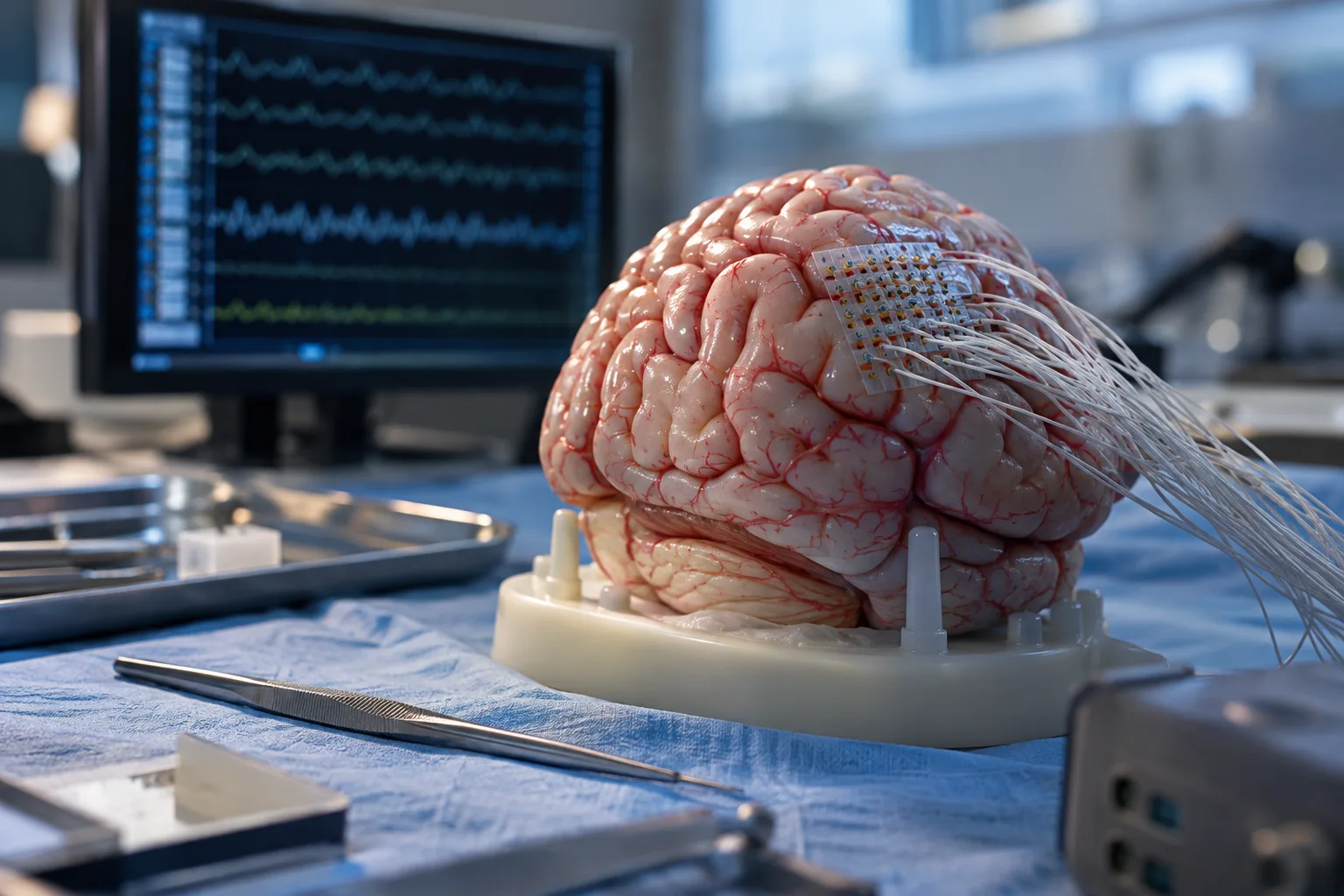
A first version would be a single-output switch rather than a speech system. A recording from the brain's surface or from a blood-vessel implant would feed a fixed decoder. The decoder would be trained in a short calibration session on the user's own attempted movements, and would produce one yes or no output. The output would drive an alert or a simple on-screen answer. The device would not attempt open-ended text or speech. This is a speculative concept, not a tested design.
Enabling technology
- Brain-computer interfaces: Brain-computer interfaces read electrical activity from the brain and turn it into text, speech or device commands. Research teams have decoded attempted speech from implanted electrodes, and one company has tested an implant placed through blood vessels. A September 2026 study used electrodes on the brain's surface to control a virtual avatar in two of three people with paralysis. Only a small number of people have been studied in all of this work.
What stands in the way
- The linked profile reports very few participants in its speech and control studies, all with severe paralysis or ALS. None of the reviewed sources tests people with locked-in syndrome, so the switch would need its own evidence base.
- In the linked profile's speech study, decoding accuracy falls as vocabulary grows. A switch with one yes or no output is therefore a more realistic first target than open-ended text. This is an inference from vocabulary size, not a tested result for yes or no decoding.
- The endovascular route avoids open-skull surgery, but its safety evidence comes from four analysed patients (five enrolled) followed for 12 months. That is too few to show rare risks. Intracortical arrays need surgery that opens the skull.
- The 2026 system was wired to external processing units. A fully implantable, wireless version is planned but has not been shown.
- The linked profile does not report stable signal quality over months, or a reliable on or off decision with few false activations. Both would need evidence before a switch could be relied on.
A cheap way to test it
Bench test, with no human participants. Build a signal generator with known ground-truth yes and no events, and replay it through the switch decoder. Repeat each run with added noise, and again with slow baseline drift to stand in for changes over time. Before any run, write down the maximum allowed false activations per hour of baseline signal and the minimum share of ground-truth events the decoder must detect. Pass if every run meets both limits. Fail if any run breaks either limit. After a fail, tune the decoder on a separate tuning set, not the test set, then run the fresh test set once.