Brain-computer interfaces
Also known as BCI, Brain-machine interfaces, Neural interfaces
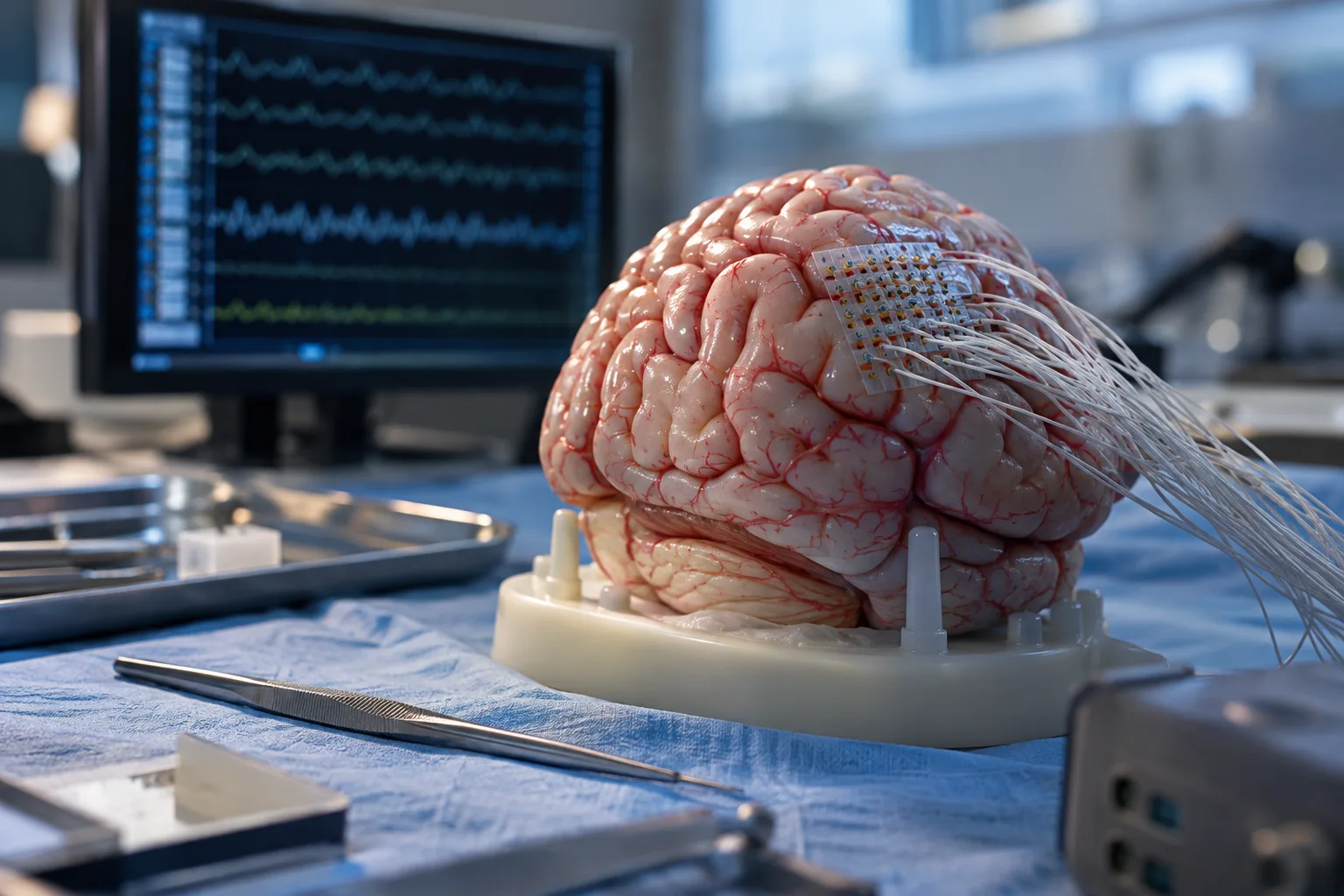
Brain-computer interfaces read electrical activity from the brain and turn it into text, speech or device commands. Research teams have decoded attempted speech from implanted electrodes, and one company has tested an implant placed through blood vessels. A September 2026 study used electrodes on the brain's surface to control a virtual avatar in two of three people with paralysis. Only a small number of people have been studied in all of this work.
In plain language
A brain-computer interface, or BCI, listens to the brain's electrical signals and translates them into something a computer can use, such as moving a cursor or producing words. For people who cannot move or speak because of paralysis, this can open a route to communication. The studies described here use surgical implants to pick up the signals.
In 2023 a research team reported that a participant with ALS, who could no longer speak clearly, produced text at about 62 words per minute using an implanted electrode array. Other devices avoid opening the skull and travel through blood vessels to reach the brain. These studies involve very small numbers of people, so the results are early rather than settled.
In September 2026 a study reported in Nature Neuroscience described an electrode array resting on the surface of the brain that picked up signals for speech and body gestures at the same time. Signals from two of three participants with paralysis were used to control a full-body virtual avatar. The system was wired to external processing units, so it is a research demonstration rather than a finished device.
Technical explanation
Intracortical BCIs record the spiking activity of neurons with microelectrode arrays placed in motor cortex. Willett and colleagues (Nature, 2023) recorded from arrays in a participant with ALS while attempting to speak, and trained decoders to map the neural activity onto speech sounds and words. Reported word error rates were 9.1% on a 50-word vocabulary and 23.8% on a 125,000-word vocabulary, for that single participant.
Earlier work helped show where speech signals come from. Stavisky and colleagues (eLife, 2019) recorded from the motor cortex hand-knob area in two people with tetraplegia. Neurons there were active during speaking and during non-speaking movements of the tongue, lips and jaw, and spoken words and syllables could be decoded from single trials. This challenged the simple idea that the motor cortex maps cleanly onto body regions at the level of single neurons.
Endovascular devices aim to avoid open-brain surgery. In the SWITCH study, Mitchell and colleagues (JAMA Neurology, 2023) implanted a stent-electrode device through the jugular vein in four patients with severe paralysis. Over 12 months, no device-related serious adverse events leading to death or permanent disability were reported, and eight mild device effects occurred across the four patients. Synchron announced the first US implant in its COMMAND trial in July 2022, as a company announcement that the sources reviewed here do not independently verify. Longer-term performance in larger groups has yet to be shown.
A 2026 study by Brosler and colleagues, reported in Nature Neuroscience according to an NIH release, used electrocorticography (ECoG), which records from a thin strip of sensors placed on the surface of the motor cortex, beneath the skull. According to the release, decoders trained on simultaneous speech and gesture data were more successful at deciphering signals from mixed speech and gesture than decoders trained on isolated speech and gestures. The release reports no accuracy figures or channel counts.
What the evidence says
Each statement is typed by the strength of its evidence and linked to the source that supports it.
Demonstrated Shown in a published experiment, test or shipping product.
A participant with ALS used an intracortical array to produce attempted speech decoded into text at about 62 words per minute.
Sources: [1] · AbstractIn that participant, the decoder reached a word error rate of 9.1% on a 50-word vocabulary and 23.8% on a 125,000-word vocabulary.
Sources: [1] · AbstractSpoken words and syllables could be decoded from single trials of motor cortex activity in two people with tetraplegia.
Sources: [2] · Abstract · medium confidenceFour patients received the Stentrode endovascular device, and no device-related serious adverse events leading to death or permanent disability were reported through 12 months.
Sources: [3] · AbstractThe Stentrode is delivered through the jugular vein, so the implant does not require open-brain surgery.
Sources: [3], [4] · Abstract; press release textThe system tested in the 2026 study was wired to external processing units.
Sources: [5] · Release text on the wired systemReported, unverified Stated by a company or team but not independently confirmed.
Synchron announced in July 2022 the first US implant of its BCI, in the COMMAND trial, at Mount Sinai West.
Sources: [4] · Press release text · medium confidenceIn a 2026 study, signals from two of three participants with paralysis were used to control a full-body virtual avatar, through an ECoG array placed on the surface of the motor cortex.
Sources: [5] · Release text on participants, implant and avatar control · medium confidenceIn the 2026 study, according to the release, decoders trained on simultaneous speech and gesture data were more successful at deciphering mixed signals than decoders trained on isolated speech and gestures.
Sources: [5] · Release text on decoder training · medium confidenceProposed A design or plan that has not yet been built or tested.
The research team plans to test a fully implantable, wireless version of the 2026 system.
Sources: [5] · Release text on next stepsSpeculative An idea or possible use. Not evidence of anything.
Speech BCIs may eventually restore communication for people who have lost speech, but this has not yet been shown beyond small research studies.
Sources: [1] · Abstract · medium confidenceLimitations and open problems
- Speech decoding has been shown in very few participants, all with severe paralysis or ALS.
- Decoding accuracy falls as vocabulary grows: word error rates rise from 9.1% on a 50-word vocabulary to 23.8% on a 125,000-word vocabulary (Willett and colleagues, 2023).
- Intracortical arrays need surgery that opens the skull, with the usual surgical risks.
- The endovascular safety evidence comes from four analysed patients, five enrolled, which is too few to show rare risks.
- The first US implant from Synchron is reported in a company announcement and has not been independently reviewed in the sources used here.
- The 2026 speech-and-gesture study reports avatar control in two participants, out of three who took part in the research, which is too few to describe performance across people with paralysis.
- The 2026 system was wired to external processing units. A fully implantable, wireless version is planned but has not been shown.
- The institutional release describes the 2026 study as a proof of concept and reports no accuracy figures, long-term use or results in larger groups.
- The NIH release notes that attempting speech and gestures at the same time seemingly diminishes speech capabilities.
Possible future uses
Ideas, not predictions. None of these has been demonstrated.
- Speech neuroprostheses that restore everyday conversation for people who have lost the ability to speak, for example after ALS or stroke.
- Control of computers, wheelchairs or household devices through neural signals for people with severe paralysis.
- Multimodal communication interfaces that combine speech and gesture output for people who cannot reliably speak or move.
- Use of implanted interfaces in conditions beyond paralysis, which no source reviewed here has tested.
Product concepts: Neural bypass for hand function after injury, Brain-computer switch for locked-in syndrome, Prosthetic hand with touch feedback
Timeline
- 10 Dec 2019eLife publishes Stavisky and colleagues' study showing that motor cortex 'hand knob' neurons are active during speech and that words and syllables can be decoded from single trials. Sources: [2]
- 19 Jul 2022Synchron announces the first human BCI implant in the United States, in its COMMAND trial, at Mount Sinai West in New York. Sources: [4]
- 9 Jan 2023JAMA Neurology publishes the SWITCH study, reporting safety results for four patients with a fully implanted endovascular BCI. Sources: [3]
- 23 Aug 2023Nature publishes Willett and colleagues' speech neuroprosthesis, which produced text at about 62 words per minute from attempted speech. Sources: [1]
- 14 Sept 2026An NIH release announces Brosler and colleagues' Nature Neuroscience study on simultaneous speech and gesture decoding from an ECoG array, with avatar control shown in two of three participants. Sources: [5]
Futures this could help bring about
Brain data protected by law
Pilots · 5 of 9 steps done
Brain-computer interfaces for everyday use
Pilots · 4 of 8 steps done
Giving people back their voice with brain implants
Engineering prototypes · 4 of 6 steps done
Restoring sight to blind people
Pilots · 4 of 8 steps done
Walking again after spinal cord injury
Engineering prototypes · 4 of 6 steps done
Related breakthroughs
Glossary
- Brain-computer interface
- A system that reads brain signals and turns them into commands or text for a computer.
- Intracortical microelectrode array
- A small set of fine electrodes placed into the brain's outer layer to record the activity of nearby neurons.
- Endovascular
- Delivered through the blood vessels, so that no open surgery on the skull is needed.
- Word error rate
- The share of words a decoder gets wrong, used to measure speech decoding accuracy.
- Electrocorticography (ECoG)
- Recording of electrical activity from electrodes placed on the surface of the brain, beneath the skull.
- Decoder
- A computer model that maps recorded neural signals to a chosen output, such as a phrase or a movement.
Sources
- peer reviewed paper
A high-performance speech neuroprosthesis
Francis R. Willett, Erin M. Kunz, Chaofei Fan et al.. Nature, 23 Aug 2023. DOI: 10.1038/s41586-023-06377-x. Accessed 21 Oct 2026. - peer reviewed paper
Neural ensemble dynamics in dorsal motor cortex during speech in people with paralysis
Sergey D. Stavisky, Francis R. Willett, Guy H. Wilson et al.. eLife, 10 Dec 2019. DOI: 10.7554/eLife.46015. Accessed 21 Oct 2026. - peer reviewed paper
Assessment of Safety of a Fully Implanted Endovascular Brain-Computer Interface for Severe Paralysis in 4 Patients: The Stentrode With Thought-Controlled Digital Switch (SWITCH) Study
Peter Mitchell, Bruce C. V. Campbell. JAMA Neurology, 9 Jan 2023. DOI: 10.1001/jamaneurol.2022.4847. Accessed 21 Oct 2026. - company announcement
Synchron Announces First Human U.S. Brain-Computer Interface Implant
Synchron, Inc.. Business Wire (Synchron, Inc. press release), 19 Jul 2022. Accessed 21 Oct 2026. - news
Neuroprosthesis for paralysis enables simultaneous speech and body language
US National Institutes of Health, Office of the Director (news release, copy on EurekAlert), 14 Sept 2026. Accessed 21 Oct 2026.
Revision history
4 changes since this profile was created.