Self-sealing bridge deck
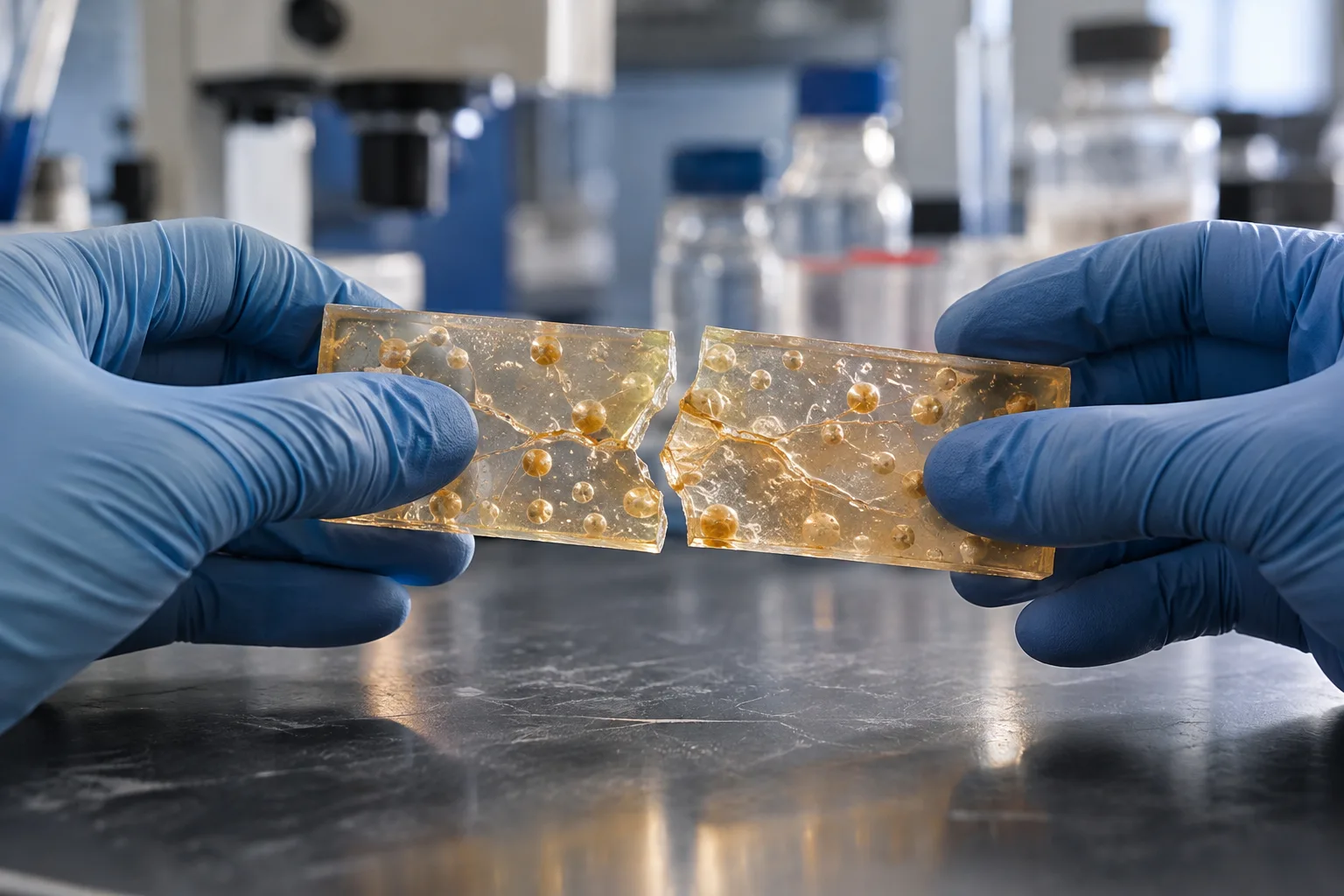
This is an idea, not a product. Nothing here has been built or tested unless a linked technology profile says so.
The problem
Small cracks in bridge decks may let water reach the reinforcement and lead to repairs later. A material that closed minor cracks without a crew having to find and seal each one could, in principle, reduce that work.
The idea
A first version would be a small set of concrete test specimens with a bacterial healing agent of spores and lactate mixed in, the approach used in the full-scale concrete demonstrators reviewed by TU Delft. Its aim would be to seal small cracks against water, not to restore load capacity. Any later step, such as a deck overlay or precast section, would only follow if the specimens show measurable sealing under controlled conditions.
Enabling technology
- Self-healing polymers: Self-healing polymers are plastics, rubbers and composites that can repair cracks or cuts, either on their own or with a trigger such as heat. Laboratory work since 2001 has shown partial to full recovery of strength in several material families. Bacteria-based concrete has reached full-scale pilots, but most systems remain at the research and prototype stage.
What stands in the way
- The healing evidence for bacteria-based concrete comes from laboratory crack tests. Sealing cracks up to 0.8 mm under lab conditions does not show that the same behaviour holds in a bridge deck.
- The TU Delft review could not prove enhanced crack healing in full-scale structures, because the demonstrators hardly cracked. The benefit in a real deck is therefore unmeasured.
- The 2024 ProRail pilot reports no measured long-term crack closure, leak reduction, structural recovery or maintenance data, so durability in service is unknown.
- According to ProRail, the bacteria become active when moisture and oxygen reach them through a crack. A deck that stays dry may not benefit at all.
- Sealing a crack does not show restored load capacity, so a self-sealing deck cannot replace structural inspection or repair. Living materials also depend on cell survival and a steady resource supply.
A cheap way to test it
In a contained laboratory, cast matched concrete specimens with and without the bacterial healing agent, plus an agent-free control. Crack the specimens to widths of up to 0.8 mm, the upper figure reported in lab tests, then place each one in a fixed water-pressure rig and measure water flow through the crack. Repeat the measurement after a set number of wet and dry cycles. Set the pass threshold, the minimum reduction in flow for the treated specimens compared with the controls, before testing starts. Use a non-pathogenic strain and a lab approved for living organisms. No human or field trial is needed for this step.