Self-healing polymers
Also known as Self-healing materials, Autonomic healing polymers, Remendable polymers, Vitrimers
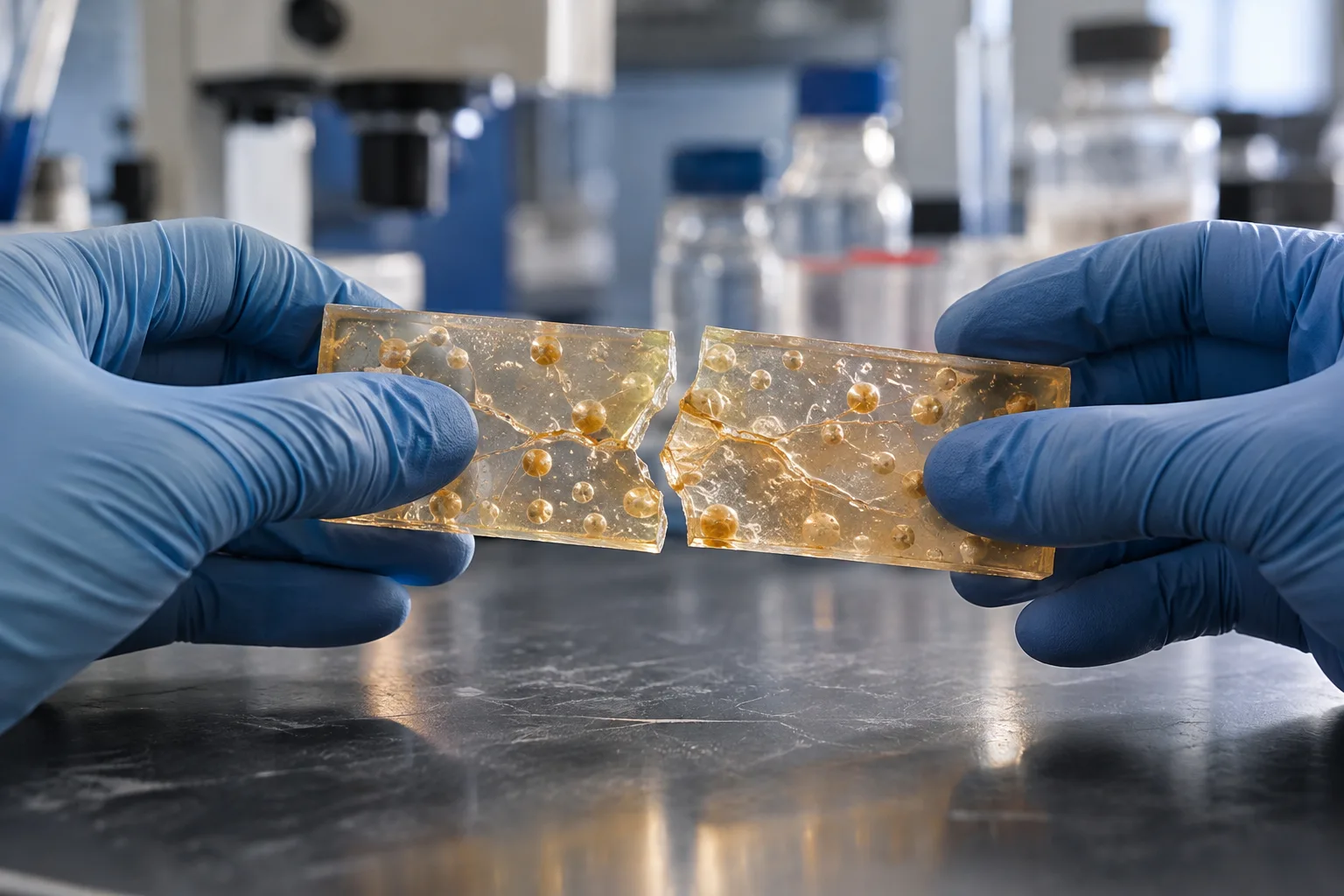
Self-healing polymers are plastics, rubbers and composites that can repair cracks or cuts, either on their own or with a trigger such as heat. Laboratory work since 2001 has shown partial to full recovery of strength in several material families. Bacteria-based concrete has reached full-scale pilots, but most systems remain at the research and prototype stage.
In plain language
Most plastics stay damaged once they crack. A self-healing polymer is designed so that a crack sets off a repair. In some materials, tiny capsules of liquid glue burst when a crack passes through them and the glue sets inside the crack. In others, the chemical bonds that hold the material together can break and re-form, so pressing two cut pieces together or warming them lets them join again.
The idea is to make parts that last longer and fail less suddenly, for example in coatings, electronics and fibre-reinforced composites. Researchers have shown the effect many times in the lab, but healing is usually partial, often needs heat, time or pressure, and does not yet suit most everyday products.
Technical explanation
Self-healing polymers are usually grouped into three approaches. Capsule-based (extrinsic) systems embed microcapsules of a liquid healing agent together with a dispersed catalyst; a propagating crack ruptures the capsules and the released monomer polymerises on contact with the catalyst, bonding the crack faces. White and colleagues reported up to 75% recovery of fracture toughness with this design in 2001. Its main weakness is that each site can heal only once, because the local supply of healing agent is used up.
Vascular systems address that limit by delivering healing agent through a channel network. Toohey and colleagues built a three-dimensional microvascular substrate under an epoxy coating, allowing repeated healing of cracks in the coating. Intrinsic systems instead rely on reversible chemistry in the polymer itself: thermally reversible Diels-Alder cross-links (Chen and colleagues, 2002), hydrogen-bonded supramolecular networks that rejoin at room temperature (Cordier and colleagues, 2008), and vitrimers, whose covalent networks rearrange by exchange reactions so they can be reshaped and welded on heating while staying insoluble (Montarnal and colleagues, 2011).
The same toolkit has been extended to functional materials. Tee and colleagues combined a supramolecular polymer with nickel microparticles to make a conductor that recovered most of its electrical conductivity and its mechanical properties after being cut, aimed at electronic skin. According to a 2010 review, most research has focused on restoring mechanical integrity after quasi-static fracture, and less on damage from fatigue, impact or corrosion.
Fatigue is a harder test than a single cut. In a 2018 hydrogel study, a sample without a pre-cut crack recovered its stress-stretch curve after thousands of loading cycles, but a sample with a pre-cut crack still extended cycle by cycle. Above a threshold, reversible noncovalent interactions slowed that growth (Bai et al., 2018). Healing has also been shown in harder materials under laboratory conditions. In a high-temperature structural ceramic with a three-dimensional network of doped MnO activator, the authors report that crack healing was accelerated by more than 6,000 times (Osada et al., 2017). A Ti2AlC ceramic repeatedly healed cracks at 1,500 K, and the healed regions were strong enough that new cracks formed elsewhere on reloading (Sloof et al., 2016).
Outside polymers, bacteria-based concrete is the most visible infrastructure case. A TU Delft review of full-scale demonstrators reports that a healing agent of bacterial spores and lactate sealed cracks up to 0.8 mm wide in laboratory tests, depending on dosage. The authors reported no negative side effects on construction performance from adding the agent, but could not prove enhanced crack healing in the structures because the demonstrators hardly cracked. In July 2024, ProRail reported a 25-metre wall section made with the same approach in the Vijf Eikentunnel at Rijen, Netherlands, as a pilot to test water-tightness in practice. The announcement does not yet give measured long-term crack closure, leak or structural data.
In polymers, a 2025 Nature Communications study used a computational model of a polymer glass. The authors report that controlled oscillatory deformation raised local molecular mobility at the surface of a cylindrical crack and restored the mechanical properties of the original material. This is a numerical simulation, not a demonstration in a manufactured part.
What the evidence says
Each statement is typed by the strength of its evidence and linked to the source that supports it.
Demonstrated Shown in a published experiment, test or shipping product.
An epoxy containing microencapsulated healing agent and a dispersed catalyst healed cracks autonomically, recovering up to 75% of its fracture toughness in laboratory fracture tests.
Sources: [1] · AbstractA transparent cross-linked polymer based on Diels-Alder chemistry can be re-mended multiple times by heating: above 120 C about 30% of its linkages break and then re-form on cooling, without added catalyst or monomer.
Sources: [2] · AbstractA three-dimensional microvascular network can supply healing agent to cracks in an epoxy coating, allowing repeated healing of damage, whereas microcapsule systems are limited to repairing a single damage event at a given location.
Sources: [3] · AbstractA hydrogen-bonded supramolecular rubber can be repaired at room temperature by pressing fractured surfaces together, and the break-and-heal cycle can be repeated many times.
Sources: [4] · AbstractVitrimer epoxy networks rearrange their structure through exchange reactions, so they stay insoluble yet can be reshaped and welded by local heating.
Sources: [6] · AbstractA supramolecular polymer filled with nickel microparticles recovered about 90% of its electrical conductivity after 15 seconds of healing and fully restored its mechanical properties after about 10 minutes, at ambient conditions.
Sources: [7] · AbstractSelf-healing approaches for polymers and composites fall into three main groups: capsule-based, vascular and intrinsic. Most research has focused on restoring mechanical integrity after quasi-static fracture, although the review also covers fatigue, impact, puncture and corrosion damage.
Sources: [5] · Abstract · medium confidenceIn a hydrogel study, a sample without a pre-cut crack recovered its stress-stretch curve after thousands of loading cycles, but a sample with a pre-cut crack extended cycle by cycle. Above the fatigue threshold, noncovalent interactions slowed the crack extension.
Sources: [8] · AbstractIn a polyampholyte hydrogel model, a bicontinuous network at about 100 nm significantly slowed fatigue crack advance, and a cross-linked network at about 10 nm set the energy threshold above which cracks grow.
Sources: [9] · Abstract · medium confidenceIn laboratory tests, a small amount of MnO activator placed in a three-dimensional network within a high-temperature structural ceramic accelerated self-crack-healing by more than 6,000 times and lowered the required reaction temperature.
Sources: [10] · Abstract · medium confidenceA Ti2AlC MAX-phase ceramic went through multiple cracking and repair cycles at 1,500 K in laboratory specimens, and healed cracks had enough integrity that subsequent cracks formed elsewhere on reloading.
Sources: [11] · AbstractAn encapsulated rejuvenator in laboratory asphalt beams gave a healing index of up to 80%. The authors identify healing temperature and healing duration as key factors.
Sources: [14] · Abstract · medium confidenceIn laboratory tests, bacteria-based concrete containing a healing agent of bacterial spores and lactate sealed cracks up to 0.8 mm wide, depending on the dosage of the agent.
Sources: [18] · Abstract · medium confidenceThe authors of a review of full-scale concrete demonstrators report no negative side effects on construction performance from adding the bacterial healing agent. They could not prove enhanced crack healing in the structures, because the demonstrators hardly cracked.
Sources: [18] · Abstract · medium confidenceReported, unverified Stated by a company or team but not independently confirmed.
According to the authors, stiff living materials made entirely from microbial cells can self-regenerate and resist organic solvents.
Sources: [15] · Abstract · medium confidenceAccording to the authors, an engineered living material made from cultured bacterial biomass (40%) and engineered curli fibres biodegrades completely in 15 to 75 days.
Sources: [16] · Abstract · medium confidenceA 2023 Nature study reports that nanoscale fatigue cracks in pure metals can heal by crack flank cold welding, driven by local stress and grain boundary migration. The authors argue this challenges current fatigue design theory. The cited work does not establish whether this occurs in structural metals in service.
Sources: [12] · Abstract · medium confidenceProRail reported in July 2024 that a 25-metre wall section of the Vijf Eikentunnel at Rijen was built with bacterial spores and nutrients, as a pilot to test water-tightness in practice. The announcement reports no measured long-term results.
Sources: [19] · Project announcement · medium confidenceAccording to ProRail, the bacteria become active when moisture and oxygen reach them through a crack, and then fill the crack with a limestone layer.
Sources: [19] · Project announcement · medium confidenceAccording to the authors, in numerical simulations of a polymer glass, controlled oscillatory deformation increased local molecular mobility at the surface of a cylindrical crack and restored the mechanical properties of the original material.
Sources: [20] · Abstract · medium confidenceProposed A design or plan that has not yet been built or tested.
Reviewers have proposed that self-healing concepts could lead to safer, longer-lasting products in coatings, electronics, transport and energy.
Sources: [5] · Abstract · medium confidenceMolecular dynamics simulations proposed that migrating grain boundaries generate disclinations that heal nanocracks in nanocrystalline metals. This is a simulation result, not an experimental observation.
Sources: [13] · Abstract · medium confidenceA 2022 review identifies a trade-off between self-healing and injectability on one side and physical stability on the other, and a lack of consensus on rheological characterisation, as key challenges for self-healing injectable hydrogels.
Sources: [17] · Abstract · medium confidenceLimitations and open problems
- Capsule-based systems can usually heal a given location only once, because the local healing agent is consumed (Toohey and colleagues, 2007).
- Many intrinsic systems need an external trigger such as heat or pressure; for example the Diels-Alder material of Chen and colleagues heals above about 120 C.
- Healing is often partial: the 2001 capsule-based epoxy recovered up to 75% of its fracture toughness rather than all of it.
- Most published work has focused on recovery after quasi-static fracture, with less attention to fatigue, impact and corrosion damage (Blaiszik and colleagues, 2010).
- Recovery under uncut, repeated loading does not show that a pre-cut crack will stop growing. A hydrogel that recovered its stress-stretch curve after thousands of cycles still let a pre-cut crack extend cycle by cycle (Bai et al., 2018).
- The ceramic healing reported so far needs very high temperatures. The Ti2AlC cracks healed at 1,500 K in laboratory specimens (Sloof et al., 2016), a different operating window from room-temperature polymers.
- Crack healing in metals has so far been reported in controlled experiments. Whether fatigue-crack cold welding occurs in structural metals in service is not established by the cited work (Barr et al., 2023).
- Healing figures are not directly comparable across studies. The 80% asphalt healing index and the 75% toughness recovery of the 2001 composite use different tests and reference points (Abadeen et al., 2022; White et al., 2001).
- Living materials depend on cell survival and resource supply. The microbial-cell materials of 2021 and 2024 report self-regeneration or healability under test conditions that should be checked in the full papers (Manjula-Basavanna et al., 2021; Manjula-Basavanna et al., 2024).
- A sealed crack does not show restored load capacity. In bacteria-based concrete, the TU Delft review could not prove enhanced healing in structures because the demonstrators hardly cracked (Mors and Jonkers, 2020).
- The 2024 ProRail pilot is a water-tightness test in practice. Its announcement reports no measured long-term crack closure, leak reduction, structural recovery or maintenance data (ProRail, 2024).
- The 2025 polymer result is a numerical study of a simulated polymer glass with a cylindrical crack. It does not show repair in a manufactured polymer part or in service (Ruiz-Franco and Giuntoli, 2025).
Possible future uses
Ideas, not predictions. None of these has been demonstrated.
- Aircraft or wind-turbine composite parts that seal small internal cracks between inspections.
- Phone or wearable casings and screen protectors that close minor scratches and cuts at room temperature.
- Self-repairing protective coatings for pipelines or bridges that reduce corrosion after minor damage.
- Recyclable vitrimer-based composites that can be reshaped or rewelded at end of life instead of being landfilled.
Product concepts: Heat-activated scratch-repair coating for outdoor equipment, Self-sealing bridge deck
Timeline
- 15 Feb 2001University of Illinois team reports a microcapsule-based epoxy that heals cracks autonomically, recovering up to 75% of fracture toughness. Sources: [1]
- Mar 2002UCLA researchers report a transparent cross-linked polymer that can be re-mended repeatedly by heating, using thermally reversible Diels-Alder bonds. Sources: [2]
- 10 Jun 2007Microvascular networks shown to deliver healing agent for repeated healing of an epoxy coating. Sources: [3]
- Feb 2008ESPCI team reports a hydrogen-bonded supramolecular rubber that self-heals at room temperature when fractured surfaces are pressed together. Sources: [4]
- Nov 2011Vitrimers introduced: epoxy networks that can be reshaped and welded on heating while remaining insoluble. Sources: [6]
- 11 Nov 2012Stanford team reports an electrically and mechanically self-healing conductive composite for electronic skin. Sources: [7]
- 14 Mar 2016Synchrotron X-ray imaging shows repeated crack healing in a Ti2AlC MAX-phase ceramic at 1,500 K. Sources: [11]
- 19 Dec 2017A MnO-activated structural ceramic with a three-dimensional activator network reports accelerated self-crack-healing in laboratory specimens. Sources: [10]
- 16 Feb 2018Hydrogel fatigue study shows that a self-recovery gel can still extend a pre-cut crack under cyclic loading. Sources: [8]
- 8 Apr 2020TU Delft review of full-scale bacteria-based concrete demonstrators reports crack sealing up to 0.8 mm in laboratory tests, but enhanced healing in the structures could not be proven because they hardly cracked. Sources: [18]
- 19 Jul 2023Fatigue cracks in metals reported to heal by cold welding in a Nature study. Sources: [12]
- 16 Jul 2024ProRail reports a 25-metre bacteria-based concrete wall in the Vijf Eikentunnel at Rijen as a pilot to test water-tightness in practice. Sources: [19]
- 12 Nov 2024A bacterial-biomass engineered living material reports complete biodegradation in 15 to 75 days. Sources: [16]
- 1 May 2025Nature Communications study reports that, in numerical simulations, controlled oscillatory deformation repairs a cylindrical crack in a polymer glass and restores the mechanical properties of the original material. Sources: [20]
Futures this could help bring about
Glossary
- Autonomic healing
- Repair that starts by itself when damage occurs, without a person or external trigger such as heating.
- Microcapsule
- A tiny shell, typically tens to hundreds of micrometres across, that holds a liquid healing agent inside the material.
- Diels-Alder reaction
- A chemical reaction that joins two molecules into a ring and can be reversed by heating, used to make re-mendable cross-links.
- Supramolecular polymer
- A material held together by weaker, reversible links such as hydrogen bonds rather than only permanent covalent bonds.
- Vitrimer
- A cross-linked plastic whose bonds can swap partners when heated, so it can be reshaped and welded but does not dissolve.
- Healing efficiency
- The ratio of a property after healing to the same property in a reference specimen, usually given as a percentage. The result depends on the reference and the test used.
- Intrinsic healing
- Repair that relies on the material's own reversible chemistry, such as dynamic bonds, rather than a separately stored healing agent.
- Extrinsic healing
- Repair that relies on a healing agent stored inside the material, such as capsules or channels.
- Full-scale demonstrator
- A structure or element built at real size to test a material in conditions close to those of actual use.
Sources
- peer reviewed paper
Autonomic healing of polymer composites
S. R. White, N. R. Sottos, P. H. Geubelle et al.. Nature, 15 Feb 2001. DOI: 10.1038/35057232. Accessed 20 Oct 2026. - peer reviewed paper
A Thermally Re-mendable Cross-Linked Polymeric Material
Xiangxu Chen, Matheus A. Dam, Kanji Ono et al.. Science, Mar 2002. DOI: 10.1126/science.1065879. Accessed 20 Oct 2026. - peer reviewed paper
Self-healing materials with microvascular networks
Kathleen S. Toohey, Nancy R. Sottos, Jennifer A. Lewis et al.. Nature Materials, 10 Jun 2007. DOI: 10.1038/nmat1934. Accessed 20 Oct 2026. - peer reviewed paper
Self-healing and thermoreversible rubber from supramolecular assembly
Philippe Cordier, François Tournilhac, Corinne Soulié-Ziakovic et al.. Nature, Feb 2008. DOI: 10.1038/nature06669. Accessed 20 Oct 2026. - review article
Self-Healing Polymers and Composites
B. J. Blaiszik, S. L. B. Kramer, S. C. Olugebefola et al.. Annual Review of Materials Research, Jun 2010. DOI: 10.1146/annurev-matsci-070909-104532. Accessed 20 Oct 2026. - peer reviewed paper
Silica-like malleable materials from permanent organic networks
Damien Montarnal, Mathieu Capelot, François Tournilhac et al.. Science, Nov 2011. DOI: 10.1126/science.1212648. Accessed 20 Oct 2026. - peer reviewed paper
An electrically and mechanically self-healing composite with pressure- and flexion-sensitive properties for electronic skin applications
B. C.-K. Tee, C. Wang, R. Allen et al.. Nature Nanotechnology, 11 Nov 2012. DOI: 10.1038/nnano.2012.192. Accessed 20 Oct 2026. - peer reviewed paper
Fatigue Fracture of Self-Recovery Hydrogels
Ruobing Bai, Jiawei Yang, Xavier P. Morelle et al.. ACS Macro Letters, 16 Feb 2018. DOI: 10.1021/acsmacrolett.8b00045. Accessed 21 Oct 2026. - peer reviewed paper
Mesoscale bicontinuous networks in self-healing hydrogels delay fatigue fracture
Xueyu Li, Kunpeng Cui, Tao Lin Sun et al.. Proceedings of the National Academy of Sciences, 24 Mar 2020. DOI: 10.1073/pnas.2000189117. Accessed 21 Oct 2026. - peer reviewed paper
A Novel Design Approach for Self-Crack-Healing Structural Ceramics with 3D Networks of Healing Activator
Toshio Osada, Kiichi Kamoda, Masanori Mitome et al.. Scientific Reports, 19 Dec 2017. DOI: 10.1038/s41598-017-17942-6. Accessed 21 Oct 2026. - peer reviewed paper
Repeated crack healing in MAX-phase ceramics revealed by 4D in situ synchrotron X-ray tomographic microscopy
Willem G. Sloof, Ruizhi Pei, Samuel A. McDonald et al.. Scientific Reports, 14 Mar 2016. DOI: 10.1038/srep23040. Accessed 21 Oct 2026. - peer reviewed paper
Autonomous healing of fatigue cracks via cold welding
Christopher M. Barr, Ta Duong, Daniel C. Bufford et al.. Nature, 19 Jul 2023. DOI: 10.1038/s41586-023-06223-0. Accessed 21 Oct 2026. - peer reviewed paper
Healing of Nanocracks by Disclinations
G. Q. Xu, M. J. Demkowicz. Physical Review Letters, 2 Oct 2013. DOI: 10.1103/PhysRevLett.111.145501. Accessed 21 Oct 2026. - peer reviewed paper
Comprehensive Self-Healing Evaluation of Asphalt Concrete Containing Encapsulated Rejuvenator
Ali Zain Ul Abadeen, Arshad Hussain, Veerappan Sathish Kumar et al.. Materials, 20 May 2022. DOI: 10.3390/ma15103672. Accessed 21 Oct 2026. - peer reviewed paper
Robust Self-Regeneratable Stiff Living Materials Fabricated from Microbial Cells
Avinash Manjula-Basavanna, Anna M. Duraj-Thatte, Neel S. Joshi. Advanced Functional Materials, 4 Mar 2021. DOI: 10.1002/adfm.202010784. Accessed 21 Oct 2026. - peer reviewed paper
Mechanically Tunable, Compostable, Healable and Scalable Engineered Living Materials
Avinash Manjula-Basavanna, Anna M. Duraj-Thatte, Neel S. Joshi. Nature Communications, 12 Nov 2024. DOI: 10.1038/s41467-024-53052-4. Accessed 21 Oct 2026. - review article
Self-Healing Injectable Hydrogels for Tissue Regeneration
Pascal Bertsch, Mani Diba, David J. Mooney et al.. Chemical Reviews, 5 Aug 2022. DOI: 10.1021/acs.chemrev.2c00179. Accessed 21 Oct 2026. - peer reviewed paper
Bacteria-based self-healing concrete: evaluation of full scale demonstrator projects
Renée M. Mors, Henk M. Jonkers. RILEM Technical Letters, 8 Apr 2020. DOI: 10.21809/rilemtechlett.2019.93. Accessed 21 Oct 2026. - company announcement
Bacterie maakt beton van tunnel Rijen 'zelfhelend'
ProRail, 16 Jul 2024. Accessed 21 Oct 2026. - peer reviewed paper
Inducing mechanical self-healing in polymer glasses
José Ruiz-Franco, Andrea Giuntoli. Nature Communications, 1 May 2025. DOI: 10.1038/s41467-025-59426-6. Accessed 21 Oct 2026.
Revision history
9 changes since this profile was created.