Prosthetic hand with touch feedback
This is an idea, not a product. Nothing here has been built or tested unless a linked technology profile says so.
The problem
People who use a prosthetic hand may find it hard to grip objects reliably without watching them, because many devices give little or no sense of touch. Better touch feedback may help some users judge how firmly they are holding something.
The idea
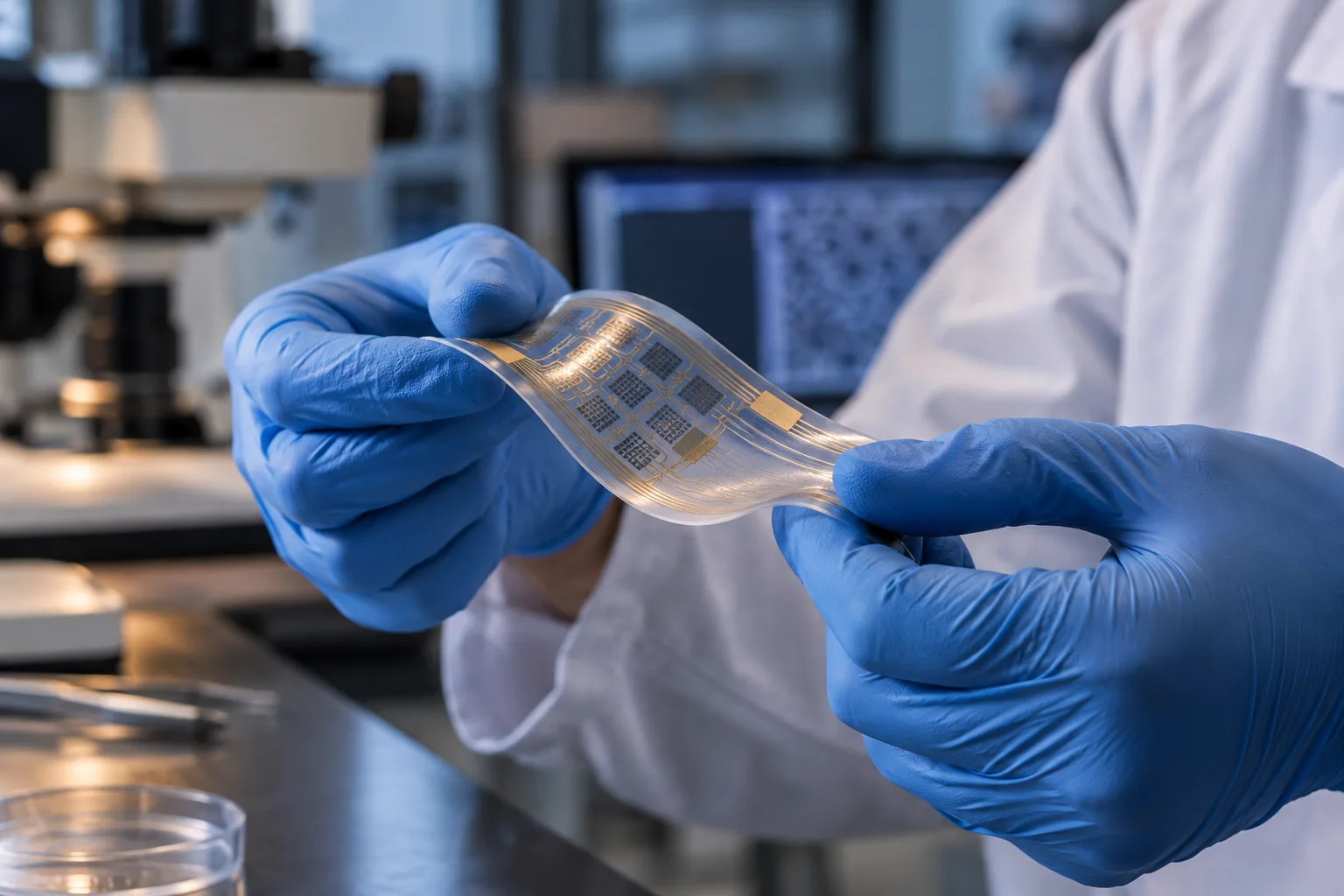
A first version would be a wearable research prototype: a stretchable pressure-sensing sheet on a prosthetic fingertip, with a small circuit that turns pressure into a simple signal. A separate non-neural cue, such as vibration on a fixed spot of the residual limb, would show when and roughly how hard the fingertip is pressing. Neither enabling technology profile covers this cue, so it is a design assumption that would need its own testing. The prototype would assume the hand's existing grip controls and would not use an implant, because the enabling technologies have not shown a safe, reliable sensory route into the nervous system in people.
Enabling technology
- Brain-computer interfaces: Brain-computer interfaces read electrical activity from the brain and turn it into text, speech or device commands. Research teams have decoded attempted speech from implanted electrodes, and one company has tested an implant placed through blood vessels. A September 2026 study used electrodes on the brain's surface to control a virtual avatar in two of three people with paralysis. Only a small number of people have been studied in all of this work.
- Electronic skin: Electronic skin is a family of thin, flexible or stretchable electronic sheets that sense touch, pressure, temperature or body signals in the way human skin does. Laboratory prototypes have shown pressure mapping, skin-mounted health sensing and stretchable transistor circuits. A 2026 study used soft optical waveguides to reconstruct the three-dimensional shape of a sensing sheet, but this remains a research demonstrator rather than a ready-to-wear system.
What stands in the way
- Stretchable electronic circuits still change their electrical behaviour under strain. In one leading demonstration cited in the electronic-skin profile, transistor mobility varied within one order of magnitude over 1,000 cycles at 100% strain. A fingertip sensor would need to hold its calibration through daily wear, sweat and bending.
- Device density in stretchable arrays is far below that of silicon electronics, so a fingertip may give only coarse pressure information rather than fine detail of texture or shape.
- Most electronic-skin demonstrations show one or a few sensing functions at a time. Combining many sensing modes, power, processing and a wireless link in one soft sheet remains difficult, according to the electronic-skin profile, and has not been shown in a soft fingertip.
- A direct route from touch sensing into the nervous system is shown only with neurons in a dish or in animal models, according to the electronic-skin profile. Brain-computer interface work reports decoding of signals in very few people with severe paralysis, so neither profile supports a sensory implant as a near-term option.
- Any implanted or surgical route would need safety evidence well beyond current studies. The brain-computer interface profile notes that the endovascular safety results cover four analysed patients (five enrolled) over 12 months, which is too few to show rare risks.
A cheap way to test it
Bench test only, with no people and no implant. Mount a pressure-sensing sheet on a silicone or 3D-printed fingertip fixed to a rig with a calibrated reference load cell. Before testing, write down the force range, the maximum error, the maximum allowed drift and the fixed number of bending cycles. Press with known forces across the force range, applied in random order, and record the sensor output against the reference at each step. Measure drift as the change in output at a repeat reference load compared with the baseline reading. Pass if the output stays within the maximum error across the full force range, and if drift stays within the maximum allowed drift after the bending cycles and after the sheet is wetted with artificial sweat. Fail if any limit is exceeded. Review the result before any further work, and do not start any human trial on the strength of this test alone.