Solid-state lidar
Also known as Solid-state LiDAR, Non-mechanical lidar
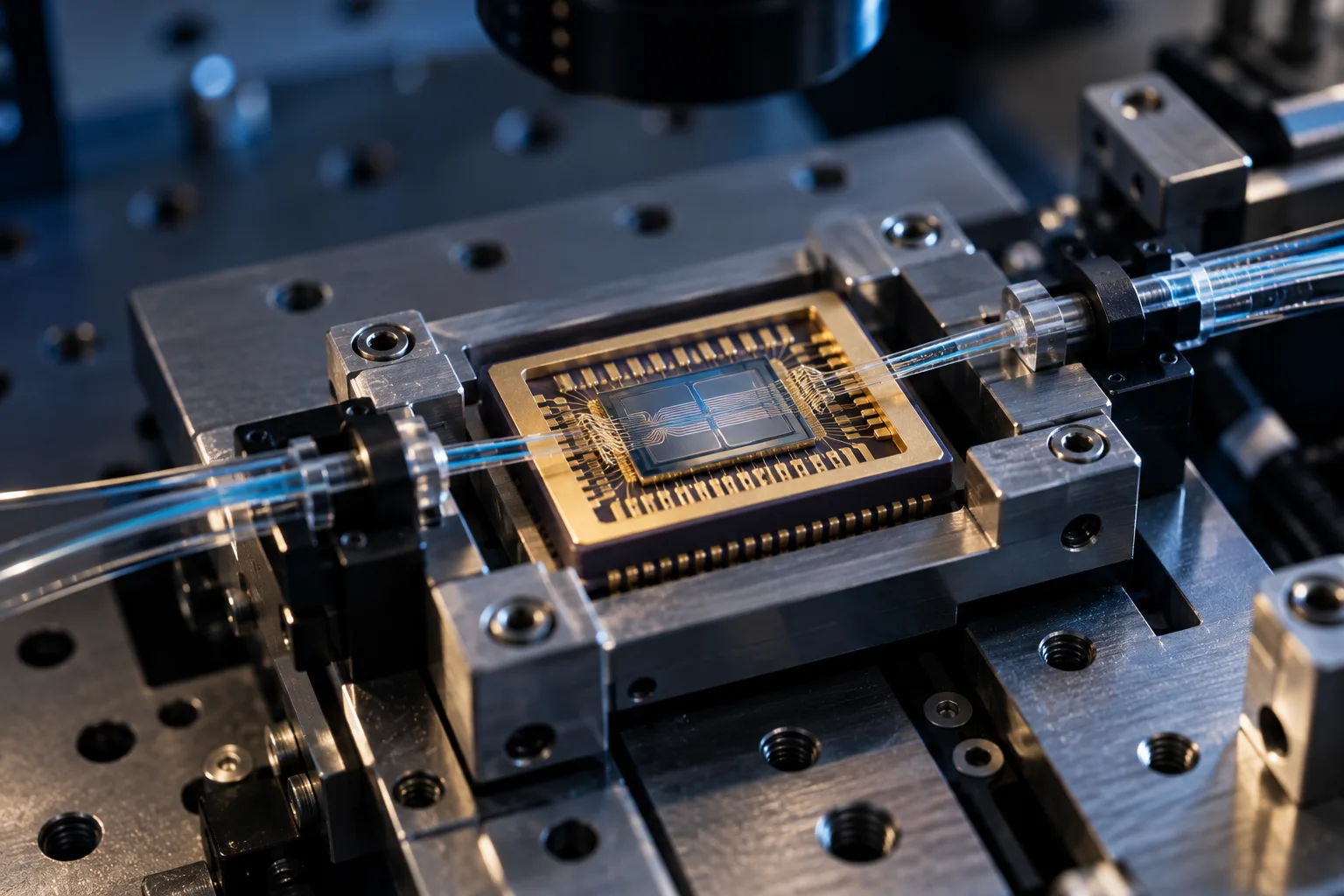
Solid-state lidar measures distance with laser light using few or no large moving parts. It uses flash illumination, optical phased arrays or chip-scale FMCW. Chip results have been shown in the laboratory, but independent evidence of long-range, low-cost sensors in production is still limited.
In plain language
Many lidar sensors on cars and robots spin or swing a mirror to aim a laser across a scene, then time how long the light takes to bounce back. Solid-state lidar removes most of those large moving parts. It aims the light electronically, floods the scene with one laser pulse, or uses a silicon chip that steers or measures many beams at once.
The appeal is durability and size. A sensor with no large moving parts can be smaller, easier to build in large numbers and less affected by vibration. The trade-offs are range, field of view and how much light can be sent out safely. Several designs are competing, and most of the evidence so far comes from laboratory chips and early products.
Technical explanation
Solid-state designs fall into a few families. Flash lidar illuminates the whole field of view at once and reads the return on a two-dimensional detector array, so it works like a camera with its own light source. Optical phased arrays (OPAs) steer a beam by setting the phase of light from many emitters on one chip, so that the waves add up in a chosen direction. MEMS mirror systems still move, but at micro scale, which places them between mechanical and fully solid-state designs. Frequency-modulated continuous-wave (FMCW) lidar sends a chirped laser and measures the frequency shift of the returning light, which gives range and radial velocity from each measurement, and it can be built on silicon photonic chips.
Chip results show what is possible at small scale. Martin and colleagues (2018) reported an integrated FMCW lidar on silicon that detected a moving hard target at up to 60 m with less than 5 mW of output power, with waveform calibration, scanning and balanced detectors on one chip. A 2026 dataset from Pointcloud GmbH describes a 352 by 176 pixel coherent FMCW focal plane array that combines radial velocity with 3D point clouds, and shows point clouds of objects 4 to 65 m away. Poulton and colleagues (2017) reported large silicon nitride phased arrays that gave a near-diffraction-limited beam at 1550 nm in the laboratory. These are laboratory or dataset results and are not, on their own, proof of a road-going sensor.
The open questions are range under eye-safety limits on emitted power, performance at long distances and in poor weather, and manufacturing yield and cost for each approach. Independent comparisons are rare. Royo and Ballesta-Garcia (2019) note that the performance data for each approach often come from different manufacturers and developers, which makes like-for-like comparison difficult.
What the evidence says
Each statement is typed by the strength of its evidence and linked to the source that supports it.
Demonstrated Shown in a published experiment, test or shipping product.
An integrated FMCW lidar on a silicon chip detected a moving hard target at up to 60 m with less than 5 mW of output power, with waveform calibration, scanning and balanced detectors on the same chip.
Sources: [1] · Abstract (via Semantic Scholar)A chip-scale electro-optical 3D FMCW lidar reported at ISSCC 2016 achieved 8 micrometre ranging precision.
Sources: [3] · Title · medium confidenceLarge silicon nitride optical phased arrays with a 4 mm by 4 mm infrared aperture at 1550 nm gave a near-diffraction-limited spot of 0.021 degrees by 0.021 degrees in the laboratory.
Sources: [2] · Abstract · medium confidenceLuminar, a lidar supplier with a Volvo programme, filed for Chapter 11 bankruptcy protection in the Southern District of Texas on 15 December 2025, after Volvo ended a supply relationship for its lidar products, according to a Luminar filing reported in the press.
Sources: [6] · Article bodyThe Pointcloud dataset is company-authored, and the journal of its associated paper is not named on the dataset page.
Sources: [5] · Dataset pageReported, unverified Stated by a company or team but not independently confirmed.
A coherent FMCW focal plane array with 352 by 176 pixels, described in a Pointcloud GmbH dataset, combines radial velocity with 3D point clouds and shows point clouds of objects 4 to 65 m away. The dataset describes per-pixel integration compatible with frame rates of 3 to 15 fps.
Sources: [5] · Dataset description (company-authored; associated paper not named) · medium confidenceRoyo and Ballesta-Garcia note that performance data for each lidar approach often come from different manufacturers and developers.
Sources: [4] · Text as quoted via Semantic Scholar; MDPI page returned HTTP 403 in this pass · medium confidenceLimitations and open problems
- Optical phased arrays steer light electronically, but the sources reviewed show laboratory-scale arrays. They do not show verified long-range performance in a road-going sensor.
- The ranges in the sources reviewed are 60 m for the chip-scale FMCW lidar and 4 to 65 m for the Pointcloud sensor. The sources give no verified performance beyond those ranges, or in poor weather.
- The sources reviewed did not give verified cost figures for solid-state units, so the cost case for any design remains unproven in this profile.
- Supplier risk is shown by Luminar, a lidar supplier with a Volvo programme, which filed for Chapter 11 bankruptcy protection in December 2025 after Volvo ended a supply relationship for its lidar products.
- Royo and Ballesta-Garcia (2019) note that performance data for each lidar approach often come from different manufacturers and developers, which makes like-for-like comparison hard.
Possible future uses
Ideas, not predictions. None of these has been demonstrated.
- Lidar on drones and small robots, where size, weight and vibration tolerance matter more than long range.
- Lidar sensors built flush into vehicle body panels, so that sensing blends into the car's design.
- Velocity-measuring FMCW pixels that help track pedestrians and cyclists at short range in busy urban streets.
Product concepts: Portable unit that warns drivers before they hit a parked car
Timeline
- Feb 2016An ISSCC 2016 paper reports a chip-scale electro-optical 3D FMCW lidar with 8 micrometre ranging precision. Sources: [3]
- 2017Optics Letters reports large silicon nitride optical phased arrays with a 4 mm by 4 mm infrared aperture at 1550 nm, giving a near-diffraction-limited spot. Sources: [2]
- 2018Journal of Lightwave Technology reports silicon-chip FMCW lidar detecting a moving hard target at up to 60 m with less than 5 mW of output power. Sources: [1]
- 15 Dec 2025Luminar files for Chapter 11 bankruptcy protection in the Southern District of Texas, after Volvo ended a supply relationship for its lidar products. Sources: [6]
- 13 Feb 2026Pointcloud GmbH publishes a dataset for a 352 by 176 pixel coherent FMCW focal plane array, with point clouds for objects 4 to 65 m away. Sources: [5]
Futures this could help bring about

Glossary
- Time of flight
- A distance measurement method that times how long a light pulse takes to travel to an object and back.
- FMCW (frequency-modulated continuous-wave)
- A method in which a laser's frequency is swept, so that the frequency shift of the returning light gives range and velocity.
- Optical phased array
- A set of light emitters on one chip whose phases are controlled so that the combined beam points in a chosen direction without moving parts.
- Flash lidar
- A lidar that lights the whole scene at once and reads the return on a detector array, like a camera with a laser light source.
Sources
- peer reviewed paper
Photonic Integrated Circuit-Based FMCW Coherent LiDAR
Aude Martin, Delphin Dodane, L. Leviandier et al.. Journal of Lightwave Technology, 28 May 2018. DOI: 10.1109/jlt.2018.2840223. Accessed 21 Oct 2026. - peer reviewed paper
Large-scale silicon nitride nanophotonic phased arrays at infrared and visible wavelengths
Christopher V. Poulton, Matthew J. Byrd, Manan Raval et al.. Optics Letters, 20 Dec 2016. DOI: 10.1364/OL.42.000021. Accessed 21 Oct 2026. - conference paper
11.8 Chip-scale electro-optical 3D FMCW lidar with 8μm ranging precision
Behnam Behroozpour, Phillip A. M. Sandborn, N. Quack et al.. IEEE International Solid-State Circuits Conference (ISSCC), Feb 2016. DOI: 10.1109/isscc.2016.7417983. Accessed 21 Oct 2026. - review article
An overview of lidar imaging systems for autonomous vehicles
Santiago Royo, Maria Ballesta-Garcia. Applied Sciences, 30 Sept 2019. DOI: 10.3390/app9194093. Accessed 21 Oct 2026. - dataset
A large-scale coherent 4D imaging sensor
Francesca Fabiana Settembrini, Arif Can Gungor, Andres Forrer et al.. Dryad, 13 Feb 2026. DOI: 10.5061/dryad.6t1g1jxcm. Accessed 21 Oct 2026. - news
Luminar Files for Bankruptcy After Losing Volvo Contract
Reshmi Basu. Bloomberg News, republished by Transport Topics (TTNews), 15 Dec 2025. Accessed 21 Oct 2026.
Revision history
3 changes since this profile was created.