Google Quantum AI reports surface code memories operating below the error-correction threshold
What was demonstrated
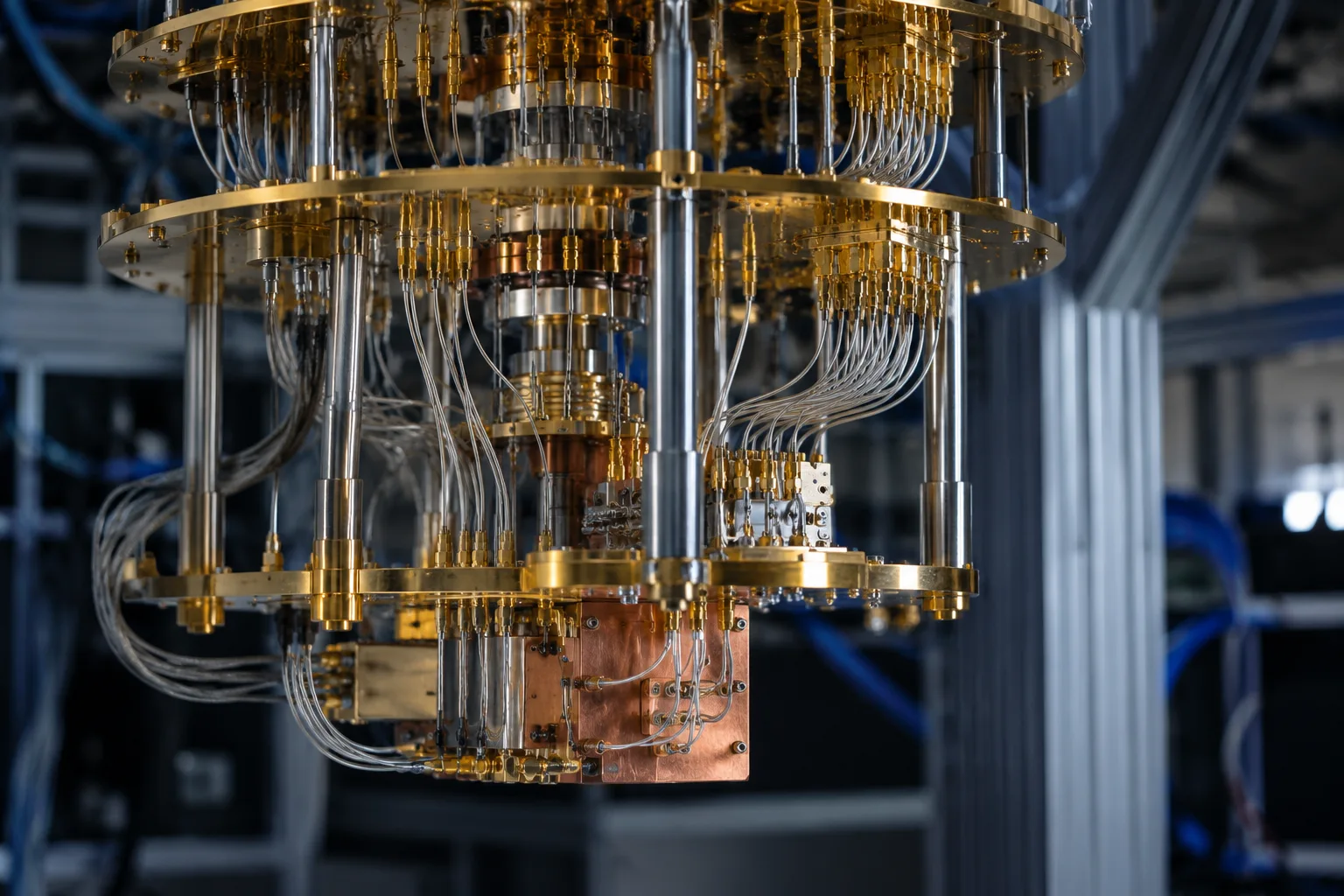
On the Willow superconducting processor, the team ran a distance-7 surface code memory (101 qubits) and a distance-5 memory with a real-time decoder. Logical error per cycle fell by a factor of 2.14 (plus or minus 0.02) each time code distance increased by 2, reaching 0.143% per cycle at distance 7. The distance-7 logical memory outlived the best physical qubit on the chip by a factor of 2.4 (plus or minus 0.3). Real-time decoding at distance 5 ran for up to a million cycles with an average decoder latency of 63 microseconds and a 1.1 microsecond cycle time.
Why it matters
Exponential suppression of logical error with code size only happens below a threshold physical error rate. This is a peer-reviewed measurement of that scaling regime on superconducting hardware, which is a precondition for fault-tolerant quantum computing.
Caveats
- The experiment stores quantum information (a memory); it does not run a useful fault-tolerant algorithm.
- Repetition-code runs up to distance 29 showed logical performance limited by rare correlated error events, roughly once per hour or every 3 billion cycles.
- Practical algorithms are expected to need far larger code distances and many more logical qubits than shown here.
Technology profiles
Sources
- peer reviewed paper
Quantum error correction below the surface code threshold
Google Quantum AI and Collaborators. Nature, 9 Dec 2024. DOI: 10.1038/s41586-024-08449-y.
Last reviewed 20 Oct 2026.