Quantum error correction
Also known as Quantum error-correcting codes, Logical qubits
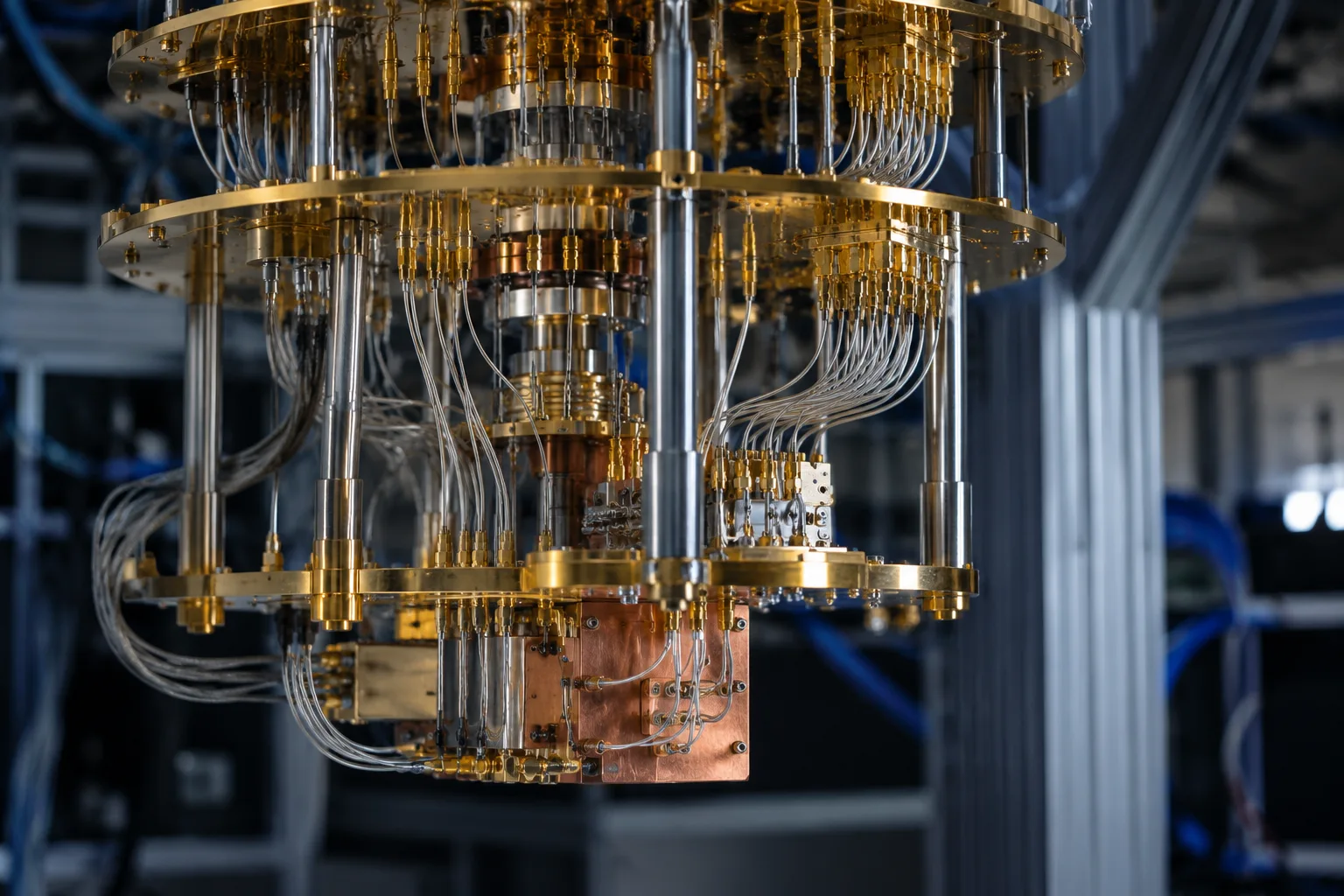
Quantum error correction spreads information across many fragile physical qubits so that errors can be spotted and fixed. In 2024 a Google team reported a superconducting memory whose error rate fell as its error-correcting code grew, but the sources reviewed here describe memories, not useful calculations.
In plain language
Quantum computers store information in qubits, which are easily upset through heat, noise and stray interactions. A single disturbed qubit can spoil a whole calculation. Quantum error correction spreads one piece of information across many physical qubits, so that errors can be detected and corrected without reading the stored answer directly.
In 2024 Google reported a superconducting chip where a larger error-correcting code made the stored information less error-prone, not more. That result shows the error rate can fall as the code grows, which is the central requirement for the approach. Building enough reliable qubits for useful calculations is still a long way off.
Technical explanation
Shor's 1995 scheme showed that one logical qubit could be encoded in an entangled state of nine physical qubits, so that errors could be detected from comparisons across groups of qubits without measuring the encoded information itself. The scheme assumed that errors act independently on each stored bit. Later codes, including the surface code, arrange qubits on a two-dimensional grid and check neighbouring groups repeatedly, which suits chips where each qubit links mainly to its nearest neighbours.
Google's 2024 experiment (Acharya and colleagues, Nature) ran distance-5 and distance-7 surface codes on its Willow superconducting processor, with a real-time decoder that reads error signals and sends corrections. Increasing the code distance from 5 to 7 reduced the logical error rate 2.14-fold. The 101-qubit distance-7 memory reached about 0.143% error per correction cycle. These are laboratory results on one platform, measured over a limited set of cycles.
The open problems are scale and speed. Useful machines are expected to need many logical qubits, each built from many physical qubits, and the classical decoder must keep pace with them. The same work found that repetition codes hit a ceiling from rare correlated error events, roughly once an hour. Whether this performance would hold at the scale needed for large fault-tolerant algorithms has not yet been shown.
What the evidence says
Each statement is typed by the strength of its evidence and linked to the source that supports it.
Demonstrated Shown in a published experiment, test or shipping product.
Google's Willow processor ran surface code memories at distance 5 and distance 7, with the larger memory using 101 physical qubits.
Sources: [1], [2] · AbstractIncreasing the code distance from 5 to 7 reduced the logical error rate 2.14-fold (error suppression factor of 2.14 plus or minus 0.02).
Sources: [1], [2] · AbstractThe distance-7 logical memory reached an error rate of about 0.143% per correction cycle.
Sources: [1] · AbstractIn the reported experiment, the distance-7 logical memory lasted about 2.4 times longer than its best physical qubit.
Sources: [1] · Abstract · medium confidenceReal-time decoding kept the distance-5 memory below threshold, with average decoding latency of about 63 microseconds.
Sources: [1] · Abstract · medium confidenceRepetition codes in the same work hit a ceiling from rare correlated error events, roughly one per hour.
Sources: [1] · Abstract · medium confidenceProposed A design or plan that has not yet been built or tested.
Speculative An idea or possible use. Not evidence of anything.
Whether this approach can scale to the number of qubits needed for useful calculations has not yet been shown.
Sources: [1] · Abstract · medium confidenceLimitations and open problems
- The best-documented result comes from a single superconducting platform and a limited range of code sizes.
- Rare correlated error events limit repetition codes at larger distances (Acharya and colleagues, 2024), and the sources reviewed here do not show whether the surface code avoids them.
- Real-time decoding has to keep pace with the qubits, which adds a heavy classical computing load.
- A useful logical qubit needs many physical qubits, and the sources reviewed here do not give a verified overhead figure.
- Shor's 1995 scheme assumed that errors act independently on each stored bit, which real hardware may not satisfy.
Possible future uses
Ideas, not predictions. None of these has been demonstrated.
- Chemistry and materials simulations too large for classical computers, run on fault-tolerant machines whose results can be trusted.
- Stable logical qubits as the memory layer in future quantum networks.
- Optimisation problems where error-free runs would give results that users can rely on without repeating them.
Timeline
- 1 Oct 1995Peter Shor publishes a scheme for reducing decoherence in quantum computer memory in Physical Review A, encoding one qubit across nine entangled qubits. Sources: [3], [4]
- 24 Aug 2024Google Quantum AI and collaborators post a preprint describing surface code memories below the threshold on the Willow processor. Sources: [2]
- 9 Dec 2024Nature publishes 'Quantum error correction below the surface code threshold', reporting a distance-7 logical memory with 101 physical qubits. Sources: [1]
Futures this could help bring about
Related breakthroughs
Glossary
- Qubit
- The basic unit of quantum information, which can hold a mix of 0 and 1 at the same time.
- Logical qubit
- One error-protected unit of information, built from many physical qubits working together.
- Surface code
- An error-correcting code that arranges qubits on a grid and checks neighbouring groups repeatedly.
- Decoder
- The classical software that reads error signals from a quantum chip and decides which corrections to apply.
Sources
- peer reviewed paper
Quantum error correction below the surface code threshold
Rajeev Acharya, Google Quantum AI and Collaborators. Nature, 9 Dec 2024. DOI: 10.1038/s41586-024-08449-y. Accessed 21 Oct 2026. - preprint
Quantum error correction below the surface code threshold
Rajeev Acharya, Google Quantum AI and Collaborators. arXiv, 24 Aug 2024. Accessed 21 Oct 2026. - peer reviewed paper
Scheme for reducing decoherence in quantum computer memory
Peter W. Shor. Physical Review A, 1 Oct 1995. DOI: 10.1103/PhysRevA.52.R2493. Accessed 21 Oct 2026. - other
Quantum Milestones, 1995: Correcting Quantum Computer Errors
David Lindley. Physics (American Physical Society), 14 Mar 2025. Accessed 21 Oct 2026.
Revision history
1 change since this profile was created.
What it took to get here
The inventions this technology was built on, oldest foundations at the top. Lines show what each one required.
- 1995Quantum error correctionLab demonstrationRequires: Topological qubits. Being researched.