Quantum technologies
Computing, sensing and communication using quantum effects.
Technology profiles
Analogue quantum simulation
Analogue quantum simulators are programmable devices, built from cold atoms, Rydberg atom arrays or trapped ions, that are tuned to behave like a chosen quantum model so that researchers can study its physics. Published experiments reach up to 256 atoms or ions and reproduce known phases of matter, while claims of practical advantage over classical computers are early and hard to verify.
Neutral-atom quantum computers
Neutral-atom quantum computers hold individual atoms in optical tweezers and use their internal states as qubits, with laser-driven links between neighbouring atoms. Since 2023, research groups have reported high-fidelity two-qubit gates, small logical-qubit processors and arrays of thousands of atoms, but no neutral-atom machine has yet run a large, error-corrected calculation.
Optical atomic clocks
Optical atomic clocks keep time by counting the oscillations of light that atoms or ions absorb, which occur at much higher frequencies than the microwaves used by today's caesium standard. Laboratory systems now report systematic uncertainties near 10⁻¹⁸, and the BIPM is preparing a redefinition of the SI second based on optical transitions, with CGPM adoption anticipated in 2030 or later.
Photonic quantum computers
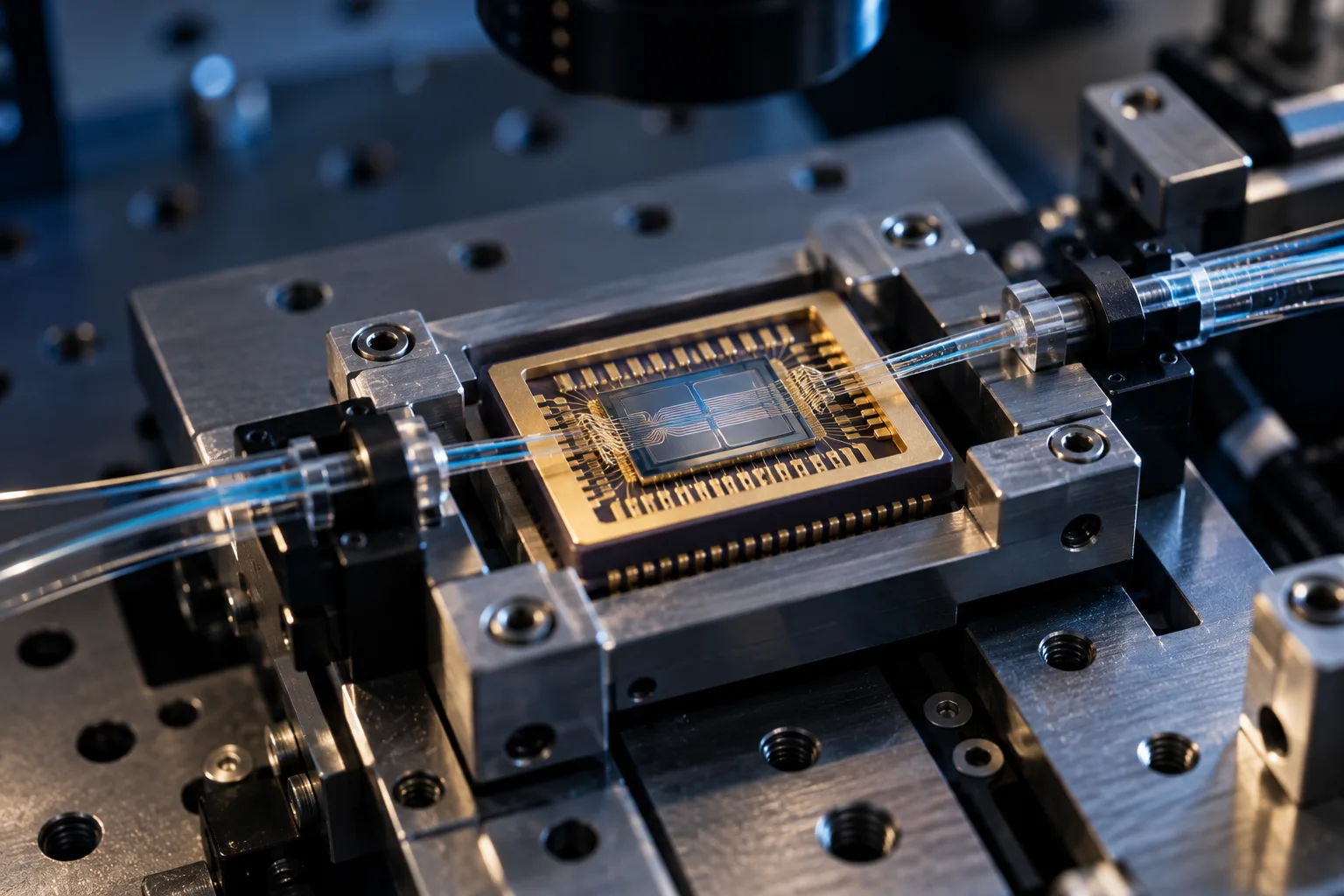
Photonic quantum computers use single particles of light, photons, as qubits and move them through chips and optical fibre. Companies such as Xanadu, PsiQuantum and Quandela have reported working prototypes and chip-level component results, but photon loss is a major barrier to building error-corrected machines at useful scale.
Post-quantum cryptography
Post-quantum cryptography is a set of new encryption and signature methods designed to stay secure if large quantum computers are built. NIST finalised its first three standards in August 2024, and governments such as the UK have set migration targets running to 2035.
Quantum annealing
Quantum annealing uses special-purpose quantum hardware, such as D-Wave's annealers, to search for low-energy answers to optimisation and simulation problems. Whether these machines beat the best classical methods is still disputed: early tests found no clear speed-up, and a 2025 claim of beyond-classical simulation has been challenged by classical researchers.
Quantum error correction
Quantum error correction spreads information across many fragile physical qubits so that errors can be spotted and fixed. In 2024 a Google team reported a superconducting memory whose error rate fell as its error-correcting code grew, but the sources reviewed here describe memories, not useful calculations.
Quantum gravimetry
Quantum gravimetry uses laser-cooled atoms to measure tiny changes in gravity, which can hint at voids, water or rock structure underground without drilling. Field and airborne tests have been reported, but survey speed and the lack of head-to-head tests against conventional methods still limit practical use.
Quantum key distribution
Quantum key distribution (QKD) lets two parties agree a shared secret key using quantum states of light, so that interception can be detected. Field experiments have reached over 1,000 km of fibre and a satellite-to-ground link, but the UK National Cyber Security Centre does not endorse QKD for government or military use.
Quantum memories
Quantum memories are devices that take a quantum state carried by light, hold it, and release it later. A solid-state memory has reached efficiency of up to 69%, and nuclear spin coherence has been measured for hours, but the best results come from separate experiments, and none of the sources reviewed shows a memory that combines long storage, high efficiency and high fidelity in one device.
Quantum random number generators
Quantum random number generators (QRNGs) turn measurements of quantum processes into random bits, and at least one smartphone has carried a chip-scale version. Whether this adds security over well-engineered classical sources is an open question, and the sources reviewed here give no public throughput figures for consumer chips.
Quantum repeaters and quantum networks
Quantum repeaters use quantum memories to store entanglement while it is passed along a chain of links, so that entanglement can reach beyond the distance that a single optical fibre allows. Small laboratory networks with two or three nodes, some linked over deployed fibre, have now been reported, but the sources reviewed here show no repeater chain yet working over long distances.
Quantum sensors
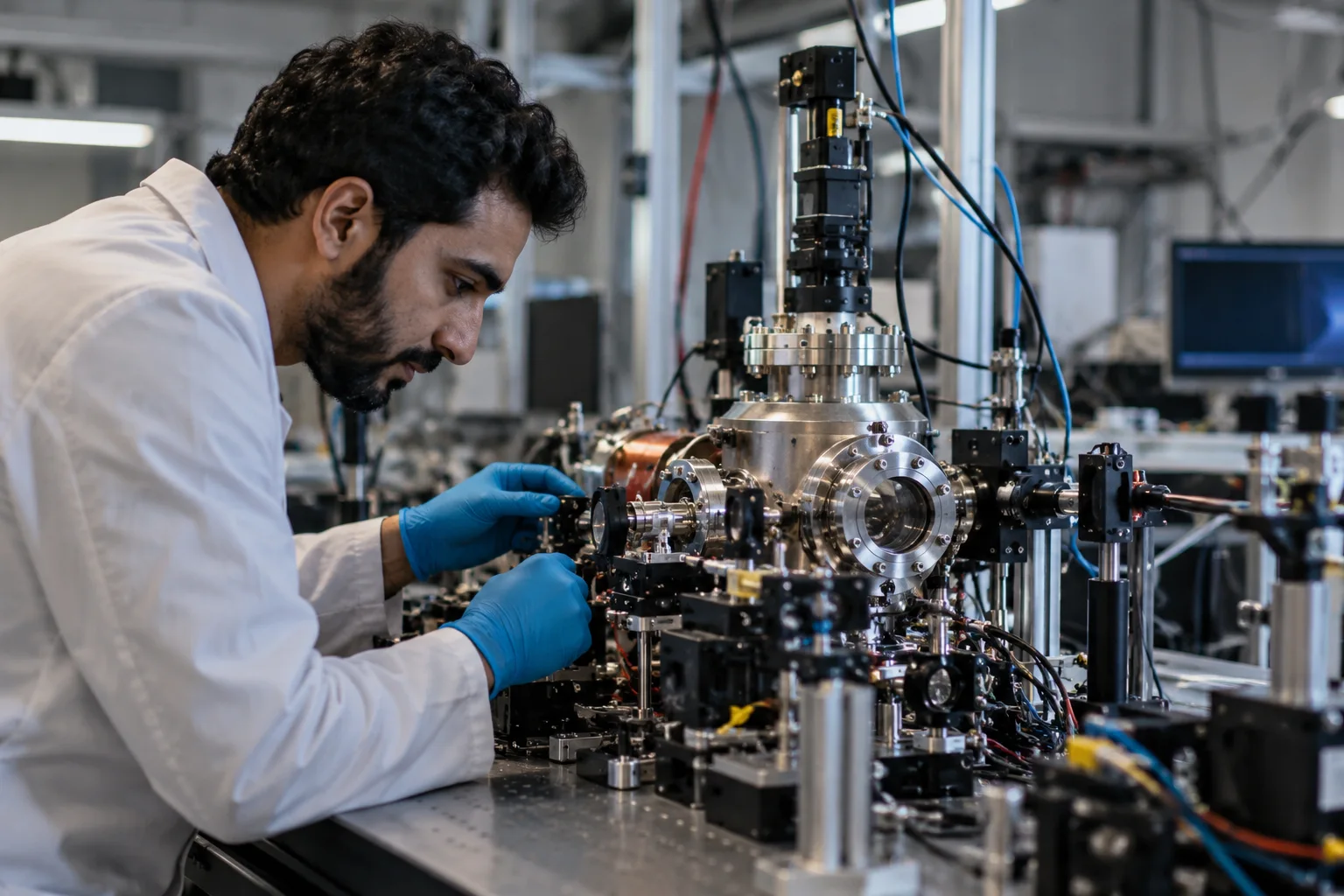
Quantum sensors use fragile quantum effects, such as the behaviour of single atoms or spins, to measure things like time, magnetic fields, gravity and motion very precisely. Optical atomic clocks and cold-atom systems have moved from the laboratory into early field trials, including a 2024 UK flight test of navigation components.
Silicon spin qubits
Silicon spin qubits store quantum information in the spin of a single electron held in a tiny silicon structure. Recent results show two-qubit devices made in a 300 mm semiconductor foundry reaching gate fidelities above 99%, but these are small arrays and the field has not yet shown error-corrected logical qubits.
Superconducting quantum computers
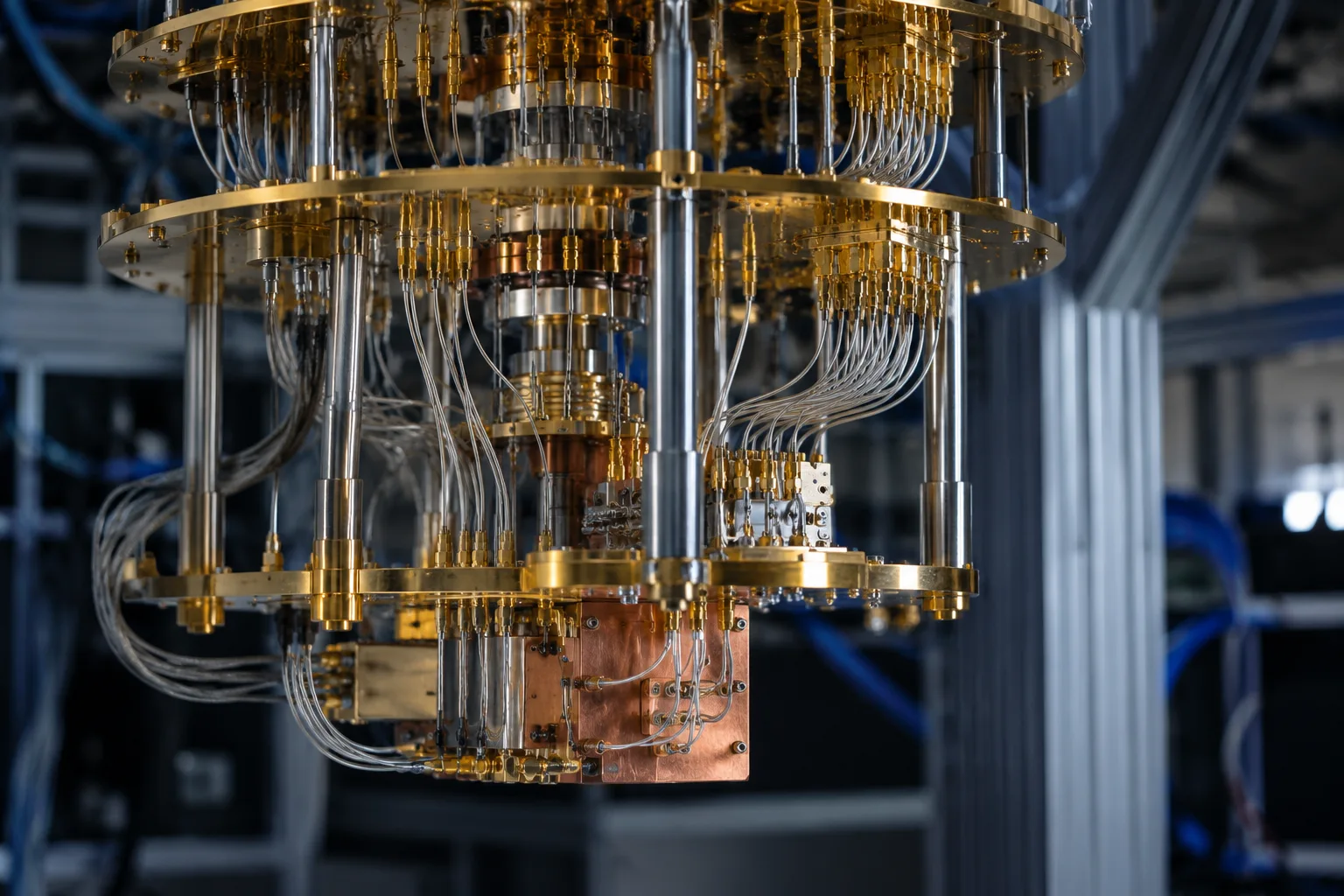
Superconducting quantum computers use tiny electrical circuits, cooled until they lose all electrical resistance, to store and process quantum information. Google has shown error-correction memory results on its superconducting chips, and IBM reports gate-quality figures for its own processors, but the machines are still research-scale and far from running long, useful fault-tolerant calculations.
Topological qubits
Topological qubits aim to store quantum information in Majorana zero modes, which could make the stored information less sensitive to local noise. Microsoft's 2025 Majorana 1 announcement and parity-readout paper are contested, and the existence of a working topological qubit is not yet established.
Trapped-ion quantum computers
Trapped-ion quantum computers store each qubit in a single charged atom held in place by electromagnetic fields. Vendor-reported figures for the 98-qubit Quantinuum Helios system show two-qubit gate errors of about 8 in 10,000, but gate speed, scaling and independent verification remain open questions.
How far away are we?
A quantum internet
Engineering prototypes · 4 of 7 steps done
An internet protected against quantum attacks
Scaling up · 3 of 8 steps done
Navigating without GPS using quantum sensors
Engineering prototypes · 5 of 8 steps done
Quantum computers solving useful chemistry problems
Science demonstrated · 3 of 7 steps done
Quantum computers that can break today's encryption
Engineering prototypes · 3 of 8 steps done
Quantum machines beating supercomputers on real problems
Science demonstrated · 5 of 7 steps done
Redefining the second with optical clocks
Engineering prototypes · 4 of 10 steps done
Storing quantum information long enough for a quantum internet
Engineering prototypes · 5 of 7 steps done
Breakthroughs
Neutral-atom system with up to 448 atoms reports below-threshold error correction
Using reconfigurable arrays of up to 448 neutral atoms, the team ran repeated surface-code error correction and reported below-threshold performance, with a suppression factor of 2.14 ± 0.13 in a four-round characterisation circuit. The system used atom loss detection and machine-learning decoding. The preprint abstract also says the team investigates logical entanglement using transversal gates and lattice surgery, and covers universal logic through transversal teleportation with 3D [[15,1,3]] codes. The abstract gives no logical error rates or logical fidelities.
Quantinuum Helios preprint reports averaged gate and state-preparation errors for a 98-qubit trapped-ion system
In an arXiv preprint, Quantinuum reports averaged error rates across all operational zones of its 98-qubit Helios trapped-ion system. The average infidelity was 2.5(1) × 10⁻⁵ for single-qubit gates, 7.9(2) × 10⁻⁴ for two-qubit gates and 4.8(6) × 10⁻⁴ for state preparation and measurement. The authors say these limits are not fundamental and could likely be improved. The authors also state that Helios operates well beyond the reach of classical simulation in random circuit sampling.
Google reports a superconducting chip run estimated to take 13,000 times longer classically
On its Willow superconducting processor, Google Quantum AI ran a benchmark circuit set measuring second-order out-of-time-order correlators (OTOC(2)). The run took about 2 hours. Google estimates the same task would take about 13,000 times longer on a classical supercomputer, compared with the best classical algorithm it could find. A set of second-order OTOC values measured on Willow is estimated to take about 3.2 years per data point to simulate on the Frontier supercomputer, according to a figure caption. The classical estimate rests on red-teaming by the authors, which they describe as about 10 person-years of work across nine classical simulation algorithms.
Neutral-atom array holds over 3,000 atoms for more than two hours
The team reloaded a neutral-atom array at a rate of 300,000 atoms per second, producing over 30,000 initialised qubits per second. Using this loading scheme, they assembled and maintained an array of more than 3,000 atoms for over two hours. The authors report that refilling the array with atoms in either a spin-polarised or a superposition state preserved the quantum states of qubits already stored. The result shows continuous operation and reloading of a large array; it does not report a logical qubit or an error-corrected calculation.
Logical qutrit and ququart memories exceed break-even in bosonic error correction
In an experiment reported in Nature, a logical qutrit (d=3) and a logical ququart (d=4), each encoded in a Gottesman-Kitaev-Preskill (GKP) bosonic code and used as a quantum memory, were error-corrected beyond break-even. The authors report gains of 1.82 ± 0.03 for the qutrit and 1.87 ± 0.03 for the ququart. A reinforcement learning agent was used to optimise the GKP qutrit and ququart as ternary and quaternary memories.
Twin-field quantum key distribution runs over a 254 km commercial telecom network at 110 bits per second
Pittaluga and colleagues report implementing the coherence-based twin-field QKD protocol over a 254 km commercial telecom network, achieving encryption key distribution at 110 bits per second. The accessible abstract does not give the link endpoints, the cooling or detector method, or the network operator, so the record does not state them.
A quantum microsatellite distributes real-time keys to portable ground stations, linking Beijing and Stellenbosch
Li, Cai, Ren, Pan, Peng, Liao and colleagues at the University of Science and Technology of China report a quantum microsatellite performing space-to-ground QKD in real time with several portable ground stations. Bidirectional optical communication is multiplexed with the quantum channel, so keys can be distilled and used for encrypted communication in real time. The satellite acted as a trusted relay for key sharing between Beijing and Stellenbosch, South Africa, about 12,900 km apart. The 2024 preprint gives a payload of about 23 kg and a portable ground station of about 100 kg. The CAS press release reports up to 1 Mbit of secure key per satellite pass.
Xanadu reports Aurora, a networked photonic quantum computer built from 35 chips
Xanadu announced Aurora, a modular photonic quantum computer built from 35 photonic chips, with 12 qubits and about 13 km of fibre optics in total, described as operating at room temperature. The company says the results were published in Nature and quantified optical loss tolerances, but its announcement gives no numerical loss figure.
Google Quantum AI reports surface code memories operating below the error-correction threshold
On the Willow superconducting processor, the team ran a distance-7 surface code memory (101 qubits) and a distance-5 memory with a real-time decoder. Logical error per cycle fell by a factor of 2.14 (plus or minus 0.02) each time code distance increased by 2, reaching 0.143% per cycle at distance 7. The distance-7 logical memory outlived the best physical qubit on the chip by a factor of 2.4 (plus or minus 0.3). Real-time decoding at distance 5 ran for up to a million cycles with an average decoder latency of 63 microseconds and a 1.1 microsecond cycle time.
NIST publishes first three final post-quantum encryption and signature standards
On 13 August 2024 NIST published three final standards. FIPS 203 (ML-KEM, derived from CRYSTALS-Kyber) is the main standard for general encryption and key establishment. FIPS 204 (ML-DSA, derived from CRYSTALS-Dilithium) is the main standard for digital signatures. FIPS 205 (SLH-DSA, derived from SPHINCS+) is a stateless hash-based signature standard that NIST describes as a backup to FIPS 204, based on a different mathematical approach. The announcement does not report measured performance or deployment results.
Strontium optical lattice clock reports 8.1 × 10⁻¹⁹ total systematic uncertainty
An optical lattice clock using the ¹S₀ to ³P₀ transition in a dilute ensemble of fermionic strontium atoms, held in a shallow, vertically oriented one-dimensional optical lattice, reported a total systematic uncertainty of 8.1 × 10⁻¹⁹ in fractional frequency units. The authors state that all other systematic effects have uncertainties below 1 × 10⁻¹⁹. This is the authors' evaluation of one laboratory clock's error budget, not a measure of performance in the field.