Brain implant decodes speech and gestures together in two people with paralysis
What was demonstrated
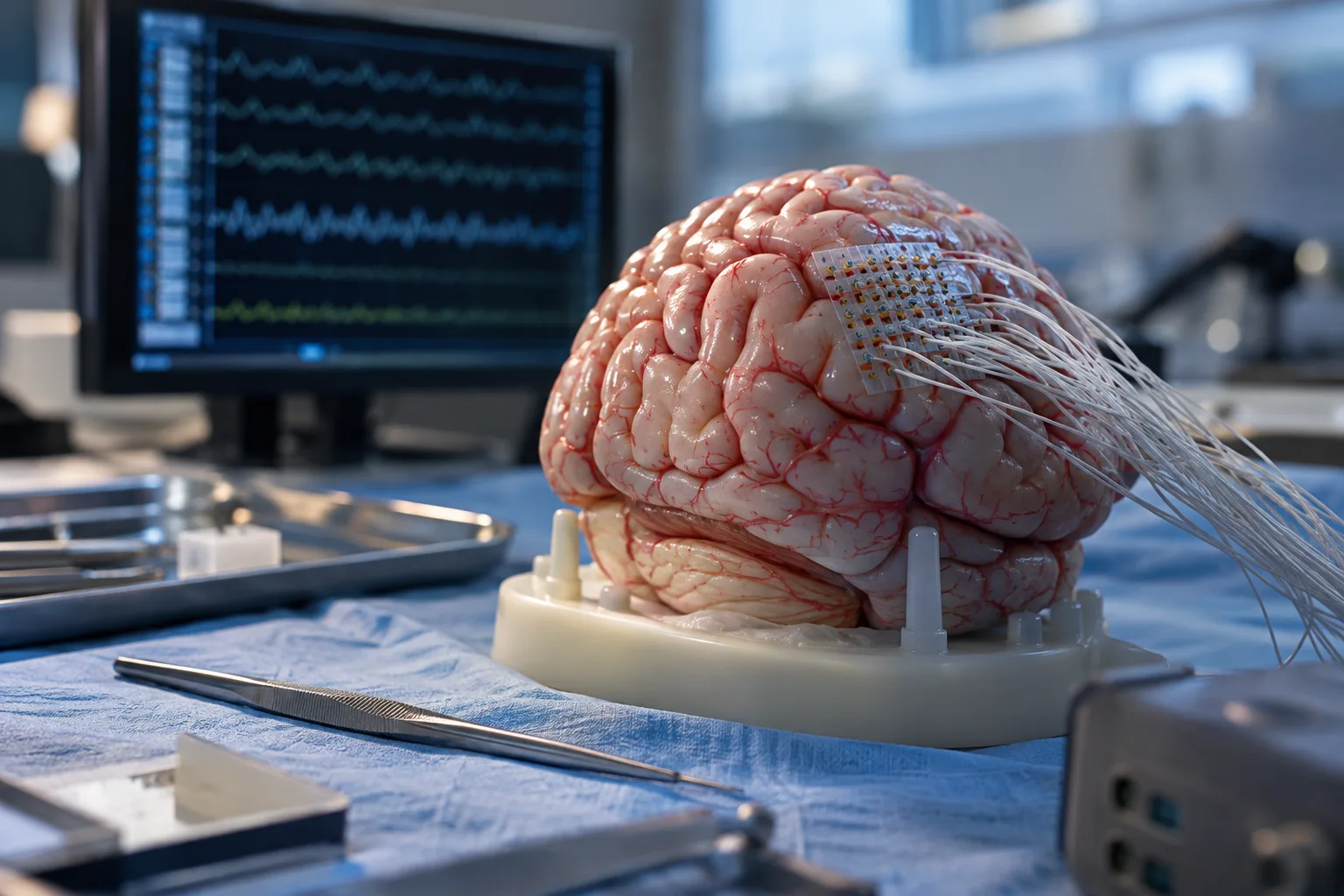
In a study of three participants with severe speech and movement impairment, a 253-channel electrocorticography (ECoG) array implanted on the pial surface of the left hemisphere, over areas of speech production and motor movement, was used for real-time decoding. Two participants (Bravo-1r and Bravo-6) completed the simultaneous speech and gesture avatar tasks; the third withdrew before that stage. In a cued conversation task with a restricted set of phrases and gestures, Bravo-6 reached 75.0% speech accuracy (95% CI 55.0 to 90.0) and 85.0% gesture accuracy (95% CI 70.0 to 100.0) over five blocks. Bravo-1r, with five phrases and four gestures, reached a median of 100% for both over three blocks. In a copy task with ten phrases and ten gestures, Bravo-6 scored 70.0% for speech and 66.0% for gestures, against chance levels of 9.1% each.
Why it matters
Decoding speech and gestures in parallel may support more expressive communication for people who cannot speak or move reliably. The authors report that generalisation to simultaneous attempts remained imperfect, possibly because of higher cognitive demand and limited simultaneous training data.
Caveats
- Only two participants completed the simultaneous tasks, and the phrase and gesture sets were small and fixed, so these figures do not describe open-ended conversation.
- The cued tasks used prompts and short blocks, which differ from spontaneous conversation.
- The system is investigational, used in a phase I early-feasibility study. It links to external equipment through a percutaneous connector and is not approved as an assistive device.
- The authors report that generalisation to simultaneous attempts remained imperfect, and that ipsilateral movements were decoded less accurately than contralateral or speech-related behaviour.
Technology profiles
Sources
- peer reviewed paper
Simultaneous speech and gesture decoding for multimodal communication in paralysis
Samantha C. Brosler, Jessie R. Liu, Alexander B. Silva et al.. Nature Neuroscience, 14 Sept 2026. DOI: 10.1038/s41593-026-02446-2.
Last reviewed 21 Oct 2026.