How far are we from drinking water pulled from dry air?
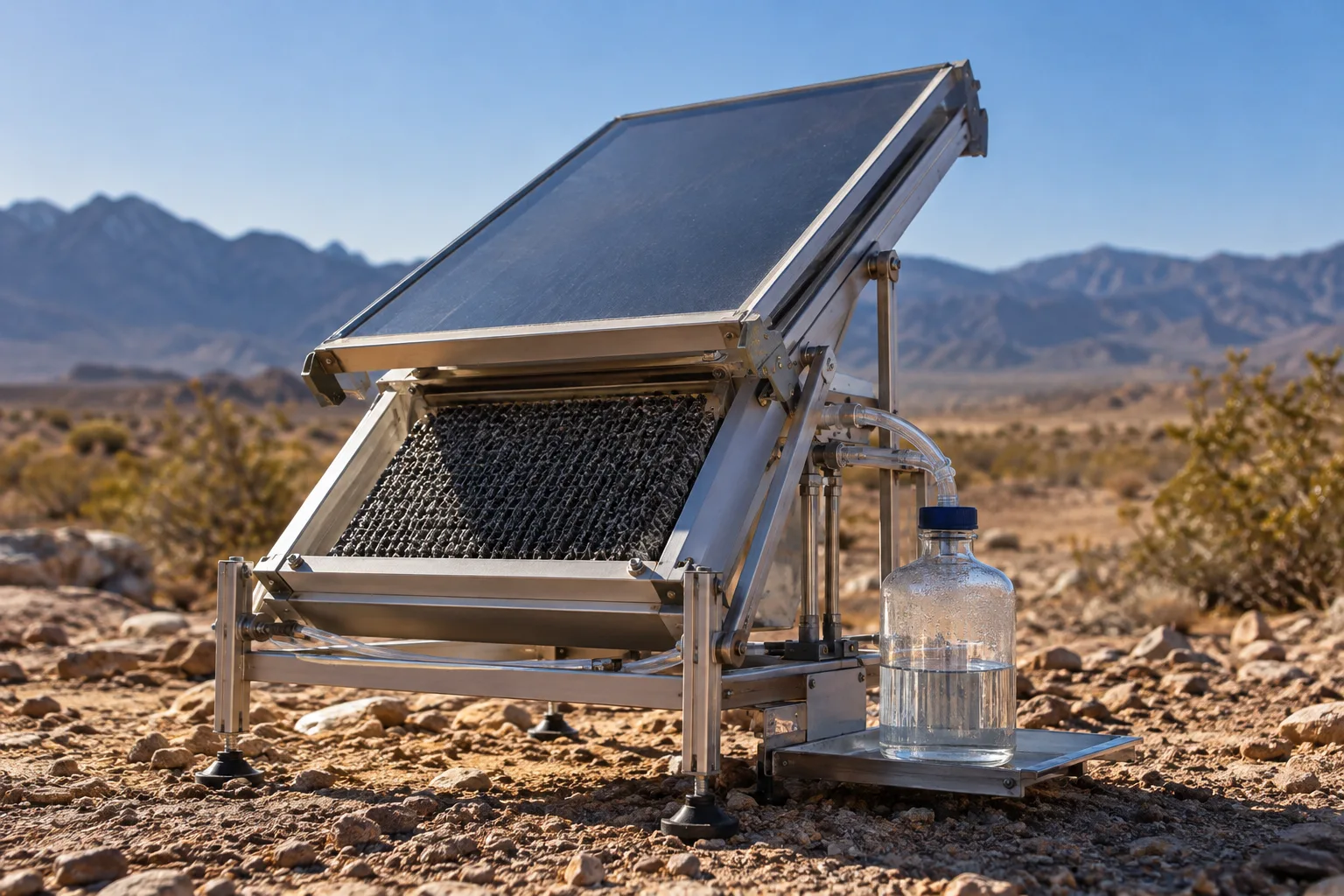
Metal-organic framework (MOF) harvesters have made water from desert air in tests in Arizona, the Mojave Desert and California. Published desert figures range from about 100 to 700 grams of water per kilogram of sorbent per day, under different conditions. Companies now plan larger containerised units, but the sources reviewed contain no independent field results for a unit that supplies households, and no cost per litre or measured energy use for a field unit.
Getting closer. Prototypes exist, but not in real-world use.
Passive prototypes have made water from desert air in outdoor tests, using kilograms of sorbent. Companies have tested prototypes in the field and plan larger units, but the sources reviewed contain no independent field results for a unit at household scale, and no pilot supplying drinking water to households. Field-tested prototypes with unverified company figures fit the engineering prototype stage.
The tech tree
Everything recorded on Vrulum that this future needs, oldest foundations at the top and the goal at the bottom. Lines show what each step requires.
- 2017Atmospheric water harvesting (MOF/sorbent based)Research and prototypesRequires: Passive daytime radiative cooling. Being researched.
- 2020Atmospheric water generatorsPilot and early commercial Unlocked.
- 2017Water captured from air at low humidity in the labDone Unlocked.
- 2018Passive prototype run outdoors in a desertDone Unlocked.
- 2019Faster cycling sorbent tested indoors and in the Mojave DesertDone Unlocked.
- 2023Two-site California field test of a MOF-303 harvesterDone Unlocked.
- Date not recordedCompany-run desert tests of a prototypeIn progress Being researched.
- Date not recordedIndependent field data on yield, energy use and water qualityNot started Locked.
- Date not recordedContainerised units supplying drinking water in an arid regionNot started Locked.
- Date not recordedCost per litre published for a field unitNot started Locked.
- GoalDrinking water pulled from dry airGoalRequires: Atmospheric water harvesting (MOF/sorbent based), Atmospheric water generators, Water captured from air at low humidity in the lab, Passive prototype run outdoors in a desert, Faster cycling sorbent tested indoors and in the Mojave Desert, Two-site California field test of a MOF-303 harvester, Company-run desert tests of a prototype, Independent field data on yield, energy use and water quality, Containerised units supplying drinking water in an arid region, Cost per litre published for a field unit. Locked.
The road so far
4 of 8 steps done, 1 in progress.
- Done · Apr 2017Water captured from air at low humidity in the lab
A MOF-801 device captured water from air at relative humidity as low as 20%, using low-grade heat from natural sunlight at a flux of less than one sun, with no additional energy input. The authors report a yield of 2.8 litres per kilogram of MOF per day under those lab conditions. [1]
- Done · Jun 2018Passive prototype run outdoors in a desert
A prototype holding up to 1.2 kg of MOF-801 produced about 100 grams of water per kilogram of MOF per day-and-night cycle in the Arizona desert, using only natural cooling and ambient sunlight. The MOF-303 sorbent gave more than twice that yield. The abstract does not state the relative humidity during the test. [2]
- Done · Aug 2019Faster cycling sorbent tested indoors and in the Mojave Desert
MOF-303 completed an adsorption and desorption cycle within minutes. The reported yield was 1.3 litres per kilogram of MOF per day indoors at 32% relative humidity and 27 degrees Celsius, and 0.7 litres per kilogram per day in the Mojave Desert, in conditions as extreme as 10% relative humidity and 27 degrees Celsius. [3]
- Done · Jul 2023Two-site California field test of a MOF-303 harvester
A research harvester run in Death Valley and Berkeley, using ambient sunlight, produced 210 grams of water per kilogram of MOF-303 per day in Death Valley and 285 grams per kilogram per day in Berkeley. It was a research device, not a household product. [4]
- In progressCompany-run desert tests of a prototype
Atoco reports testing its technology in Death Valley, and its product market specialist said the water produced was near distilled water quality. MIT Technology Review reports that Atoco plans further field tests in the Mojave Desert, scheduled for early 2026. No results from those tests were found in the sources reviewed. [6][5]
- Not startedIndependent field data on yield, energy use and water quality
No independent field test of a commercial unit, with measured yield, energy use and water quality, was found in the sources reviewed. The MIT Technology Review feature reports no independent performance data for Atoco. [5]
- Not startedContainerised units supplying drinking water in an arid region
Atoco describes a planned 20-foot containerised unit for industrial deployment, and the article gives design outputs of around 2,000 to 4,000 litres per day for on-grid units and up to 1,000 litres per day for off-grid units. The article names controlled-environment agriculture, including greenhouses and indoor farms, plus other industries, as target markets, and describes the water as a supplementary source rather than a full replacement for existing supplies. [6]
- Not startedCost per litre published for a field unit
The sources reviewed give no dollar figures for water production from a MOF-based harvester, and no measured energy use per litre for a field unit. [5]
Why it matters
Many dry and remote places have little surface or ground water that is easy to reach. A device that makes water from air without a grid connection could help where pipes do not reach. Whether it works in practice depends on yield per kilogram of sorbent, cost per litre and water quality, and none of these has yet been shown at household scale.
What stands in the way
- Output is small per kilogram of sorbent. The published desert figures, about 100 to 700 grams per kilogram per day, mean that large volumes need large amounts of sorbent.
- Yield depends strongly on humidity and temperature. The lab and field figures come from different conditions, so they are hard to compare directly.
- No independent field results for a commercial-scale unit were found. Company figures for output and water quality are unverified.
- No cost per litre has been published for a MOF-based harvester in the sources reviewed, so its cost cannot be compared with other supplies.
- Releasing the water needs heat. The industrial design described by MIT Technology Review uses electricity to speed the process, and no measured energy use per litre for a field unit was found in the sources reviewed.
- Water quality from a device must be tested independently before it is used as drinking water.
Published forecasts
What others have predicted. These are their estimates, not ours.
| Who | Forecast | Timeframe | Made |
|---|---|---|---|
| Atoco (company, as reported by AgNavigator) | The company is moving toward a commercial rollout of its atmospheric water harvesting technology within the next year. The article gives no more specific date. [6] | Not given | 21 Jan 2026 |
Signals to watch
- A peer-reviewed or independently run field test of a containerised or household unit, reporting yield per kilogram of sorbent per day, energy use and water quality.
- A published cost per litre for a MOF-based unit, with the operating conditions stated.
- Results from Atoco's planned Mojave Desert tests, if published with their conditions.
- A pilot in a community without a reliable water supply, with independent water testing.
- Sorbent production costs at scale reported by a manufacturer and checked by a third party.
Sources
- peer reviewed paper
Water harvesting from air with metal-organic frameworks powered by natural sunlight
Hyunho Kim, Sungwoo Yang, Sameer R. Rao et al.. Science, Apr 2017. - peer reviewed paper
Practical water production from desert air
Farhad Fathieh, Markus J. Kalmutzki, Eugene A. Kapustin et al.. Science Advances, Jun 2018. - peer reviewed paper
Rapid Cycling and Exceptional Yield in a Metal-Organic Framework Water Harvester
Nikita Hanikel, Mathieu S. Prévot, Farhad Fathieh et al.. ACS Central Science, Aug 2019. - peer reviewed paper
MOF water harvester produces water from Death Valley desert air in ambient sunlight
Woochul Song, Zhiling Zheng, Ali H. Alawadhi et al.. Nature Water, Jul 2023. - news
This Nobel Prize-winning chemist dreams of making water from thin air
Alexander C. Kaufman. MIT Technology Review, 17 Dec 2025.
Last reviewed 21 Oct 2026.