How far are we from making fuel from sunlight like a leaf?
Artificial leaves that split water into hydrogen and oxygen have reached 11.2% solar-to-hydrogen efficiency in a 16 cm2 laboratory module under 1-sun illumination. A standalone device reached 8.4% in a laboratory test. A scaled-up version of up to 441 cm2 reached 2.7% under natural sunlight. A photoanode component was stable for over 520 hours, and the small electrodes in the module for 140 hours, under test conditions. The largest outdoor test found, a 100 m2 array of photocatalyst panels, peaked at 0.76%. The sources reviewed do not show a device running for years at useful scale, or hydrogen produced at a competitive cost.
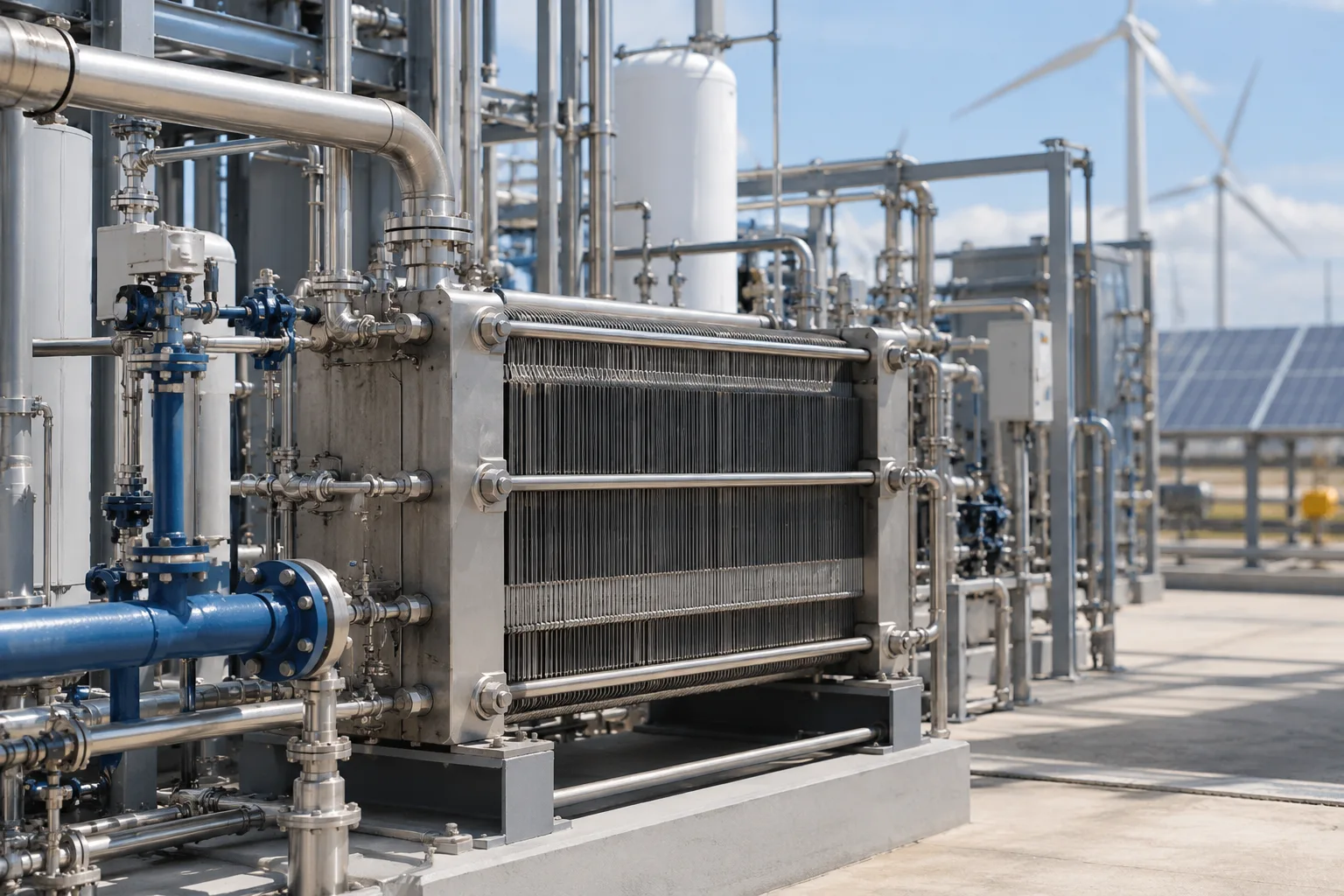
Getting closer. Prototypes exist, but not in real-world use.
Integrated devices that split water with sunlight alone have been built and tested in the laboratory, including a 16 cm2 module and a standalone device. Small outdoor tests have been reported. None of the sources reviewed shows a device running for years at useful scale, producing hydrogen commercially, or meeting a stated cost target. The stage is therefore engineering prototype, not pilot.
The tech tree
Everything recorded on Vrulum that this future needs, oldest foundations at the top and the goal at the bottom. Lines show what each step requires.
- 2011Artificial photosynthesisResearch and prototypes Being researched.
- 2021Electrochemical CO2 conversionResearch and prototypes Being researched.
- 2023Electrolysers for low-carbon hydrogenPilot and early commercial Unlocked.
- 2011Efficiency and stability of early wireless silicon devicesDone Unlocked.
- 2021Outdoor array of photocatalyst panelsDone Unlocked.
- 2025Standalone bismuth vanadate and silicon leafDone Unlocked.
- 2025Scaled-up leaf under natural sunlightDone Unlocked.
- 2025Module-sized integrated leaf in the laboratoryDone Unlocked.
- Date not recordedYears of outdoor operation at useful scaleNot started Locked.
- Date not recordedIndependent replication under a common test protocolNot started Locked.
- Date not recordedHydrogen production at a cost that competesNot started Locked.
- GoalMaking fuel from sunlight like a leafGoalRequires: Artificial photosynthesis, Electrochemical CO2 conversion, Electrolysers for low-carbon hydrogen, Efficiency and stability of early wireless silicon devices, Module-sized integrated leaf in the laboratory, Standalone bismuth vanadate and silicon leaf, Scaled-up leaf under natural sunlight, Outdoor array of photocatalyst panels, Years of outdoor operation at useful scale, Independent replication under a common test protocol, Hydrogen production at a cost that competes. Locked.
The road so far
5 of 8 steps done.
- Done · Nov 2011Efficiency and stability of early wireless silicon devices
Reece and colleagues reported 4.7% efficiency for the solar-driven water-splitting reaction in a wired silicon-based device, and 2.5% for a wireless configuration, both under 1 sun of AM 1.5 simulated sunlight. Both figures come from laboratory tests. [1]
- Done · 6 May 2025Module-sized integrated leaf in the laboratory
A 16 cm2 mini-module, built from a 4 by 4 array of 1 cm2 perovskite photoelectrodes, reached 11.2% module-level solar-to-hydrogen efficiency in unbiased water splitting under 1-sun illumination. The abstract reports stability for 140 hours for the 1 cm2 photoelectrodes, and does not report that stability for the full module. [2]
- Done · Mar 2025Standalone bismuth vanadate and silicon leaf
A bismuth vanadate photoanode paired with a silicon photovoltaic cell reached 8.4% solar-to-hydrogen efficiency in a laboratory test. The photoanode was stable for over 520 hours under AM 1.5G illumination. That is a component-level result, not a lifetime test of the whole device. [3]
- Done · Mar 2025Scaled-up leaf under natural sunlight
The abstract reports that scaling up to 441 cm2 gave 2.7% solar-to-hydrogen efficiency under natural sunlight, down from 8.4% in the laboratory test. The abstract does not report a long-duration outdoor test for this device. [3]
- Done · 3 Sept 2021Outdoor array of photocatalyst panels
A 100 m2 array of panel reactors, using an aluminium-doped strontium titanate particle photocatalyst, operated outdoors over several months. Peak solar-to-hydrogen efficiency was 0.76%. The researchers described hydrogen production by this route as inefficient and energy negative overall. [4]
- Not startedYears of outdoor operation at useful scale
No device in the sources reviewed has been shown to run outdoors for years, through seasonal change and routine maintenance. Durability figures so far come from laboratory tests of electrodes or components.
- Not startedIndependent replication under a common test protocol
The reported efficiencies cover different device areas and test conditions, from 1 cm2 electrodes to a 100 m2 outdoor array, so they cannot be compared directly. The sources reviewed do not show independent replication under a shared protocol.
- Not startedHydrogen production at a cost that competes
The sources reviewed give no cost per kilogram of hydrogen from a demonstrated artificial leaf. The IEA lists uncertainties about costs, infrastructure and regulation as barriers to faster hydrogen deployment in general. [5]
Why it matters
A device that turns sunlight and water directly into a storable fuel could link variable solar power with uses that need molecules rather than electricity. The question is whether direct solar conversion can match other routes on durability, cost and lifecycle impact, not only on laboratory efficiency.
What stands in the way
- Durability at useful scale: the longest tests are on small electrodes or components, not on full devices running outdoors for years.
- Efficiency falls as area grows. The 11.2% module and 8.4% standalone results were laboratory tests. The 2.7% result for the scaled-up device was measured under natural sunlight at a larger area.
- Cost: no published cost per kilogram of hydrogen from a demonstrated artificial leaf was found in the sources reviewed.
- Gas separation and handling: hydrogen and oxygen must be separated and collected. The 100 m2 outdoor test covered gas collection and separation, which the press release says were shown to be possible.
- Materials and containment: the 16 cm2 module uses a lead-containing perovskite absorber, and whole-device safety under damage and at end of life is not shown in the sources reviewed.
- Hydrogen from water is not CO2 conversion: the demonstrations here make hydrogen, and do not show carbon-based fuels from sunlight.
Signals to watch
- Integrated devices reporting hydrogen and oxygen measured independently, with full active and total areas and no external bias.
- Outdoor operating tests of several months or longer that report degradation, downtime and gas purity.
- Replication of efficiency results by groups other than the original authors.
- Lifecycle and cost estimates based on measured device lifetime and manufacturing yield.
- Solar-to-product efficiency reported for CO2 conversion systems, with carbon-source accounting.
Sources
- peer reviewed paper
Wireless Solar Water Splitting Using Silicon-Based Semiconductors and Earth-Abundant Catalysts
S. Y. Reece, J. A. Hamel, K. Sung et al.. Science, Nov 2011. - peer reviewed paper
Scalable and durable module-sized artificial leaf with a solar-to-hydrogen efficiency over 10%
D. Hansora, R. Mehrotra, E. Noh et al.. Nature Communications, 6 May 2025. - peer reviewed paper
A standalone bismuth vanadate-silicon artificial leaf achieving 8.4% efficiency for hydrogen production
B. Liu, X. Wang, Y. Zhang et al.. Nature Communications, 21 Mar 2025. - university press release
Photocatalytic solar hydrogen production from water on a 100m2-scale
Hiroshi Nishiyama, Taro Yamada, Mamiko Nakabayashi et al.. The University of Tokyo, 3 Sept 2021. - government report
Global Hydrogen Review 2025
International Energy Agency, 12 Sept 2025.
Last reviewed 21 Oct 2026.