Electrochemical CO2 conversion
Also known as CO2 electroreduction, Electrochemical CO2 reduction, CO2 electroreduction to formate, Electrochemical formate production
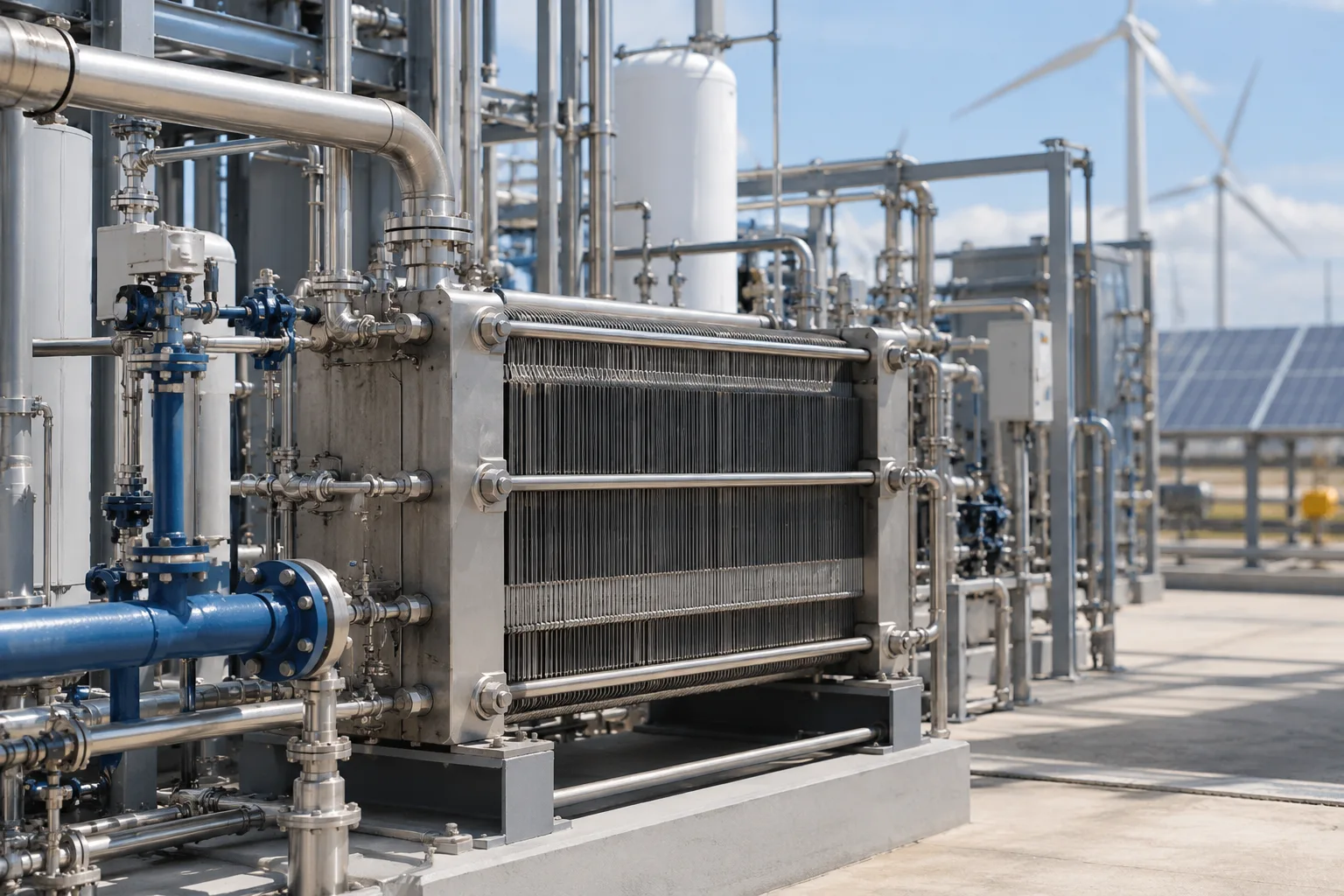
Electrochemical CO2 conversion uses electricity to turn carbon dioxide into chemicals such as formate. Prototype stacks built from 1,526 cm² cells have been reported, but long-term stability, energy use and climate benefit at industrial scale are not yet shown.

In plain language
An electrolyser uses electricity to drive a chemical reaction at electrodes. In electrochemical CO2 conversion, carbon dioxide reaches a cathode, where a catalyst helps it take up electrons and form a new product. For formate, which is an ion used in salts and chemical products, tin and bismuth catalysts are among those studied.
The chemistry is known, but making it work in a large device is harder than in a small lab cell. Small cells can be supplied with carefully controlled conditions. Larger cells must spread gas and liquid evenly across the electrode and control the water in the CO2 feed, and both affect how much product forms and how much energy it takes.
Technical explanation
The share of electrical charge that forms the target product is called the Faradaic efficiency. Fink and colleagues use gas-diffusion cathodes, which bring gaseous CO2 close to the catalyst sites. In a zero-gap design, the electrode and membrane are pressed together to reduce resistance. Abarca and colleagues (2025) varied the current density and the water content of the CO2 feed in a zero-gap prototype, and found an optimum at 15 g of water per hour.
Fink and colleagues (2024) report a stack of two 1,526 cm² three-compartment cells with gas-diffusion cathodes that makes potassium formate. They report over 60% current selectivity towards potassium formate at 200 mA per cm² and cell voltages of about 4.0 V. They state that a pressure difference of 10 to 14 kPa between the gas and catholyte compartments must be applied for the reaction to take place, and that optimal operating parameters depend strongly on cell architecture. Abarca and colleagues (2025) report a 100 cm² zero-gap prototype with a serpentine flow field. At 200 mA per cm² and a water content of 15 g per hour, they report a formate concentration of 760 g per litre, a Faradaic efficiency of 67%, a production rate of 7 mmol per square metre per second, and energy consumption of 507 kWh per kmol, with energy efficiency somewhat reduced by ohmic losses.
Long-duration results have been reported, but the Li and colleagues (2021) abstract does not give electrode area. Their Sn-Bi/SnO2 catalyst kept the CO2-to-formate pathway stable for 2,400 hours at 100 mA per cm², with a Faradaic efficiency of 95%, and produced 3.4 molar formate solution over 100 hours in a membrane electrode assembly. These results should not be read as durability of a large-area stack. A 2024 review by Leonzio, Hankin and Shah notes that carbon monoxide and formic acid are currently the main products targeted for economic reasons, and expects production costs to fall.
What the evidence says
Each statement is typed by the strength of its evidence and linked to the source that supports it.
Demonstrated Shown in a published experiment, test or shipping product.
Fink and colleagues report CO2 electroreduction to potassium formate in a stack of two 1,526 cm² three-compartment cells with gas-diffusion electrode cathodes.
Sources: [1] · AbstractFink and colleagues report over 60% current selectivity towards potassium formate at 200 mA per cm² and cell voltages of about 4.0 V.
Sources: [1] · AbstractFink and colleagues report that a minimum pressure difference of 10 to 14 kPa must be applied between the gas and catholyte compartments for CO2 reduction to take place in their cell.
Sources: [1] · AbstractA 100 cm² zero-gap prototype with a serpentine flow field reached a formate concentration of 760 g per litre, a Faradaic efficiency of 67% and a production rate of 7 mmol per square metre per second at 200 mA per cm² and a water content of 15 g per hour in the CO2 feed.
Sources: [2] · AbstractThe 100 cm² prototype consumed 507 kWh per kmol of formate. Its authors state that energy efficiency is somewhat reduced by ohmic losses and that further improvements in design and energy management are still needed.
Sources: [2] · AbstractA Sn-Bi/SnO2 catalyst kept the CO2-to-formate pathway stable for 2,400 hours of continuous operation at 100 mA per cm², with a Faradaic efficiency of 95%.
Sources: [3] · AbstractIn a cation-exchange membrane electrode assembly device, Li and colleagues produced 3.4 molar (15 wt%) formate solution stably over 100 hours.
Sources: [3] · AbstractReported, unverified Stated by a company or team but not independently confirmed.
A 2024 review states that carbon monoxide and formic acid are currently the primary CO2-reduction product targets from an economic point of view, and expects production costs to fall in future.
Sources: [4] · Abstract · medium confidenceLimitations and open problems
- The large-area results reviewed here are early-stage prototype tests. Durability over thousands of hours at large area has not been shown in the sources reviewed.
- The energy use reported for the 100 cm² prototype is 507 kWh per kmol of formate, and ohmic losses reduce energy efficiency. The climate value depends on the carbon intensity of the electricity used.
- The prototypes were fed with a supplied CO2 gas stream and do not show direct capture of CO2 from air. The source of CO2 decides whether carbon is removed or only reused.
- Performance depends on the water balance. The 2025 prototype study evaluated the water content of the CO2 feed and reports an optimum at 15 g per hour. Its authors say further improvements in design and energy management are still needed.
- Carbon utilisation is not carbon removal. Formate can release its carbon when it is used, burned or decomposed, so the climate benefit depends on product lifetime and on the conventional process it replaces, which the sources reviewed do not establish.
- Product markets may be too small to absorb CO2 from large capture projects. Surplus product could lower prices or divert carbon into low-value uses.
Possible future uses
Ideas, not predictions. None of these has been demonstrated.
- A renewable-powered formate plant beside a biogenic or industrial CO2 source, supplying formate to nearby customers.
- Modular electrolysers that run when low-cost renewable electricity is available and supply formate to a local industrial customer.
- Formate as an energy carrier or feedstock for biological or chemical processes, subject to full material and energy balances.
Product concepts: CO2-to-protein reactor
Timeline
- Sept 2021Li and colleagues report a Sn-Bi/SnO2 catalyst that keeps formate production stable for 2,400 hours at 100 mA per cm² in Nature Communications. Sources: [3]
- Jan 2024Fink and colleagues report a stack of two 1,526 cm² cells for CO2-to-potassium-formate electrolysis in ChemCatChem. Sources: [1]
- Aug 2024Leonzio, Hankin and Shah publish a review of CO2 electrochemical reduction with economic and environmental analyses. Sources: [4]
- Jul 2025Abarca and colleagues report validation of a 100 cm² zero-gap CO2-to-formate prototype in ChemSusChem. Sources: [2]
Futures this could help bring about
Glossary
- Formate
- The ion HCOO⁻, or its salts such as potassium formate, used in chemical products and processes.
- Faradaic efficiency
- The fraction of electrical charge that produces the desired chemical product.
- Gas-diffusion electrode
- A porous electrode that brings gaseous reactants such as CO2 to catalyst sites.
- Zero-gap electrolyser
- A cell design in which the electrode and membrane are pressed together to reduce electrical resistance.
Sources
- peer reviewed paper
Scale-up of electrochemical flow cell towards industrial CO2 reduction to potassium formate
Arthur G. Fink, Fabiola Navarro-Pardo, Jason R. Tavares et al.. ChemCatChem, Jan 2024. DOI: 10.1002/cctc.202300977. Accessed 21 Oct 2026. - peer reviewed paper
Prototype Validation of a Large-Scale CO2-to-Formate Zero-Gap Electrolyzer
Jose Antonio Abarca, Cristina González-Fernández, Camilo Estevan Peralta et al.. ChemSusChem, Jul 2025. DOI: 10.1002/cssc.202501116. Accessed 21 Oct 2026. - peer reviewed paper
Stable, active CO2 reduction to formate via redox-modulated stabilization of active sites
Le Li, Adnan Ozden, Shuyi Guo et al.. Nature Communications, Sept 2021. DOI: 10.1038/s41467-021-25573-9. Accessed 21 Oct 2026. - review article
CO2 electrochemical reduction: A state-of-the-art review with economic and environmental analyses
Grazia Leonzio, Anna Hankin, Nilay Shah. Chemical Engineering Research and Design, Aug 2024. DOI: 10.1016/j.cherd.2024.07.014. Accessed 21 Oct 2026.
Revision history
3 changes since this profile was created.