Electrolysers for low-carbon hydrogen
Also known as Water electrolysers, Water electrolysis, Electrolysers
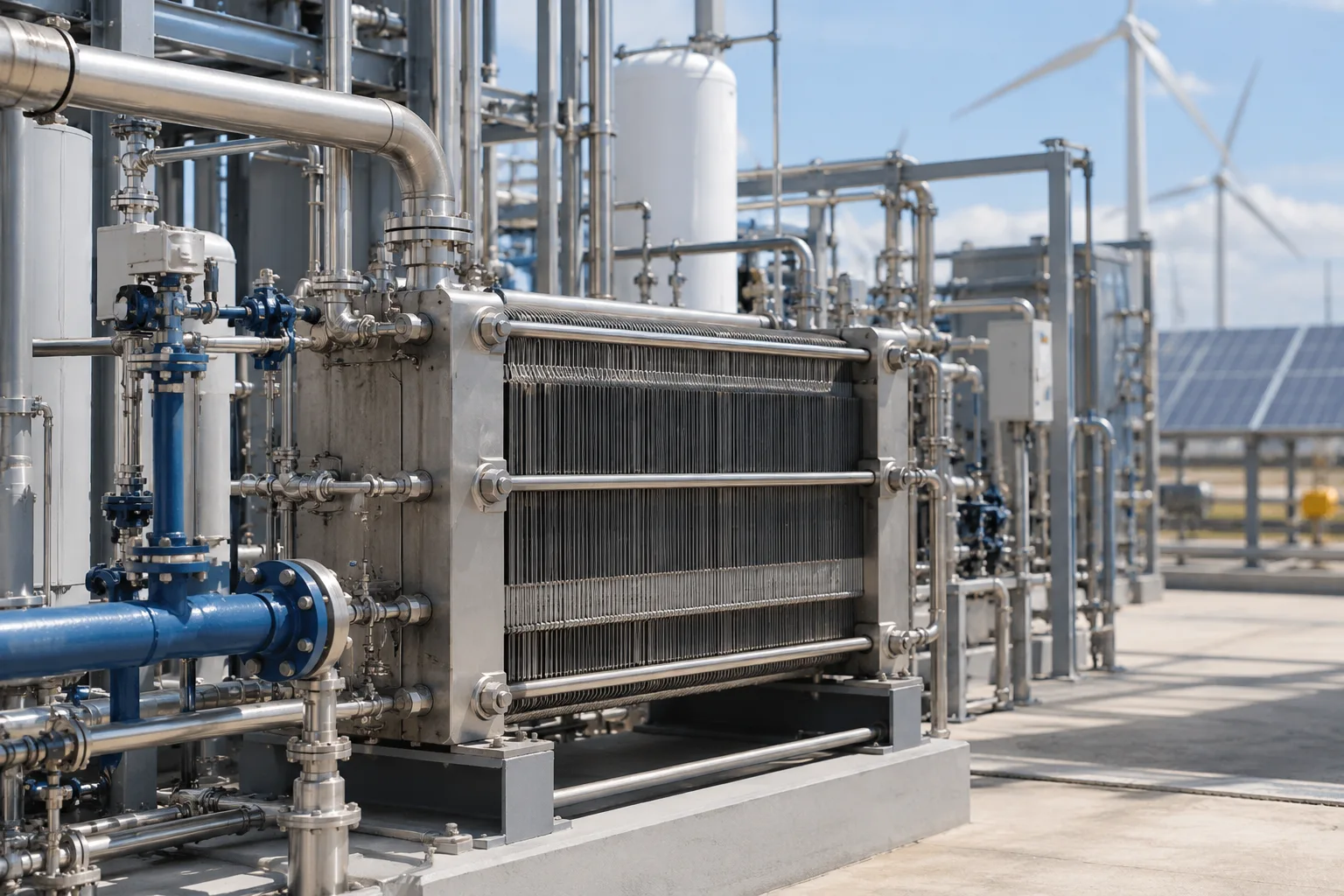
Electrolysers use electricity to split water into hydrogen and oxygen. Alkaline and proton-exchange-membrane systems are commercially available, while solid-oxide and anion-exchange-membrane designs offer different trade-offs and maturity levels. Hydrogen is only low emissions when the electricity and wider supply chain are low emissions; project announcements and electrolyser capacity do not by themselves establish climate benefit or delivered hydrogen output.
In plain language
An electrolyser uses electricity to split water into hydrogen and oxygen. If it is powered by low-carbon electricity, it can make hydrogen with lower production emissions than conventional fossil-fuel routes. Hydrogen can serve as a chemical feedstock or fuel in applications where direct electricity use is difficult, but making and using hydrogen involves energy conversions and infrastructure of its own.
There is more than one kind of electrolyser. Alkaline systems use a liquid alkaline solution and are an established commercial design. Proton-exchange-membrane (PEM) systems use a solid membrane and can respond quickly to changing power. Solid-oxide electrolysers run hot and can use heat as well as electricity, but their high operating temperature creates materials and durability challenges. Anion-exchange-membrane systems are an emerging design that uses a solid membrane to conduct hydroxide ions. These differences matter when matching a plant to an electricity source and industrial site.
A low electrolyser price or a large project pipeline does not guarantee low-cost hydrogen. Plants need suitable water, electricity connections, power conversion, gas drying and compression, storage or transport, and a buyer able to use hydrogen. If the electrolyser draws on a carbon-intensive grid or causes fossil generation to increase, the emissions benefit can be reduced. The IEA reports that installed capacity and low-emissions hydrogen production remain small relative to announced ambitions, with policy certainty affecting investment decisions.
Technical explanation
Water electrolysis uses electric current to drive hydrogen evolution at the cathode and oxygen evolution at the anode. The electrolyte and ion-conducting separator distinguish the main cell families. Alkaline water electrolysers circulate liquid potassium- or sodium-hydroxide electrolyte across a porous separator. PEM electrolysers conduct protons through a solid polymer membrane. AEM electrolysers conduct hydroxide ions through a polymer membrane, aiming to combine membrane-based operation with less expensive catalyst options, though the technology is less mature. Solid-oxide electrolyser cells (SOECs) conduct oxide ions through a ceramic electrolyte at high temperature and can use process heat to reduce the electrical input required.
Each design has different operating constraints. The US Department of Energy describes alkaline and PEM units as established lower-temperature approaches, AEM as an emerging membrane approach, and SOEC as a high-temperature technology. PEM systems can support rapid response and compact, high-pressure designs; alkaline systems have a longer industrial history; SOECs may benefit from integrated heat but must manage thermal cycling and material durability. These are tendencies, not universal specifications: efficiency, start-up time, turndown, pressure and lifetime depend on the stack and balance-of-plant design.
System boundaries matter when quoting efficiency. Stack efficiency excludes some equipment such as water treatment, power electronics, cooling, gas purification and compression. Plant-level energy use and hydrogen cost therefore cannot be inferred from cell voltage or a catalyst result alone. Water must meet system purity requirements, and output gas must be separated and conditioned for its intended use. Electricity carbon intensity, plant utilisation, equipment manufacture and hydrogen delivery also affect lifecycle emissions.
Kumar and Lim (2023) review recent advances in PEM electrolysis; the full text and cost data were not reviewed for this profile. IEA data report project and capacity status rather than proving that every announced project will be built. In October 2024, the IEA reported 20 GW of electrolyser capacity at final investment decision and more than 6 GW reaching that stage in the prior twelve months. Its June 2026 data page labels 2026 values as estimates.
What the evidence says
Each statement is typed by the strength of its evidence and linked to the source that supports it.
Demonstrated Shown in a published experiment, test or shipping product.
The total electrolyser capacity that had reached final investment decision stood at 20 GW globally in October 2024, according to the IEA.
Sources: [3] · Article textIn the year to October 2024, more than 6 GW of electrolyser capacity reached final investment decision, with China accounting for more than 40% of it.
Sources: [3] · Article text · medium confidenceThe IEA states that installed capacity for electrolysers and low-emissions hydrogen volumes remain low, as developers wait for clarity on government support before making investments.
Sources: [3] · Article text · medium confidenceAlkaline electrolysers use liquid alkaline electrolyte, PEM electrolysers use a proton-conducting polymer membrane, AEM electrolysers use a hydroxide-conducting polymer membrane, and solid-oxide electrolysers use a ceramic electrolyte that conducts oxide ions at high temperature.
Sources: [2] · Technology descriptionsThe IEA describes alkaline and PEM electrolysers as commercial designs, while noting that they cannot compete with traditional hydrogen production technologies without policy support.
Sources: [4] · Electrolyser technology pageReported, unverified Stated by a company or team but not independently confirmed.
IEA estimates for 2026 electrolyser installed capacity and low-emissions hydrogen production are not yet confirmed data.
Sources: [4] · Chart notes · medium confidenceProposed A design or plan that has not yet been built or tested.
Announced projects could raise global low-emissions hydrogen output to almost 50 million tonnes a year by about 2030, but this depends on all announced projects being built, according to the IEA.
Sources: [3] · Article text · low confidenceLimitations and open problems
- The lifecycle emissions benefit depends on electricity carbon intensity, plant utilisation and the wider equipment and delivery chain; the label 'electrolytic' alone does not establish low emissions.
- Plant efficiency depends on the system boundary. Stack figures do not include every energy demand for water treatment, power conversion, gas purification, cooling, compression or transport.
- Water quality and reliable water supply are operating requirements; hydrogen output also needs drying, purification, compression or conversion for many end uses.
- Alkaline and PEM designs are commercial, while SOEC and AEM designs have different maturity and durability constraints; one efficiency or flexibility figure cannot be applied to all types.
- Installed electrolyser capacity and low-emissions hydrogen output remain low relative to announced ambitions (IEA, 2024).
- Many announced projects have not reached final investment decision. The IEA notes its 2030 output outlook holds only if all announced projects are realised (IEA, 2024).
- The IEA's most recent capacity figures are estimates, so precise current totals are not confirmed by the sources reviewed here (IEA, 2026).
Possible future uses
Ideas, not predictions. None of these has been demonstrated.
- Using hydrogen to store surplus renewable electricity over weeks or months.
- Supplying hydrogen for steelmaking to replace coal-based reduction.
- Hydrogen blending into existing gas networks at low concentrations.
Timeline
- Jul 2023Kumar and Lim publish a review of recent advances in PEM water electrolysis in Sustainable Energy and Fuels. Sources: [1]
- 2 Oct 2024The IEA reports that 20 GW of electrolyser capacity has reached final investment decision globally. Sources: [3]
- Jun 2026The IEA publishes updated electrolyser installed capacity and low-emissions hydrogen production charts, with 2026 values marked as estimates. Sources: [4]
Futures this could help bring about
Glossary
- Electrolyser
- A device that uses electricity to split water into hydrogen and oxygen.
- Final investment decision
- The point at which a company commits money to build a project, as opposed to only announcing it.
- Electrocatalyst
- A material that speeds up the chemical reactions at an electrode, often made from precious metals in electrolysers.
- Low-emissions hydrogen
- Hydrogen produced with much lower greenhouse gas emissions than conventional methods, usually through electrolysis powered by low-carbon electricity.
Sources
- review article
Recent advances in hydrogen production through proton exchange membrane water electrolysis - a review
S. Shiva Kumar, Hankwon Lim. Sustainable Energy & Fuels, Jul 2023. DOI: 10.1039/d3se00336a. Accessed 21 Oct 2026. - government report
Hydrogen Production: Electrolysis
US Department of Energy, 2024. Accessed 22 Oct 2026. - other
Low-emissions hydrogen projects grow as policy support races to catch up
International Energy Agency, 2 Oct 2024. Accessed 21 Oct 2026. - government report
Hydrogen - Production and electrolyser installed capacity
International Energy Agency, Jun 2026. Accessed 21 Oct 2026.
Revision history
4 changes since this profile was created.