CO2-to-protein reactor
This is an idea, not a product. Nothing here has been built or tested unless a linked technology profile says so.
The problem
Food makers may want a protein made without farmed animals, and industrial sites that emit CO2 may want a use for the carbon they capture. Both needs may be met only if the process is cheap enough and has a lower carbon footprint than the routes it replaces.
The idea
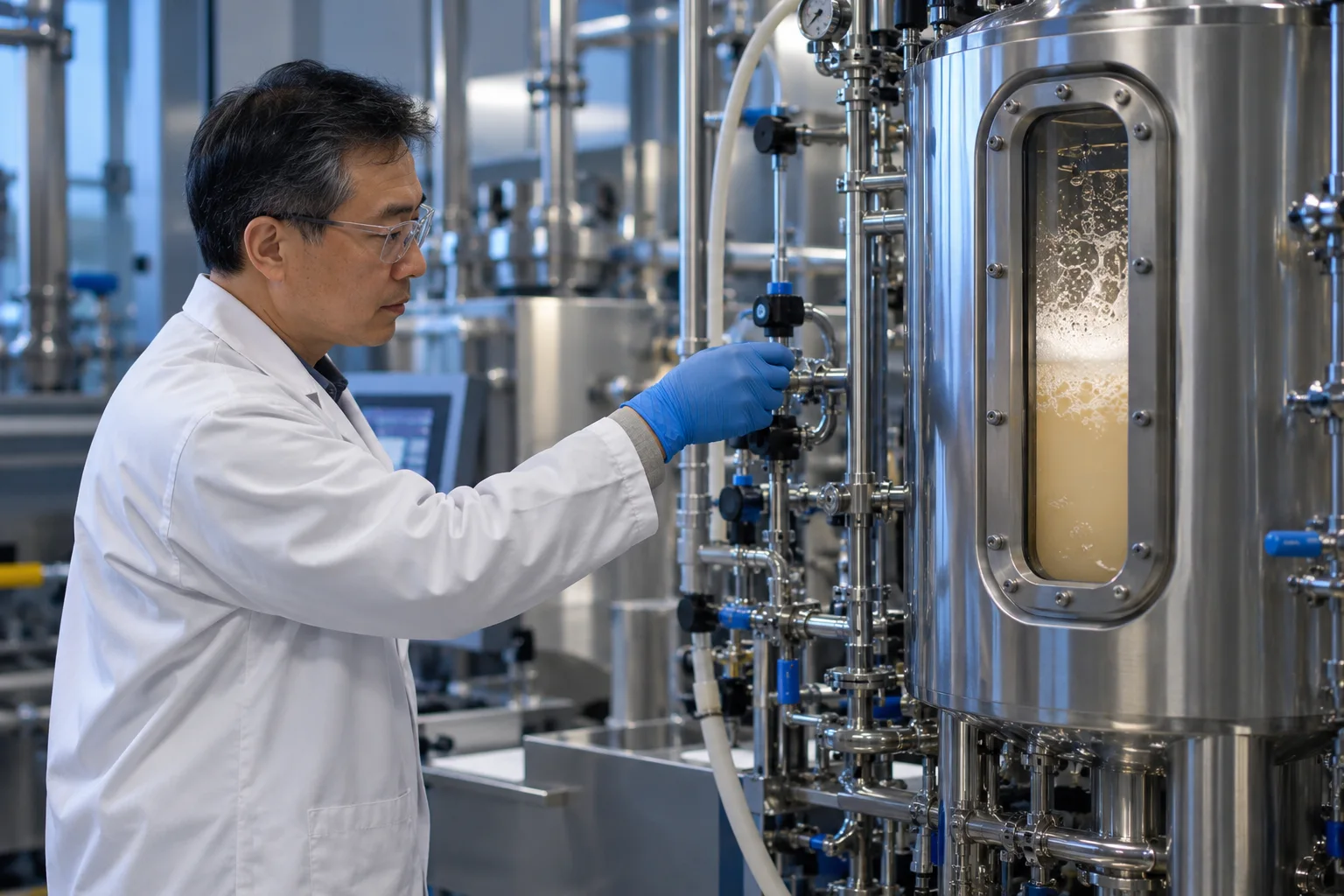
A modest first version would be a bench-scale, two-stage set-up, not a plant. An electrolyser would turn a supplied CO2 stream into formate. A microbial host, engineered to make one target protein, would then be grown on that formate in a small fermenter. No linked profile shows a host growing on formate, so this link is the untested assumption that the first experiment is designed to test. The first goal is to show that the two stages connect, not to make a food.
Enabling technology
- Electrochemical CO2 conversion: Electrochemical CO2 conversion uses electricity to turn carbon dioxide into chemicals such as formate. Prototype stacks built from 1,526 cm² cells have been reported, but long-term stability, energy use and climate benefit at industrial scale are not yet shown.
- Precision fermentation: Precision fermentation uses microorganisms engineered to make specific animal proteins, such as whey protein, without farmed animals. The FDA's public GRAS notice inventory records 'no questions' responses for some fermentation-made beta-lactoglobulin ingredients with stated food uses. Lab-scale work has also produced recombinant casein at low titre. Evidence on cost and scale-up is still limited.
What stands in the way
- No linked profile shows a microbe growing on formate to make a protein. The electrolysis and fermentation profiles describe each stage separately, so the link between them is unproven.
- The best-characterised electrochemical result in the profiles is a 100 cm² prototype, with a Faradaic efficiency of 67% and energy use of 507 kWh per kmol of formate. A stack of two 1,526 cm² cells has been reported, but only over 60% selectivity to potassium formate is given for it. Durability at large area over thousands of hours has not been shown.
- Protein recovery is a known weak point. One laboratory study, in a different host and for a different protein, reports a casein titre of 56.9 mg/L. The protein sat in an insoluble fraction, which adds cell disruption and purification steps. Recovery at industrial scale is not assessed.
- Regulatory clearance differs by country, and clearance in one market does not carry over to others. If the target protein is a milk protein such as beta-lactoglobulin, it would be a major milk allergen, and allergen labelling would apply.
- The prototypes were fed with supplied CO2 gas, not air. Carbon is only reused unless the CO2 source is itself a removal route, and the full energy and carbon balance has not been established.
A cheap way to test it
Stage 1, no living organisms: run a lab-scale electrolyser on a supplied CO2 stream for 100 hours, a bench duration chosen for this test, and measure formate concentration and Faradaic efficiency in the product stream at a stated current density. Pass if Faradaic efficiency stays at or above 67% for the whole run. The 67% figure is a reference point from a 100 cm² prototype at 200 mA per cm², not a result this cell has been shown to reach, so if the lab cell runs at a different current density the threshold should be reset to a reference for that condition. Stage 2, contained laboratory only: grow a chosen host on the formate from stage 1 in a small sealed fermenter, under the lab's existing biosafety approval. Confirm the host's food-grade status before selection. Pass if biomass rises over the run and the target protein is detected by a standard assay. Report any titre for context against the 56.9 mg/L reported for casein in a different host, which is only a rough reference. Redesign if the host does not grow on the formate. No human or food testing is part of this experiment.