Dissolving post-surgery monitor
This is an idea, not a product. Nothing here has been built or tested unless a linked technology profile says so.
The problem
Some patients recovering from surgery may benefit from short-term monitoring at the surgical site. Many temporary implants have wires or parts that must be pulled out later, which adds a second procedure and carries risks such as infection or bleeding.
The idea
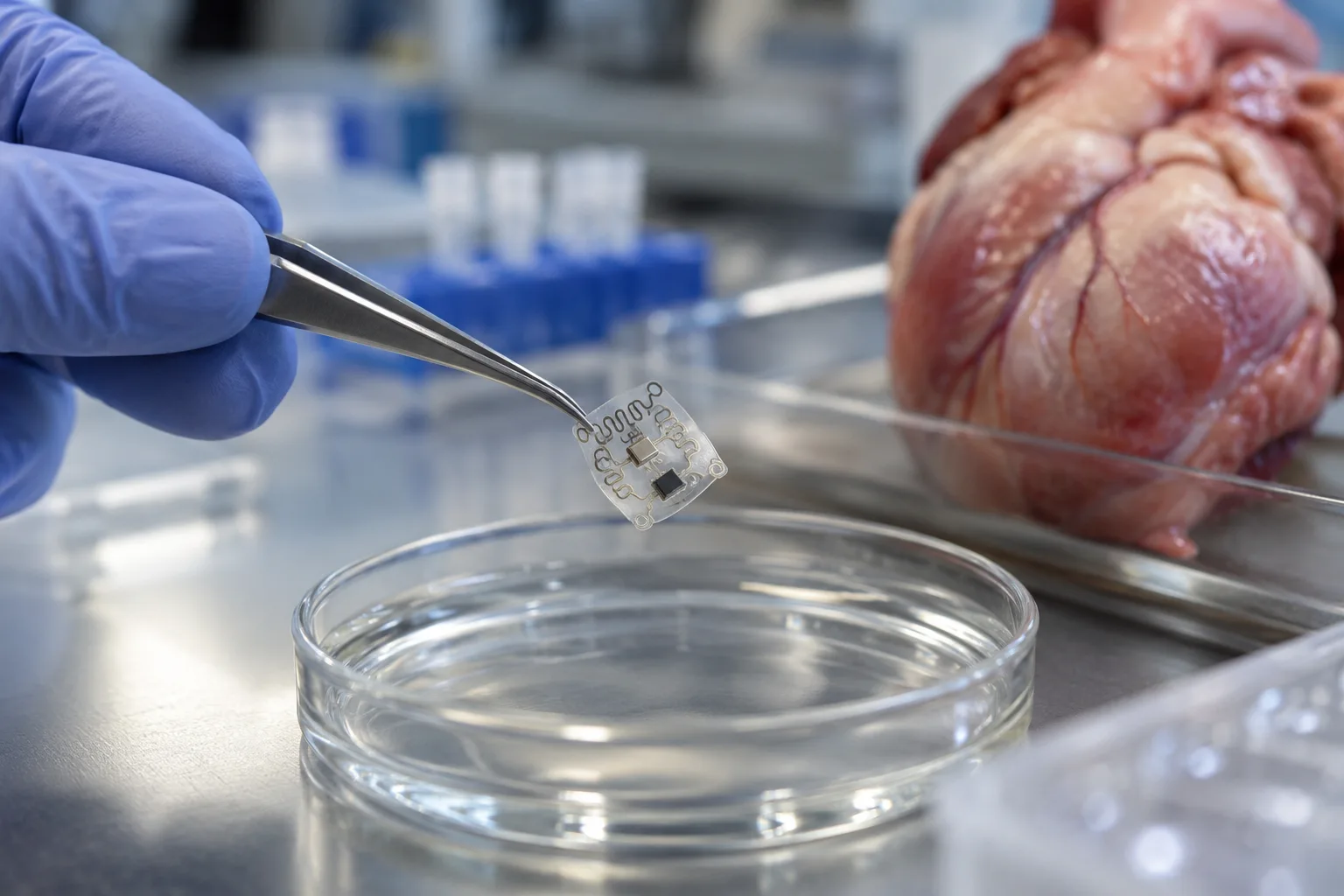
A first version would be one battery-free, bioresorbable pressure or temperature sensor, placed at a single surgical site during the operation and read through the skin by an external radio reader for a fixed period. The reader's field would power and read the sensor. The sensor would dissolve after that period, so no removal procedure would be needed. It would report pressure or temperature trends at one site. It would not diagnose leaks or infection, and would remain a research prototype rather than a clinical device.
Enabling technology
- Battery-free wireless implant sensors: Researchers have built flexible wireless sensors that can detect water getting through the protective coating of an implant, without an onboard battery. The tests so far are laboratory, explanted tissue and post-mortem experiments, not monitoring in living patients.
- Bioresorbable (transient) electronics: Bioresorbable electronics are working circuits, sensors and stimulators made from materials designed to dissolve in the body after a set time. They aim to provide temporary implants, such as short-term pacemakers or brain pressure monitors, that never need surgical removal.
What stands in the way
- Working life in animals is short and hard to set precisely. Bioresorbable pacemakers paced rats for about 4 days (2021), up to 6 days (magnesium-based, 2025) and up to 20 days (zinc-based, 2025), so a post-surgery window must fit within that range or the design must extend it.
- The 2016 bioresorbable silicon sensors measured pressure and temperature in rat brains, but the profiles do not say how those sensors were powered. The battery-free readout in the profiles was tested only in vitro, in explanted chicken tissue and in post-mortem mouse tissue. The two approaches have not been combined in a living animal.
- Readout needs an external radio field, and signal gain falls as implant depth increases because tissue attenuates the link. The profiles report this for battery-free sensing, and deeper placement has not been tested.
- Fibrous tissue formed around a bioresorbable pacemaker within about 4 weeks in rats, which may decouple the sensor from tissue and slow resorption.
- Full resorption times are often estimates rather than measurements, and the safety of degradation products at clinical scale is not yet shown. No fully implanted bioresorbable device in these profiles has completed human trials.
A cheap way to test it
Bench test with no living subjects. Build a set of sensors, each with a bioresorbable pressure or temperature element on a flexible substrate, plus unencapsulated controls made from the same element. Before soaking, check each sensor against a reference gauge or thermometer for a step change, and write down the acceptance tolerance before testing starts. Soak the sensors in phosphate-buffered saline at 37 °C and read each one through an external coil at fixed intervals. Fix the monitoring window in advance and keep it well inside the reference below. The encapsulated sensors pass if they stay within tolerance for the whole window. As a reference, the 2023 printed zinc study reported about 28 days to a 90% loss of conductivity for 30 µm encapsulated traces, so a longer window would need a different design. For a zinc element, the unencapsulated controls should lose about an order of magnitude of conductivity in about 46.6 hours on average, as reported for those traces. If they do not, the soak is not a fair test. Finally, repeat the readout with a tissue-equivalent spacer of increasing thickness and record the thickness at which the signal is lost. The depth test passes only if that thickness exceeds the planned depth at the target site, which is written down before the test.