Battery-free wireless implant sensors
Also known as Battery-free implant monitoring, Backscatter implant sensors, Implantable water-permeation sensor
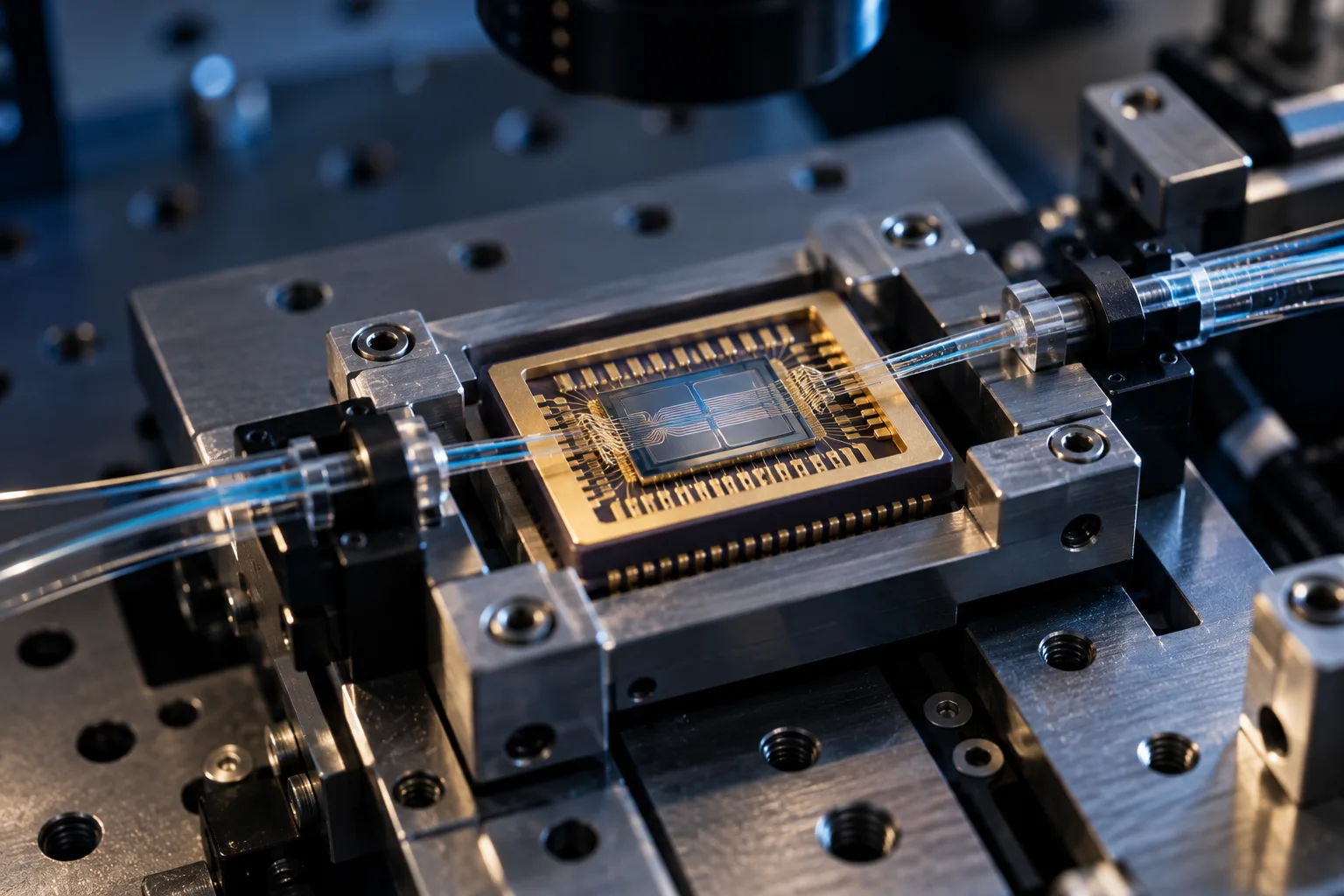
Researchers have built flexible wireless sensors that can detect water getting through the protective coating of an implant, without an onboard battery. The tests so far are laboratory, explanted tissue and post-mortem experiments, not monitoring in living patients.
In plain language
Implants such as pacemakers and neural devices contain electronics that must be sealed from water and body fluids. Over time, the protective coating can let water through, and checking how well that seal holds is hard once a device is inside the body.
One approach is a thin, flexible sensor that is read wirelessly. It has no battery, but it does need a radio field from outside the body to power it and to read its response. A small magnesium element sits under the coating and slowly corrodes as water reaches it. The corrosion changes the signal the sensor sends back, so a reader can estimate how much water is getting through. So far this has been shown in lab tests, in explanted chicken tissue and in post-mortem mouse tissue, not in living animals or patients.
Technical explanation
The sensing element is a thin magnesium resistor placed beneath a thin-film encapsulation. Water that permeates the film corrodes the magnesium, which changes its resistance. In the reported design, this shifts the oscillation frequency of the sensing circuit, and the change is read by backscatter communication: the reader sends a radio-frequency field, and the tag alters how it reflects that field. The same external field powers the circuit, so 'battery-free' means there is no onboard battery, not that the device is independent of an external energy source.
Wireless power and telemetry for implants is an established research area with several routes. Hwang and colleagues (2012) reported a physically transient form of silicon electronics that disappears through resorption by the body. Choi and colleagues (2021) reported a bioresorbable pacemaker powered wirelessly, with no battery and no leads, with pacing shown in mouse, rat, rabbit and canine cardiac models. Choi and colleagues (2022) reported a wirelessly powered bioresorbable module alongside skin-worn modules whose battery life and recharging the article refers to, which shows that a system can be battery-free in one part and not in another.
The sensor's performance has clear limits. The authors report that signal gain falls as implant depth increases because tissue attenuates the wireless link, and that the magnesium element reflects permeation only in the coating directly above it, so mapping a larger implant would need several sensors. Power draw in the reported prototypes was about 3.5 to 5 mW. The estimated water transmission rate of about 2 g m-2 day-1 comes from a post-mortem test and should not be read as in vivo performance.
What the evidence says
Each statement is typed by the strength of its evidence and linked to the source that supports it.
Demonstrated Shown in a published experiment, test or shipping product.
Water permeating a thin-film encapsulation corrodes a magnesium resistive sensor, and the corrosion shifts the oscillation frequency of the sensing circuit, which is read by backscatter communication.
Sources: [1] · AbstractAccelerated soaking tests in phosphate-buffered saline at pH 7.4 and at 37, 67 and 85 degrees Celsius monitored magnesium resistance and signal frequency over time.
Sources: [1] · MethodsIn a post-mortem test, a miniaturised sensor implanted under the skin of mice immediately after death, and kept at 37 degrees Celsius, gave an estimated water transmission rate of about 2 g per square metre per day. The authors note that ex vivo and in vivo performance could differ.
Sources: [1] · Results · medium confidenceThe sensor has no onboard battery but needs an external radio-frequency field to power its sensing circuit and to read its response. The reported power draw was about 3.5 mW for the flexible version and 5 mW for the rigid version.
Sources: [1] · ResultsThe authors report that signal gain drops as implant depth increases because biological tissue attenuates the wireless link, and that the magnesium sensor reflects permeation only at the coating area directly above it.
Sources: [1] · DiscussionChoi and colleagues report a bioresorbable cardiac pacemaker powered wirelessly, with no battery and no leads, with pacing shown in mouse, rat, rabbit and canine cardiac models and in human cardiac models.
Sources: [2] · AbstractIn a later wireless network, the implanted bioresorbable module receives power through an RF power harvester. The article refers to battery life and recharging for the skin-worn modules, so the system as a whole is not battery-free.
Sources: [3] · ResultsHwang and colleagues report silicon electronics that are physically transient and completely disappear via resorption by the body.
Sources: [4] · AbstractProposed A design or plan that has not yet been built or tested.
The authors propose the platform for real-time monitoring of implanted bioelectronics. The reported tests are in vitro, explanted tissue and post-mortem; no in-patient monitoring is reported.
Sources: [1] · Abstract · medium confidenceLimitations and open problems
- This is a laboratory proof of concept. The mouse experiment used mice euthanised and implanted immediately after death, kept at body temperature, not live mice. The authors note that ex vivo and in vivo performance could differ.
- Battery-free does not mean power-independent. An external radio-frequency field powers the sensing circuit and enables readout.
- Signal gain drops with implantation depth because biological tissue attenuates the wireless link, so deeper placement is untested.
- Each magnesium sensor measures permeation only at the coating area directly above it. Mapping the integrity of a larger implant would need multiple sensors or a different layout.
- Live-animal operation, deeper placement and long-term durability are not tested in the reported work.
Possible future uses
Ideas, not predictions. None of these has been demonstrated.
- Continuous monitoring of package failure in patients with implanted bioelectronics, so that clinicians could detect water ingress before a device fails.
- Use of the sensor as a test tool during accelerated ageing of new implant encapsulation materials.
- Arrays of several sensors across a large implant to map where its barrier is weakest.
Product concepts: Dissolving post-surgery monitor
Timeline
- 1 Sept 2012Hwang and colleagues report a physically transient form of silicon electronics that completely disappears via resorption by the body. Sources: [4]
- 28 Jun 2021Choi and colleagues report a fully implantable, bioresorbable cardiac pacemaker powered wirelessly, with no battery or leads. Sources: [2]
- 26 May 2022Choi and colleagues report a transient, closed-loop network of wireless, body-integrated devices built around a bioresorbable pacemaker. The skin-worn modules refer to battery life and recharging. Sources: [3]
- 28 Aug 2024Mariello and colleagues publish a battery-free wireless sensor that estimates water permeation through thin-film encapsulation, tested in vitro, in explanted chicken tissue and in post-mortem mouse tissue. Sources: [1]
Futures this could help bring about
Glossary
- Backscatter
- A communication method that sends information by changing how a device reflects an incoming radio signal, instead of generating its own radio carrier.
- Encapsulation
- A protective layer around electronics that limits exposure to water, ions or other environmental factors.
- Water transmission rate
- A normalised measure of how much water passes through a barrier over a given time and area.
- Ex vivo
- Tested outside the body, using tissue removed from an organism.
Sources
- peer reviewed paper
Wireless, battery-free, and real-time monitoring of water permeation across thin-film encapsulation
Massimo Mariello, James Daniel Rosenthal, Francesco Cecchetti et al.. Nature Communications, 28 Aug 2024. DOI: 10.1038/s41467-024-51247-3. Accessed 21 Oct 2026. - peer reviewed paper
Fully implantable and bioresorbable cardiac pacemakers without leads or batteries
Yeon Sik Choi, Rose T. Yin, Anna Pfenniger et al.. Nature Biotechnology, 28 Jun 2021. DOI: 10.1038/s41587-021-00948-x. Accessed 21 Oct 2026. - peer reviewed paper
A transient, closed-loop network of wireless, body-integrated devices for autonomous electrotherapy
Yeon Sik Choi, John A. Rogers. Science, 26 May 2022. DOI: 10.1126/science.abm1703. Accessed 21 Oct 2026. - peer reviewed paper
A Physically Transient Form of Silicon Electronics, With Integrated Sensors, Actuators and Power Supply
Suk-Won Hwang, Hu Tao, Dae-Hyeong Kim et al.. Science, 1 Sept 2012. DOI: 10.1126/science.1226325. Accessed 21 Oct 2026.
Revision history
3 changes since this profile was created.