Autonomous surgical robots
Also known as Autonomous robotic surgery, Autonomous laparoscopic surgery, Supervised autonomous surgical robots
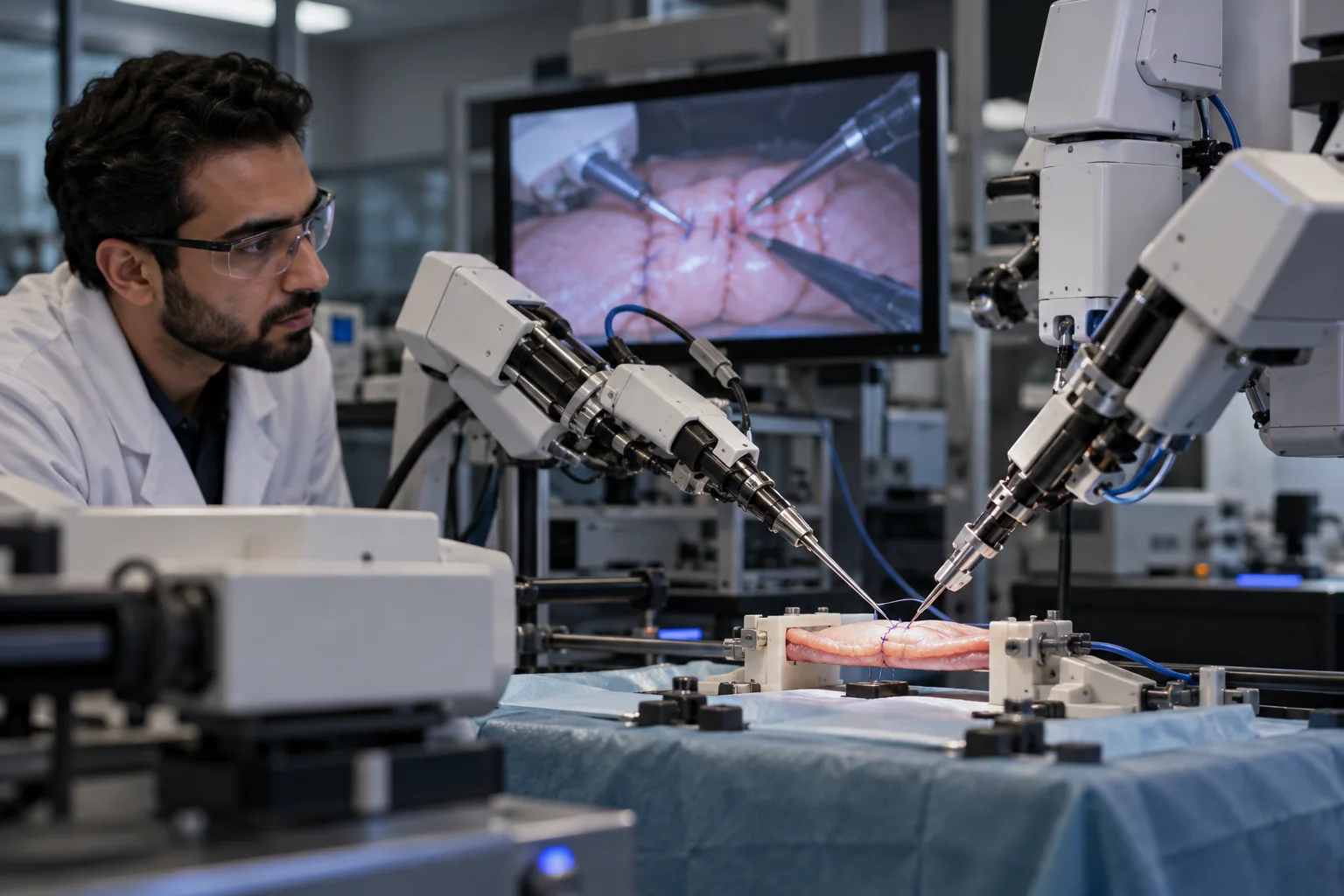
Autonomous surgical robots carry out defined surgical steps, such as placing stitches, on their own after a surgeon sets up or approves the plan. Studies so far use model tissue, ex vivo tissue and a small number of pigs, and no human use is described in the sources reviewed here.
In plain language
Most surgical robots in use today are steered by a surgeon at a console. An autonomous surgical robot is different because it decides how to carry out a step, such as where to place a stitch, and then does it with its own motions. In current research, the surgeon still prepares the operation and approves the robot's plan.
In 2022, a research team that included Axel Krieger reported a robot called STAR that joined two pieces of pig small intestine using keyhole surgery. The surgeon first exposed the tissue, the robot proposed a stitch plan, and after approval it sewed the tissue by itself. The results come from model tissue and pigs, so the work shows what is technically possible, not that the method is ready for patients.
Technical explanation
The STAR system (Smart Tissue Autonomous Robot) uses images of the tissue to build a suture plan based on its shape and thickness, and it runs the approved plan. If the tissue shifts beyond a set threshold, it asks the surgeon for a new plan (NIBIB, 2022). Saeidi and colleagues (2022) compared the autonomous approach with manual laparoscopy and robot-assisted surgery on suture spacing, completion time, lumen patency and leak pressure. In phantom tissue, the autonomous system was more consistent and accurate than expert surgeons' manual technique and robot-assisted technique, and the in vivo work used five pigs, four operated on by STAR and one by a surgeon.
A later system, SRT-H, takes a different route. Kim and colleagues (2025) describe a two-level framework: a high-level planner that issues language instructions and a low-level motion policy, trained through imitation learning. In eight ex vivo pig gallbladders, the system completed one phase of cholecystectomy without human intervention, with a 100% success rate. The sources reviewed here describe no in vivo or human results for this system.
Yang and colleagues (2017) review the regulatory, ethical and legal considerations that arise as medical robots gain more autonomy. They argue that these questions need careful thought at each level of autonomy and in the context where the robot is used.
What the evidence says
Each statement is typed by the strength of its evidence and linked to the source that supports it.
Demonstrated Shown in a published experiment, test or shipping product.
In 2022, the STAR robot performed laparoscopic small bowel anastomosis autonomously after a surgeon exposed the tissue and approved the suture plan.
Sources: [2], [3]In phantom tests, the autonomous system was more consistent and accurate than expert surgeons' manual technique and robot-assisted technique.
Sources: [2] · Abstract · medium confidenceThe STAR in vivo study used five pigs: STAR operated on four and a surgeon used manual laparoscopy on the fifth.
Sources: [3]The SRT-H system completed one phase of cholecystectomy without human intervention in eight ex vivo pig gallbladders, with a 100% success rate.
Sources: [4] · Abstract · medium confidenceProposed A design or plan that has not yet been built or tested.
Yang and colleagues argue that regulatory, ethical and legal questions arise as medical and surgical robots reach higher levels of autonomy.
Sources: [1] · Abstract · medium confidenceLimitations and open problems
- The studies reviewed use phantoms, ex vivo tissue and a very small number of pigs (five in the STAR in vivo work); no human use is described in these sources.
- The STAR surgeon still exposes the tissue, approves the plan and must answer when the robot asks for a new plan, so the robot does not handle unexpected changes alone (NIBIB, 2022).
- The SRT-H results cover one phase of gallbladder removal in ex vivo tissue; no in vivo or human results for this system are described in the sources reviewed here (Kim and colleagues, 2025).
- Regulatory routes for autonomous surgical robots are not settled, and higher autonomy levels raise ethical and legal questions (Yang and colleagues, 2017).
- Results so far are reported by small research teams; independent replication across hospitals and surgeons has not been described in the sources reviewed.
Possible future uses
Ideas, not predictions. None of these has been demonstrated.
- Autonomous completion of routine, repeatable steps in keyhole surgery, with the surgeon overseeing each stage.
- Remote or under-served settings where a robot could carry out routine steps while a specialist supervises from a distance.
- Autonomous suturing that adapts to tissue movement during breathing or heartbeat, reducing the need for manual repositioning.
Product concepts: Robotic eye surgery assistant with real-time tissue mapping
Timeline
- Mar 2017Yang and colleagues review regulatory, ethical and legal considerations for increasing levels of autonomy in medical robots in Science Robotics. Sources: [1]
- 26 Jan 2022Saeidi and colleagues report autonomous laparoscopic small bowel anastomosis in phantom and in vivo pig tissue in Science Robotics. Sources: [2], [3]
- 9 Jul 2025Kim and colleagues report SRT-H, which completes one phase of cholecystectomy autonomously in eight ex vivo pig gallbladders, in Science Robotics. Sources: [4]
Futures this could help bring about
Related breakthroughs
Glossary
- Anastomosis
- A surgical join between two openings or tubes, such as two pieces of intestine.
- Laparoscopy
- Keyhole surgery in which instruments and a camera are inserted through small incisions in the abdomen.
- Phantom
- A model, often made of artificial material, used to test surgical procedures without animals or patients.
- Imitation learning
- A way of training a robot by showing it examples of a task so that it learns to copy the behaviour.
Sources
- review article
Medical robotics: Regulatory, ethical, and legal considerations for increasing levels of autonomy
Guang-Zhong Yang, James Cambias, Kevin Cleary et al.. Science Robotics, Mar 2017. DOI: 10.1126/scirobotics.aam8638. Accessed 21 Oct 2026. - peer reviewed paper
Autonomous robotic laparoscopic surgery for intestinal anastomosis
H. Saeidi, J. D. Opfermann, M. Kam et al.. Science Robotics, 26 Jan 2022. DOI: 10.1126/scirobotics.abj2908. Accessed 21 Oct 2026. - other
Robot performs soft tissue surgery with minimal human help
National Institute of Biomedical Imaging and Bioengineering (NIH), 20 Apr 2022. Accessed 21 Oct 2026. - peer reviewed paper
SRT-H: A hierarchical framework for autonomous surgery via language-conditioned imitation learning
Ji Woong (Brian) Kim, Juo-Tung Chen, Pascal Hansen et al.. Science Robotics, 9 Jul 2025. DOI: 10.1126/scirobotics.adt5254. Accessed 21 Oct 2026.