Soft robotic grippers
Also known as Soft grippers, Soft robotic hands, Compliant grippers
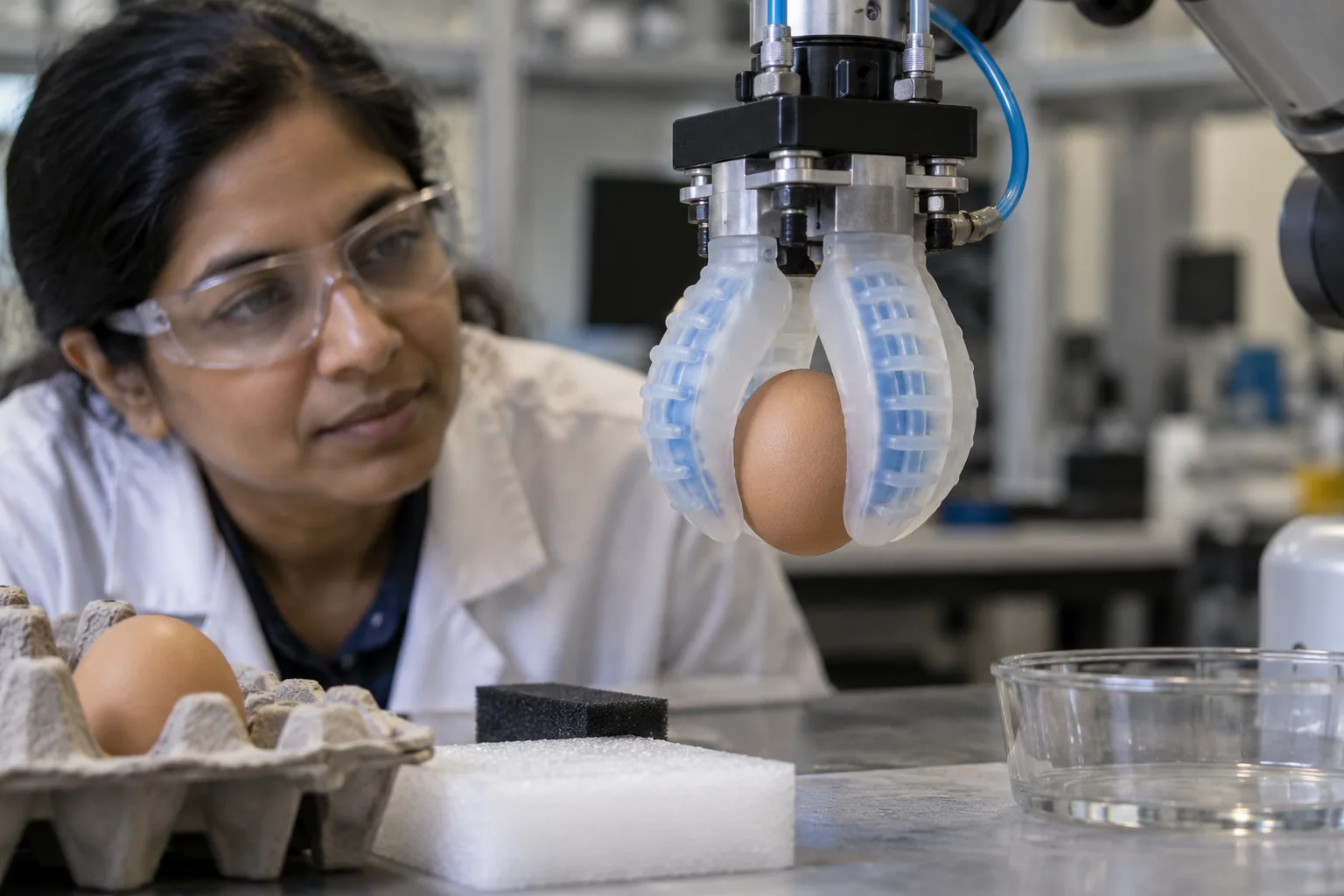
Soft robotic grippers pick things up with flexible, deformable materials instead of rigid metal fingers, so they can handle delicate or oddly shaped objects. The field is active in research and prototypes, but the sources reviewed here do not show wide industrial use.
In plain language
A normal robot gripper is made of hard metal parts and grips by squeezing with strong, precise force. A soft gripper is made of rubber-like or other flexible materials that bend and wrap around an object. Because the fingers conform to the shape of what they hold, the gripper can often pick up fragile items without needing exact positioning.
Most soft grippers are moved by air or fluid pressure, although researchers also use electric, magnetic and heat-driven methods. Some designs use suction instead of fingers. The main trade-off is that soft parts are harder to control precisely and, in some designs, wear out faster.
Technical explanation
Soft grippers are usually classed by how they move and how they grip. A 2018 review in Advanced Materials by Shintake and colleagues grouped soft gripping approaches into three families: actuation, controlled stiffness and controlled adhesion. Actuation covers how the fingers bend or open. Controlled stiffness lets a soft structure become rigid when needed, and controlled adhesion uses surface effects to hold objects.
A common actuator design is the pneumatic network, or pneu-net, in which a soft elastomer contains a set of connected air chambers. Mosadegh and colleagues (2014) reported a pneu-net actuator that bent from a linear to a quasi-circular shape in about 50 milliseconds at 345 kPa and kept working over a million cycles in laboratory tests. That result is for a single actuator, not a complete gripper.
A different route is vacuum gripping. Villegas Diaz and colleagues (2019) presented a vacuum-driven origami gripper that folds around objects and lifts a range of items, including delicate foods and heavy bottles, in tests. The 2025 review by Zhang and colleagues covers fluid pressure, mechanical force, electric, magnetic and thermal actuation, along with hydrogels, shape memory alloys, magnetic materials and liquid metals. The reviewed sources do not give a single agreed measure of grip force or payload across designs, so direct comparisons between published grippers need care.
What the evidence says
Each statement is typed by the strength of its evidence and linked to the source that supports it.
Demonstrated Shown in a published experiment, test or shipping product.
Shintake and colleagues group soft gripping approaches into three families: actuation, controlled stiffness and controlled adhesion.
Sources: [1] · AbstractIn laboratory tests, a pneumatic network actuator bent from a linear to a quasi-circular shape in about 50 milliseconds at 345 kPa and operated for over a million cycles without significant loss of performance.
Sources: [2] · Abstract · medium confidenceA vacuum-driven origami soft gripper lifted a range of objects, including delicate foods and heavy bottles, in tests reported by its authors.
Sources: [3] · Abstract · medium confidenceReported, unverified Stated by a company or team but not independently confirmed.
The authors of a 2025 review describe soft grippers as having high flexibility and environmental adaptability.
Sources: [4] · Abstract · medium confidenceMiniaturisation, robustness, speed, sensor integration and control are listed as open challenges for soft grippers.
Sources: [1] · Abstract · medium confidenceSoft grippers have shown promising applications, according to the authors of a 2025 review.
Sources: [4] · Abstract · medium confidenceLimitations and open problems
- Control precision is listed as an open challenge in the 2018 review (Shintake and colleagues, 2018).
- Miniaturisation, robustness, speed and sensor integration are also listed as open challenges (Shintake and colleagues, 2018).
- The tests reported by Villegas Diaz and colleagues are the authors' own grasping and load tests, so performance in cluttered, real-world settings is not established by the sources reviewed here (Villegas Diaz and colleagues, 2019).
- The pneu-net result is for a single actuator in laboratory tests, not a complete gripper (Mosadegh and colleagues, 2014).
Possible future uses
Ideas, not predictions. None of these has been demonstrated.
- Handling soft produce and food items on packing lines with less bruising than rigid grippers.
- Surgical or medical tools that conform to soft tissue, if sterile and reliable designs can be made.
- Underwater sampling, where soft fingers can grip without damaging fragile organisms.
Product concepts: Dressing and bathing assist robot, Household bin that sorts waste for recycling, Soft fruit picking gripper
Timeline
- Apr 2014Mosadegh and colleagues publish pneu-net soft actuators that bend rapidly and survive over a million lab cycles in Advanced Functional Materials. Sources: [2]
- May 2018Shintake and colleagues publish a review of soft robotic grippers in Advanced Materials, grouping approaches into actuation, controlled stiffness and controlled adhesion. Sources: [1]
- May 2019Villegas Diaz and colleagues present a vacuum-driven origami soft gripper at the IEEE International Conference on Robotics and Automation. Sources: [3]
- 27 Oct 2025Zhang and colleagues publish a review of soft robotic grippers covering actuation methods and materials in Frontiers in Materials. Sources: [4]
Futures this could help bring about

Related breakthroughs
Glossary
- Elastomer
- A rubber-like polymer that can be stretched or bent and then return to its shape.
- Pneu-net
- A soft actuator made of connected air chambers that inflate and bend when pressurised.
- Actuation
- The means by which a device produces movement, such as air pressure, electric fields or magnetism.
- Compliance
- How easily a structure deforms when a force is applied; soft grippers are highly compliant.
Sources
- review article
Soft Robotic Grippers
Jun Shintake, Vito Cacucciolo, Dario Floreano et al.. Advanced Materials, May 2018. DOI: 10.1002/adma.201707035. Accessed 21 Oct 2026. - peer reviewed paper
Pneumatic Networks for Soft Robotics that Actuate Rapidly
Bobak Mosadegh, Panagiotis Polygerinos, Christoph Keplinger et al.. Advanced Functional Materials, Apr 2014. DOI: 10.1002/adfm.201303288. Accessed 21 Oct 2026. - conference paper
A Vacuum-driven Origami Magic-ball Soft Gripper
Evelin Villegas Diaz, Robert J. Wood, John J. Stampfli et al.. IEEE, Proceedings of the 2019 IEEE International Conference on Robotics and Automation, May 2019. Accessed 21 Oct 2026. - review article
Soft robotic grippers: a review
Youyou Zhang, Jianhao Man, Xiaoang Liu et al.. Frontiers in Materials, 27 Oct 2025. DOI: 10.3389/fmats.2025.1692206. Accessed 21 Oct 2026.
Revision history
3 changes since this profile was created.
What it took to get here
The inventions this technology was built on, oldest foundations at the top. Lines show what each one required.
- 2014Soft robotic grippersResearch and prototypesRequires: Robotic fruit and vegetable harvesting. Being researched.