Quantum memories
Also known as Quantum memory, Optical quantum memory, Quantum memories for light
Quantum memories are devices that take a quantum state carried by light, hold it, and release it later. A solid-state memory has reached efficiency of up to 69%, and nuclear spin coherence has been measured for hours, but the best results come from separate experiments, and none of the sources reviewed shows a memory that combines long storage, high efficiency and high fidelity in one device.
In plain language
A quantum memory stores a quantum state, such as the state of a single photon, and releases it later without copying it or disturbing it. Light is useful for carrying quantum information over distances, but light moves on and cannot wait. A memory lets a network hold a photon's state while other parts of the network do their job, for example while a neighbouring link is being prepared.
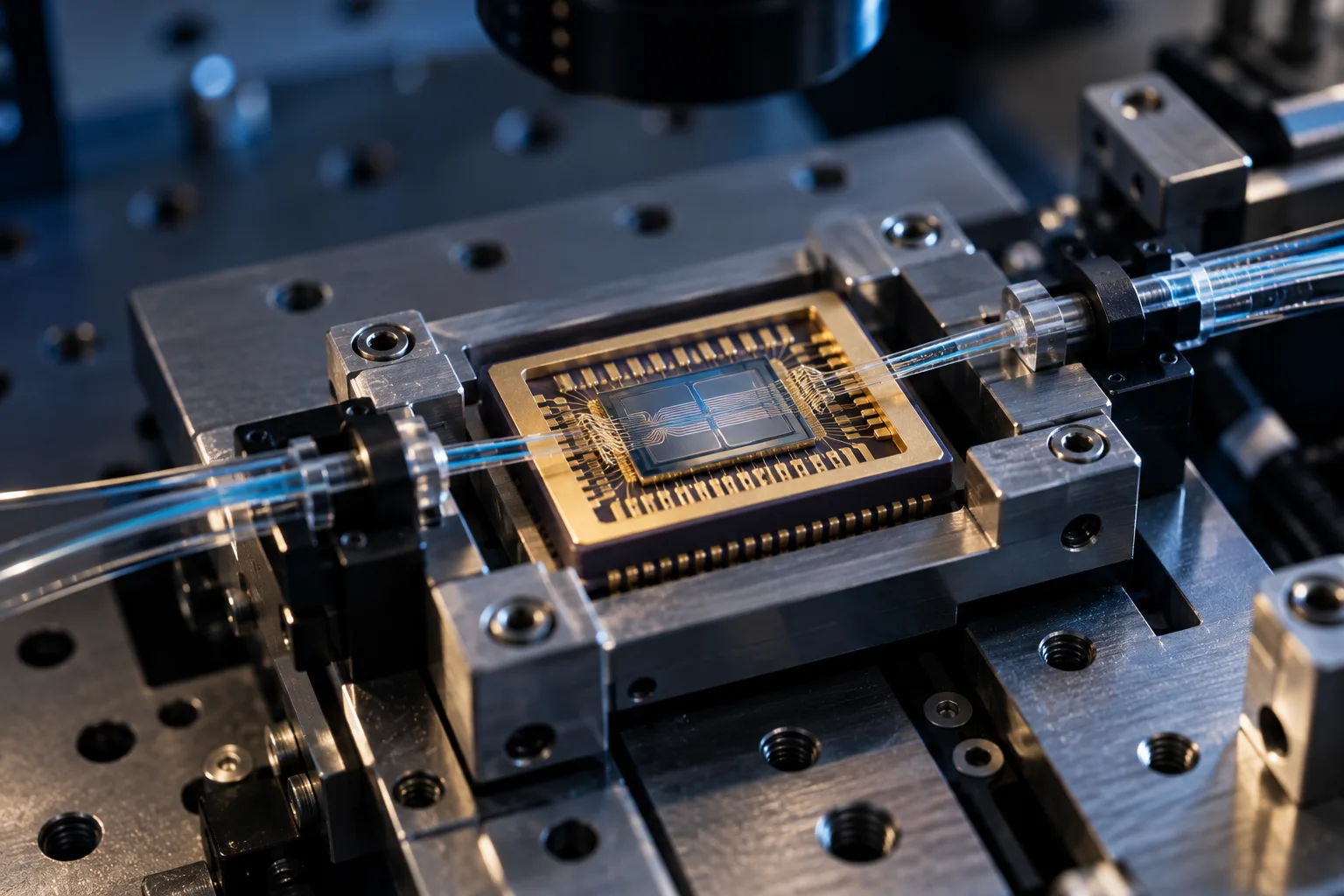
The memories described in the research papers reviewed here use a crystal or a cloud of atoms as the storage medium. Light is absorbed into the material, the quantum state is kept in the atoms or in the spins of the ions, and the light is later released. Two numbers matter most: how long the state survives, and how much of the original light is recovered. Experiments have shown long storage times and high recovery, but usually in different devices, so a single memory that does both well has not yet been shown.
Technical explanation
Optical quantum memories map the state of a light pulse onto a material and later map it back. Common schemes include atomic ensembles and rare-earth-ion crystals with atomic frequency comb or gradient echo protocols. The storage time is limited by how long the stored coherence lasts, and the efficiency is the fraction of input light that is recalled. Heshami and colleagues (2016) describe quantum memories as devices that synchronise probabilistic events, which is why they are seen as a key component of quantum repeaters.
Early theory showed that atomic ensembles could work as the nodes of a long-distance network. Duan, Lukin, Cirac and Zoller (2001) proposed a scheme that uses laser-manipulated atomic ensembles, beam splitters and single-photon detectors, and argued that its communication efficiency scales polynomially rather than exponentially with channel length. In 2010, Hedges and colleagues reported a solid-state memory in praseodymium-doped yttrium orthosilicate that reached efficiencies of up to 69%, above the below-17% efficiencies earlier atomic-vapour memories had shown. The memory handled inputs from single-photon level up to about 500 photons.
For long storage times, the longest-lived result uses spin coherence in a solid. Zhong and colleagues (2015) measured a nuclear-spin coherence time of 370 plus or minus 60 minutes at 2 kelvin in europium-doped yttrium orthosilicate, using dynamical decoupling. This is a measure of the spin, not of an optical pulse held in the crystal. Ma and colleagues (2021) reported coherent optical storage of light in an atomic frequency comb memory for over one hour, using a zero-first-order-Zeeman field and dynamical decoupling. Their abstract does not give a storage efficiency. Bhaskar and colleagues (2020) used a single solid-state spin memory in a nanophotonic diamond resonator to run asynchronous photonic Bell-state measurements, a repeater building block, at megahertz clock speeds.
What the evidence says
Each statement is typed by the strength of its evidence and linked to the source that supports it.
Demonstrated Shown in a published experiment, test or shipping product.
Hedges and colleagues reported a solid-state quantum memory for light in praseodymium-doped yttrium orthosilicate with efficiency of up to 69%, compared with below 17% for earlier atomic-vapour demonstrations.
Sources: [2] · AbstractThe 2010 memory stored and recalled light from weak coherent states at the single-photon level up to bright states of about 500 photons, and for average inputs of 30 photons or fewer its performance exceeded the no-cloning limit.
Sources: [2] · Abstract · medium confidenceZhong and colleagues measured a coherence time of 370 plus or minus 60 minutes at 2 kelvin for the nuclear spin of europium ions in yttrium orthosilicate, using dynamical decoupling. This measures a spin, not light stored in the crystal.
Sources: [3] · AbstractMa and colleagues reported coherent optical storage of light in an atomic frequency comb memory for over one hour, using a zero-first-order-Zeeman field and dynamical decoupling. The authors describe the previous longest storage of optical memories as approximately one minute.
Sources: [5] · AbstractThe Ma and colleagues abstract does not report a storage efficiency for the one-hour memory.
Sources: [5] · AbstractBhaskar and colleagues used a single solid-state spin memory in a nanophotonic diamond resonator to perform asynchronous photonic Bell-state measurements, a key quantum repeater component, at megahertz clock speeds.
Sources: [4] · AbstractThe abstracts reviewed report high storage efficiency (Hedges and colleagues, 2010) and long storage times (Zhong and colleagues, 2015; Ma and colleagues, 2021) in separate experiments, and do not report a single memory with both.
Sources: [2], [3], [5] · Editorial synthesis of the abstracts above · medium confidenceProposed A design or plan that has not yet been built or tested.
Duan and colleagues proposed a scheme for long-distance quantum communication using laser-manipulated atomic ensembles, beam splitters and single-photon detectors, and argued that its communication efficiency scales polynomially with channel length.
Sources: [1] · AbstractHeshami and colleagues state that the ability of quantum memories to synchronise probabilistic events makes them a key component in quantum repeaters.
Sources: [6] · AbstractLimitations and open problems
- The longest storage times come from spin coherence in a solid (Zhong and colleagues, 2015) or from light stored for over an hour (Ma and colleagues, 2021), and neither source shows high recovery efficiency for the same device.
- The highest efficiency reported in the sources reviewed (up to 69%, Hedges and colleagues, 2010) is a maximum under particular conditions, and the abstract gives no matching storage time.
- Some demonstrations reviewed use cryogenic temperatures, for example the spin memory at 2 kelvin (Zhong and colleagues, 2015). This adds cost and complexity to any deployed network.
- The sources reviewed show single-memory or two-node results. Scaling to many memories that work together in a network is not shown.
- Adding a memory to a network adds loss and noise. The sources reviewed do not give a full error budget for a complete memory-based link.
Possible future uses
Ideas, not predictions. None of these has been demonstrated.
- Transportable quantum memories that carry entanglement between cities or between a ground station and a satellite, with storage times long enough to cover travel.
- Multiplexed memory arrays that store many photons at once, so a repeater node can try many links in parallel.
- Memory-based interfaces that connect superconducting or spin-based quantum processors to optical fibre links.
Timeline
- Nov 2001Duan, Lukin, Cirac and Zoller propose long-distance quantum communication using laser-manipulated atomic ensembles, beam splitters and single-photon detectors. Sources: [1]
- Jun 2010Solid-state praseodymium-doped yttrium orthosilicate memory reports efficiencies of up to 69%, above the earlier atomic-vapour results of below 17%. Sources: [2]
- Jan 2015Europium-doped yttrium orthosilicate nuclear spin reports a coherence time of 370 plus or minus 60 minutes at 2 kelvin. Sources: [3]
- Mar 2020Single solid-state spin memory in a nanophotonic diamond resonator performs asynchronous photonic Bell-state measurements, a repeater building block, at megahertz clock speeds. Sources: [4]
- Apr 2021Light is stored coherently in an atomic frequency comb memory for more than one hour. Sources: [5]
Futures this could help bring about
Glossary
- Quantum state
- The full description of a quantum system, such as the polarisation or timing of a single photon.
- Coherence time
- How long a quantum system keeps the phase relationships that carry its quantum information.
- Atomic frequency comb
- A storage protocol that uses a comb of absorption peaks in a crystal to hold light and release it at a set time.
- Dynamical decoupling
- A sequence of pulses that cancels out some noise so that a quantum state lasts longer.
Sources
- peer reviewed paper
Long-distance quantum communication with atomic ensembles and linear optics
L. M. Duan, M. D. Lukin, J. I. Cirac et al.. Nature, Nov 2001. DOI: 10.1038/35106500. Accessed 22 Oct 2026. - peer reviewed paper
Efficient quantum memory for light
Morgan P. Hedges, Jevon J. Longdell, Yongmin Li et al.. Nature, Jun 2010. DOI: 10.1038/nature09081. Accessed 22 Oct 2026. - peer reviewed paper
Optically addressable nuclear spins in a solid with a six-hour coherence time
M. Zhong, M. P. Hedges, R. L. Ahlefeldt et al.. Nature, Jan 2015. DOI: 10.1038/nature14025. Accessed 22 Oct 2026. - peer reviewed paper
Experimental demonstration of memory-enhanced quantum communication
M. K. Bhaskar, R. Riedinger, B. Machielse et al.. Nature, Mar 2020. DOI: 10.1038/s41586-020-2103-5. Accessed 22 Oct 2026. - peer reviewed paper
One-hour coherent optical storage in an atomic frequency comb memory
Yu Ma, You-Zhi Ma, Zong-Quan Zhou et al.. Nature Communications, Apr 2021. DOI: 10.1038/s41467-021-22706-y. Accessed 22 Oct 2026. - review article
Quantum memories: emerging applications and recent advances
Khabat Heshami, Duncan G. England, Peter C. Humphreys et al.. Journal of Modern Optics, 16 Mar 2016. DOI: 10.1080/09500340.2016.1148212. Accessed 22 Oct 2026.
Revision history
3 changes since this profile was created.