Quantum key distribution
Also known as QKD, Quantum cryptography key exchange
Quantum key distribution (QKD) lets two parties agree a shared secret key using quantum states of light, so that interception can be detected. Field experiments have reached over 1,000 km of fibre and a satellite-to-ground link, but the UK National Cyber Security Centre does not endorse QKD for government or military use.
In plain language
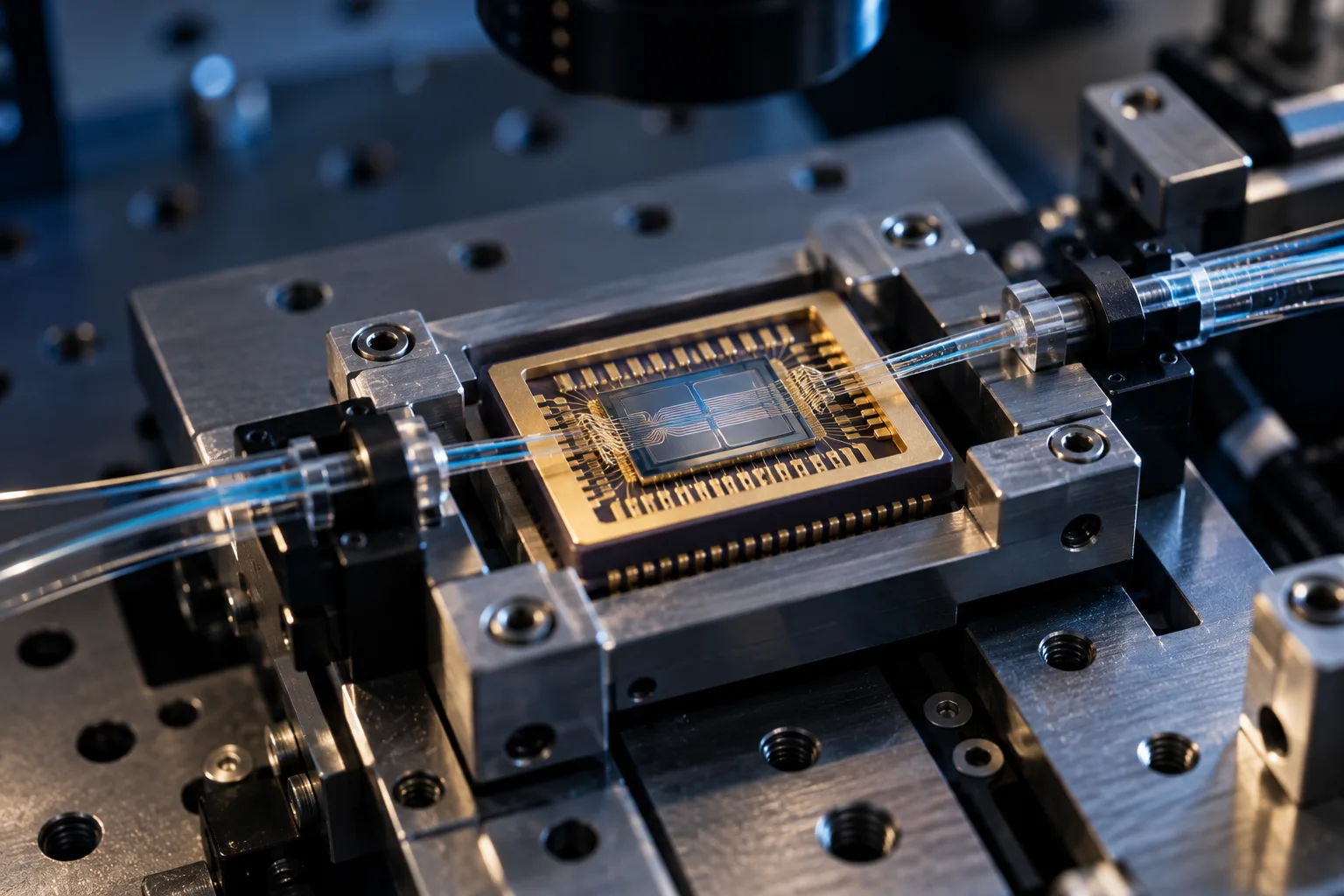
Quantum key distribution, or QKD, is a method for two people to agree a secret key that they can later use to protect messages. The key is carried by light: the sender encodes random bits in very weak pulses, often single photons, and the receiver measures them. The security comes from the rules of quantum physics rather than from how hard a calculation is to run, so an eavesdropper who tries to read the light leaves a disturbance that the two parties can check for.
QKD only creates the key. The messages themselves are still encrypted with ordinary methods that use the key. Experiments have sent keys down long fibre spools and from a satellite to ground stations, but the rates fall quickly with distance and the equipment is specialised. For that reason, the UK's National Cyber Security Centre does not endorse QKD for government or military use, and it advises against relying on QKD alone for business-critical networks.
Technical explanation
QKD protocols encode information in a quantum property of single photons or weak light pulses, such as polarisation or phase. The two parties compare part of their measurements to estimate how much an eavesdropper could have learned, then remove that information from the raw key. The security of practical systems, which differ from idealised models, is analysed in a review by Scarani and colleagues (2009). That review covers discrete-variable, continuous-variable and distributed-phase-reference protocols, and it presents the theory used to assess the security of each.
In 2017, Liao and colleagues reported satellite-to-ground QKD using the decoy-state method, which varies pulse intensities so that certain attacks can be detected. They reported a kilohertz key rate from the satellite to the ground over distances up to 1,200 km. They also state that the satellite link is up to 20 orders of magnitude more efficient at transmitting photons than an optical fibre of the same length, a comparison of photon transmission rather than key rate. In 2023, Liu and colleagues reported twin-field QKD over 1,002 km of fibre, with a secure key rate of 9.53 × 10^-12 per pulse in the asymptotic regime and 8.75 × 10^-12 per pulse at 952 km when finite-size effects are included.
The practical limits are key rate, hardware and authentication. A QKD link still needs an authenticated classical channel, so the two parties must already have a reliable way to confirm each other's identity. The UK NCSC advises that robust quantum-safe authentication mechanisms should be implemented alongside QKD.
What the evidence says
Each statement is typed by the strength of its evidence and linked to the source that supports it.
Demonstrated Shown in a published experiment, test or shipping product.
Quantum key distribution lets two parties establish a secret key over a quantum channel and an authenticated classical channel.
Sources: [1] · AbstractLiao and colleagues report decoy-state QKD from a satellite to the ground with a kilohertz key rate over distances up to 1,200 km.
Sources: [2] · AbstractLiu and colleagues report a secure key rate of 9.53 × 10^-12 per pulse through 1,002 km of fibre in the asymptotic regime, using twin-field QKD.
Sources: [3] · AbstractLiu and colleagues report a secure key rate of 8.75 × 10^-12 per pulse at 952 km when the finite-size effect is included.
Sources: [3] · Abstract · medium confidenceThe UK National Cyber Security Centre does not endorse the use of QKD for any government or military application.
Sources: [4] · Guidance textThe UK National Cyber Security Centre cautions against sole reliance on QKD for business-critical networks and advises that robust quantum-safe authentication be implemented alongside it.
Sources: [4] · Guidance textReported, unverified Stated by a company or team but not independently confirmed.
The 2009 review states that QKD is already fit for commercialisation and analyses the security of practical discrete-variable, continuous-variable and distributed-phase-reference protocols.
Sources: [1] · Abstract · medium confidenceLiao and colleagues state that their satellite link achieves photon transmission efficiency up to 20 orders of magnitude higher than expected for an optical fibre of the same length. This compares photon transmission, not key rate.
Sources: [2] · Abstract · medium confidenceLimitations and open problems
- Secure key rates fall steeply with distance. The twin-field result over 1,002 km gives 9.53 × 10^-12 per pulse in the asymptotic regime (Liu and colleagues, 2023), which is far below what most applications would need from a single link.
- QKD still needs an authenticated classical channel, so it cannot establish identity on its own (NCSC, 2020).
- The UK NCSC does not endorse QKD for government or military applications and cautions against sole reliance on QKD for business-critical networks (NCSC, 2020).
- Security proofs must account for imperfect real hardware, which makes practical QKD harder to certify than the idealised theory (Scarani and colleagues, 2009).
- The sources reviewed here do not give verified cost figures for commercial QKD equipment.
Possible future uses
Ideas, not predictions. None of these has been demonstrated.
- Key distribution between government or industrial sites that are linked by fibre, if key rates and certification improve.
- Satellite-based key distribution to remote or maritime locations where fibre is not practical.
- Hybrid systems that combine QKD with post-quantum cryptography, using QKD for key material and quantum-safe methods for authentication.
Timeline
- 29 Sept 2009Scarani and colleagues publish a review of the security of practical QKD in Reviews of Modern Physics. Sources: [1]
- Sept 2017Liao and colleagues report satellite-to-ground decoy-state QKD with kilohertz key rates over distances up to 1,200 km in Nature. Sources: [2]
- 24 Mar 2020The UK National Cyber Security Centre publishes its QKD guidance, stating that it does not endorse QKD for government or military applications. Sources: [4]
- 2023Liu and colleagues report twin-field QKD over 1,002 km of fibre in Physical Review Letters. Sources: [3]
Futures this could help bring about
Related breakthroughs
Glossary
- Quantum key distribution
- A method for two parties to create a shared secret key using quantum states of light, where interception normally leaves a detectable disturbance.
- Decoy-state method
- A QKD technique in which the sender randomly varies pulse intensities so that certain attacks on multi-photon pulses can be detected.
- Twin-field QKD
- A QKD protocol in which both users send light to a central station that combines it, allowing longer fibre distances than direct exchange.
- Authenticated classical channel
- An ordinary communication link in which each message is checked to come from the claimed sender.
Sources
- peer reviewed paper
The security of practical quantum key distribution
Valerio Scarani, Helle Bechmann-Pasquinucci, Nicolas J. Cerf et al.. Reviews of Modern Physics, 29 Sept 2009. DOI: 10.1103/RevModPhys.81.1301. Accessed 21 Oct 2026. - peer reviewed paper
Satellite-to-ground quantum key distribution
Sheng-Kai Liao, Jian-Wei Pan. Nature, Sept 2017. DOI: 10.1038/nature23655. Accessed 21 Oct 2026. - peer reviewed paper
Experimental Twin-Field Quantum Key Distribution Over 1000 km Fiber Distance
Yang Liu. Physical Review Letters, 25 May 2023. DOI: 10.1103/PhysRevLett.130.210801. Accessed 21 Oct 2026. - government report
Quantum security technologies
UK National Cyber Security Centre, 24 Mar 2020. Accessed 21 Oct 2026.
Revision history
3 changes since this profile was created.